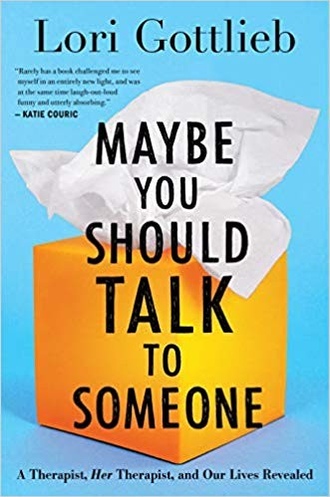
Maybe You Should Talk to Someone is the book that did more than any other in recent memory to demystify what actually happens in therapy. Lori Gottlieb is a therapist in Los Angeles and a former television writer, and in 2019 she published a memoir-slash-group-portrait that follows five people through the therapy room simultaneously - four of her patients, and Gottlieb herself, who turns up in a therapist's office after a relationship ends in ways she cannot process alone. The book sold over a million copies, spent more than a year on the bestseller list, and is being adapted for television. More importantly, a striking number of therapists now give it to first-time patients as a way of explaining what they have actually signed up for.
What the book covers
The book is structured around five people. John is a successful television producer, a self-described arsehole, who comes to Gottlieb because he is stressed and irritable and leaves flaming voicemails when she is a minute late. Julie is a thirty-three-year-old newlywed recently diagnosed with terminal cancer. Rita is a woman in her late sixties who has decided that if her life does not meaningfully improve by her seventieth birthday she will end it. Charlotte is a young woman in her twenties drinking too much and repeating the same self-destructive relationship pattern. And Gottlieb is reeling from a sudden break-up that has knocked her far more sideways than she expected, and ends up, reluctantly, in the office of a senior therapist named Wendell.
What Gottlieb does, chapter by chapter, is move between these five threads, letting them echo and illuminate each other. She writes with unusual honesty about what the work actually looks like from the therapist's chair - the moments of being stuck, the unexpected emotional reactions to a patient, the internal monologue that happens behind the neutral face. And she writes with equal honesty about what it is to be on the patient side, as herself, failing to feel better for weeks on end, testing Wendell's patience, slowly uncovering the grief she has been running from for much longer than the recent break-up. The book lets you watch the same process from both chairs, which is a structural move that almost no one else in this genre has attempted with this much skill.
Along the way, Gottlieb folds in a genuine education in how therapy works - what transference actually is, why insight alone rarely changes behaviour, why the relationship itself is load-bearing, what is happening in the long pauses that look like the therapist is just not saying anything. She does this lightly, never in a textbook register, and by the end of the book a reader who has never set foot in a consulting room understands the project at a level that most books about therapy cannot reach.
Who should read this
This is for the reader considering therapy and unsure what they are signing up for. It is also for the reader already in therapy, especially in the frustrated middle stage, who needs to be reminded that what they are experiencing - the plateau, the transference, the private conviction that their therapist secretly dislikes them - is the work, not a sign the work is failing. It is for the person whose friend or partner is in therapy and who would like to understand what is happening on the other side of the fifty-minute hour. And it is for anyone who has ever been curious about what therapists say to each other when the door closes.
It is not the right book for someone in acute crisis who needs immediate strategy. This is a book about the experience of therapy, not a manual. For strategy, look elsewhere - Russ Harris or David Burns will serve you better on that front. For understanding, for permission, for company, for the quiet relief of being told that what is happening in your own head is not as unique or as shameful as you feared, this book is rare.
Strengths and weaknesses
The strength of the book is the warmth. Gottlieb is funny, generous, and emotionally precise, and she writes about her patients with a specific kind of respectful honesty that is difficult to fake. She is also, in the sections about her own therapy, unusually willing to be unflattering about herself, which makes the book far more credible than the average therapist memoir. The structural choice to tell five stories at once also pays off - the reader learns to recognise the same psychological patterns showing up in wildly different lives, which is the point therapists are always trying to make and almost never manage to dramatise this well.
The weaknesses are modest. The book is long - over four hundred pages - and while the interweaving structure mostly justifies the length, there are stretches, particularly around the middle third, where a tighter edit would have helped. A few of Gottlieb's reflective passages tip slightly into the polished register of a columnist (she writes for The Atlantic), and readers who are more tuned into that register than others will notice. Some reviewers have also argued that Gottlieb's own therapy story is treated more kindly than some of her patients' stories, which is a fair observation without being a fatal one.
A 4.5 is right. The book is doing something rare, is doing it well, and has quietly changed how a lot of readers think about the entire enterprise of therapy.
Why this matters for mental health
One of the larger barriers to getting into therapy is simply not knowing what it is. Popular culture has coded it either as a house-of-mirrors drama or as a punchline, and a lot of people arriving at their first session are expecting either too much or too little. Gottlieb's book meets that gap directly. By showing the messiness, the slowness, the humour, the real emotional weather of the work, she makes it both more plausible and less intimidating. Research on therapy consistently finds that the quality of the relationship between therapist and patient is one of the strongest predictors of outcome, and Gottlieb is effectively writing a book about what that relationship actually feels like to be inside. For the Mind Wobble reader considering therapy, or partway through, this book is one of the most useful things to read alongside the work itself.
Final verdict
Maybe You Should Talk to Someone is the book you give to anyone who is considering therapy and wants to know what they are walking into. It is also the book you read yourself, quietly, when you have been in the work for a while and need to be reminded that what you are feeling is the process, not a failure of it. Warm, funny, occasionally devastating, and quietly one of the best books on therapy ever written for a general reader. Start here.