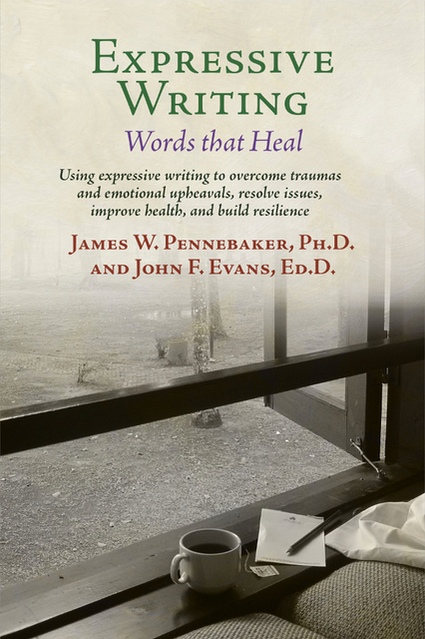
There is a moment, usually around 2 a.m., when the thing you have been not-thinking-about all day finally has the floor. You lie there and it talks. If you have ever had that night, this is a book worth knowing about, because it offers something almost suspiciously simple: pick up a pen, write about the thing for twenty minutes, do it four days running, and you will likely feel measurably better. Not metaphorically better. Better in ways researchers can put a number on.
That claim would be easy to dismiss if it came from anyone else. It comes from James Pennebaker, the University of Texas social psychologist who essentially invented this field of research in the 1980s, paired here with health coach John Evans, who has spent years turning the science into something ordinary people can actually do. The result is less a self-help book than a quiet, well-evidenced instruction manual for one of the most reliable wellness practices we have.
What the book covers
At its heart, the book hands you a protocol and then gets out of the way. The famous one is the four-day program: twenty minutes a day, writing continuously about an emotional upheaval that still has its hooks in you. No editing, no audience, no worrying about grammar. You write for yourself and then, if you want, you can throw the pages away. The writing itself is the medicine.
From there, Pennebaker and Evans widen the lens. There is a six-week program that rotates through a different technique each week, so the practice does not go stale, plus a set of more inventive approaches for people who want to keep going. They also teach you something genuinely useful: how to read your own writing back, watching for the shift from raw feeling toward understanding, which is where the real benefit seems to live. Threaded through all of this are the research findings, delivered in plain language rather than dumped on you as a wall of statistics. You learn why writing often works better than talking, why building a coherent narrative matters more than simply venting, and why a few sessions can ripple outward into sleep, immune function, and mood. The famous instruction sits at the center of it all: write about what keeps you awake at night.
Who should read this
This is a book for the person who knows, somewhere, that they are carrying something they have never properly put into words. A loss they moved past too quickly. A relationship that ended in confusion. A childhood thread that keeps tugging. If you have tried conventional journaling and found it pleasant but somehow inert, this offers structure and purpose where free-form writing can drift.
It is also a quietly excellent companion for people who feel wary of therapy, or who cannot access it easily, and want something they can do privately, tonight, for free. That said, this is not a replacement for professional help with severe trauma. The authors are honest about the practice stirring up difficult material, and anyone dealing with acute crisis should treat writing as a companion to support, not a substitute for it. Read with that boundary in mind, it is one of the most accessible mental-health tools you can put in your own hands.
Strengths and weaknesses
The book's great strength is credibility wedded to simplicity. Plenty of wellness writing asks you to take its promises on faith. This one is standing on three decades of replicated studies, and it still manages to explain itself without ever sounding like a lecture. You finish a chapter knowing both that the method works and why, which is rare and reassuring. The practicality is the other gift: there is no fluff between you and the actual doing of it. You could read the core instructions in twenty minutes and start that same evening.
The weaknesses are mostly the flip side of those virtues. It is slim, and in places it reads a little dry, more clinical handbook than warm bedside companion. Readers who come to books like this for story and voice may find Pennebaker's restraint a touch cool. And while the authors are careful about trauma, the book is necessarily light on what to do when writing surfaces something too big to hold alone. Reader reception reflects this gentle split: most people find it genuinely helpful and a few wish it went deeper or warmer. Weighing the unusually strong evidence base and the real-world usefulness against its slightness and occasional dryness, this lands at a confident four out of five. It does exactly what it promises, and what it promises is worth a great deal.
Why this matters for mental health
Most of us carry emotional weight we never name, and unnamed things have a way of leaking out sideways into our sleep, our health, our relationships. What Pennebaker's research keeps showing is that the simple act of translating a private upheaval into language changes our relationship to it. We stop being trapped inside the experience and start being its narrator. That small shift, from feeling to telling, appears to be where the body and mind begin to let go. For a wellness practice, it is almost unreasonably cheap, fast, and effective.
Final verdict
If you only ever try one evidence-based self-help technique, make it this one, because the cost is a pen, the time is twenty minutes, and the payoff is your own quieter mind. Buy it, read the first few chapters tonight, and write about the thing you have been avoiding. Your future self, the one finally sleeping through the night, will thank you.