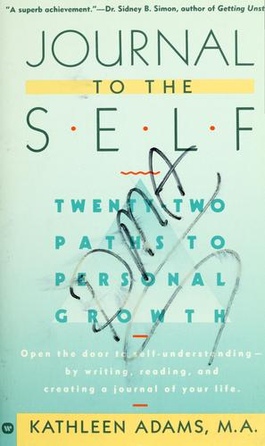
Some journaling books hand you inspiration and leave you staring at a blank page wondering what to actually do with it. Kathleen Adams wrote the opposite kind of book. Journal to the Self, first published in 1990 and still in print more than three decades later, is essentially a toolbox - twenty-two distinct writing techniques you can pick up and use the moment your motivation outpaces your know-how. It became a New York Times bestseller, helped define the field now called journal therapy, and earned Adams a place alongside Anais Nin and Anne Frank in one widely cited poll of the most significant influences on modern journal keeping. With a steady 3.99 average across more than 1,100 reader ratings, it has the quiet durability of a book people keep on the shelf and return to.
That credibility is not incidental. Adams is a licensed professional counsellor and a registered psychotherapist who has pioneered journal therapy since 1985, and she founded the Center for Journal Therapy to train others in it. When she tells you that writing an unsent letter or holding a dialogue with a part of yourself can shift something stuck, she is speaking from clinical practice, not just a hunch about what feels nice. That grounding is what separates this from the wave of prettier, vaguer journals that followed it.
What the book covers
The heart of the book is its catalogue of techniques, each one a different way in. There is the Sentence Stem, a half-finished prompt you complete on instinct. There is the List of 100, where you write a hundred items on a single theme and watch your real preoccupations surface somewhere around number sixty. There is Clustering, a loose web of associations spun out from a central word; the Character Sketch, in which you describe a person - or a feeling - as though introducing them to a reader; and the Captured Moment, a vivid freeze-frame of a single experience. The Dialogue lets you hold a written conversation with anyone or anything: a person, your body, your fear, a decision you cannot make. The Unsent Letter lets you say everything you would never send. Around these sit Springboards, Steppingstones, Time Capsules, Topics du Jour, Perspectives, and work with dreams and imagery.
Two practical devices hold it all together. The five-minute sprint gives reluctant writers permission to start small, and the timed, dated entry keeps the practice contained so it sharpens your life rather than consuming it. Adams also offers a sensible structure for choosing which technique to reach for, so the abundance never tips into paralysis. You finish the book not with a vague urge to write more, but with a genuine sense of what to try tomorrow morning.
Who should read this
This is a book for doers. If you have tried to journal and stalled because freewriting felt formless, the structure here will be a relief - you always have somewhere specific to begin. If you have journaled for years and feel your entries have flattened into a log of events, the techniques will crack the practice back open and take you somewhere deeper than "today I." It works beautifully as a self-guided course, and it has also long been used by therapists, counsellors, and writing facilitators who want concrete tools to offer clients and groups.
It is less suited to readers who want a daily fill-in-the-blank journal with the work done for them, or who are looking for memoir-style reflection to read rather than methods to apply. This is a manual, and it rewards people who are willing to pick up a pen and actually try the exercises. Read passively, it can feel like a list; worked actively, it becomes a practice.
Strengths and weaknesses
The great strength is range and usability. Because there are twenty-two doors rather than one, there is almost always a technique that fits your mood, your problem, or the ten minutes you happen to have. Several of them - the Unsent Letter and the Dialogue in particular - are genuinely powerful for emotional processing, the kind of tool you reach for in a hard week and feel lighter for having used. The organisation is clear, the instructions are concrete, and the whole thing is short enough to read in an afternoon and useful enough to keep for a decade. That combination is rare.
Honesty requires naming the weaknesses, and there are two worth flagging. The first is tone. To illustrate her techniques, Adams draws heavily on examples involving alcoholism, abuse, bereavement, divorce, and crisis. It makes sense - this is therapeutic writing, and pain is what people most need help processing - but read end to end, the cumulative heaviness can feel relentless, and more than one reader has wished for lighter, everyday illustrations alongside the difficult ones. The second is age. Published in 1990, the book occasionally shows it, in a reference here or a framing there, and it predates the explosion of research on expressive writing that a newer reader might expect to see cited. Neither flaw undermines the techniques themselves, which is why this lands at a confident 4.0 rather than a flawless five - a genuinely valuable, well-built toolbox carrying a slightly dated, somewhat sombre frame.
Why this matters for mental health
Journaling is one of the most accessible forms of self-care we have, and Journal to the Self is, in effect, an early and practical manual of journal therapy. The techniques map cleanly onto the things that help us emotionally: the Unsent Letter gives shape to anger and grief you have nowhere else to put; the Dialogue lets you approach a fear or a loss obliquely, in conversation, when facing it head on feels impossible; the Captured Moment helps you slow down and actually feel an experience rather than rushing past it. Working privately, on your own schedule and at your own pace, you can use these tools to process difficult feelings, clarify decisions, and gently observe the patterns running through your life. That Adams built them from real clinical work is exactly why they hold up.
Final verdict
Journal to the Self has outlasted most of the journaling trends that came after it because it offers something an inspirational notebook never can: a reliable set of methods you can use for the rest of your life. Yes, the examples skew heavy and the edges show their 1990 vintage. But if you have ever wanted to journal and not known how, or wanted to journal deeper and not known where to dig, this is the book that puts a full set of tools in your hands. Pick up a copy, keep it next to a fresh notebook, and start with whichever of the twenty-two paths calls to you - then watch where your pen goes.