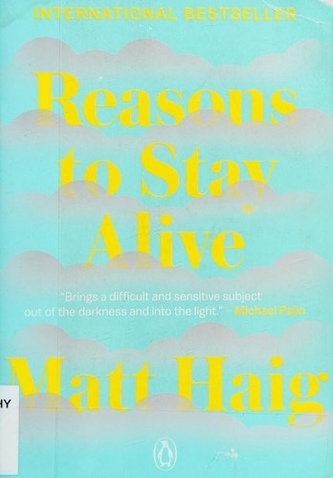
Reasons to Stay Alive is a small book that carries unusual weight. Matt Haig, a British novelist who would later write The Midnight Library and The Comfort Book, spent his mid-twenties inside a severe depressive and anxiety episode that very nearly killed him. In 2015, twelve years after he first considered stepping off a cliff in Ibiza, he wrote the memoir he had needed to read at twenty-four. It became one of the most-read mental health books in the UK, a fixture on therapist reading lists, and - in a way that is difficult to overstate - the book that a lot of readers credit with changing the course of their own worst months.
What the book covers
The book is structured as a series of short fragments - some a single sentence, some a few pages - that together form an account of depression and recovery from the inside. Haig opens on the cliff edge and works backwards through the weeks that led there, forwards through the years that followed, and sideways into reflections on what depression is, what it does, and what helped him eventually live with it. The fragmentary structure is not stylistic flourish. Depression, as Haig writes, is not a condition that organises itself into a narrative, and the broken-up form of the book is closer to the shape of the experience than a more conventional memoir would be.
Within that structure, Haig moves through the major territory anyone who has been depressed will recognise. The terror of the first panic attacks. The loss of the ability to read, watch television, eat, sleep, or feel anything approaching joy. The way the world physically looks different - drained of colour, oddly distant, as if observed through glass. The specific cruelty of anxiety compounding depression, so that even the exhausted parts of the mind cannot rest. The particular agony of loving someone through it - Haig writes beautifully and often about his partner Andrea, who kept him alive through the worst months and is in many ways the quiet hero of the book. He also writes about what eventually began to help, though he is careful not to generalise. Books, walks, very slow exposure to ordinary life, the slow rebuilding of routine, and the eventual emergence of a self that had, against all its own predictions, survived.
The book is not structured as advice. There is a short section near the end called How to Live (forty small suggestions) and another called Things I Have Enjoyed Since I Considered Jumping Off a Cliff, which lands harder than any list has a right to. But the main work of the book is testimony. Haig is telling you, specifically, that he was where you may be now, that the voice telling you it will not end is lying, and that he is on the other side and has remained there.
Who should read this
This is for the reader currently inside an episode. For the person who has been told by their depression that it will never pass and who has started to half-believe it. For the friend or partner of someone depressed who cannot understand what they are going through. For the teenager who has never read an account of mental illness that did not feel sanitised or dramatised. And for the clinician who wants a short, sharp, truthful book to give their patients between sessions.
It is less useful as a first clinical reference. Haig does not pretend to offer a treatment framework, and readers looking for evidence-based strategy should pair this with something like Russ Harris on ACT or David Burns on CBT. What this book does, uniquely well, is company. It sits with you, and the sitting matters more than most people realise until they have needed it themselves.
Strengths and weaknesses
The strength of the book is the honesty. Haig does not prettify depression, does not perform recovery, and does not offer easy framings. His prose is plain, precise, and occasionally luminous, and the fragmentary structure allows him to move between despair and quiet hope without the transitions feeling forced. He is also extremely careful about not being prescriptive. He says, repeatedly, that what helped him might not help you, that recovery is specific and individual, and that the only universal he will offer is the claim that depression lies about its own permanence. For a genre full of overconfident authors, this restraint is a real gift.
The weaknesses are mostly structural. The fragmentary form that makes the book powerful also means some readers feel it never quite commits to being a single thing - not fully a memoir, not fully an essay, not fully a self-help book. Readers looking for narrative arc or therapeutic structure can find it frustrating. The middle section, where Haig's thoughts on depression as a cultural phenomenon sit alongside the autobiography, can occasionally feel looser than the personal passages. These are minor observations. The book is, in the end, doing something rare and doing it with uncommon skill.
A 4.5 is right. The book is short, specific, and for its intended reader, close to essential.
Why this matters for mental health
Testimony is its own form of treatment. A meaningful part of depression is the conviction that you are alone in how you feel, that no one else has been quite this far inside the dark, and that recovery is something that happens to other people. Books like this are one of the better correctives to that conviction. Haig does not replace professional treatment - he is explicit about this - but for a reader waiting to start therapy, or partway through it, or just beginning to understand what has been happening to them, his book is often the one that finally lets them name what they are living through. That naming is itself part of getting better.
Final verdict
Reasons to Stay Alive is a book to keep on the shelf and hand to the right person at the right moment. It is short enough to read in a single sitting on a bad day and true enough to return to years later. Matt Haig has written more commercially successful books since, but this is the one that will keep being pressed into the hands of people who need it. Few books earn that kind of life. This one does.