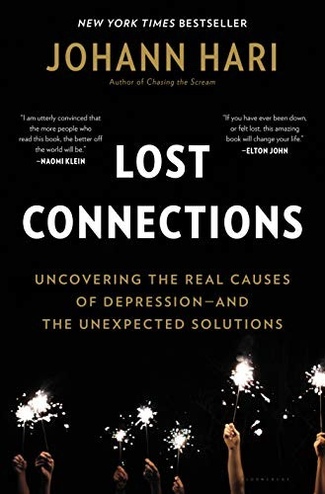
Lost Connections arrived in 2018 into an argument that has been quietly brewing in psychiatry for two decades. Johann Hari, a British journalist, had taken antidepressants for years and had grown up believing, as many of us have, that depression was essentially a chemical imbalance in the brain - a problem of serotonin, solvable with medication. The book is what happened when he started asking whether that story was actually true. It is one of the most read popular mental health books of the last decade, it has been both praised and criticised with unusual intensity, and it rewards a reader who will engage with it critically rather than take it as gospel.
What the book covers
Hari structures the book around what he calls the nine causes of depression and anxiety - seven environmental and social, two biological. The social ones are the heart of the book. Disconnection from meaningful work. Disconnection from other people. Disconnection from meaningful values, in favour of materialistic ones. Disconnection from childhood trauma that has never been named. Disconnection from status and respect. Disconnection from the natural world. Disconnection from a hopeful or secure future. Each chapter works the same way - Hari reports a story, interviews researchers, and argues that the accumulating weight of these disconnections does more to explain the modern depression epidemic than the chemical story alone.
The research he draws on is not fringe. Johns Cacioppo on loneliness, Michael Marmot on status and the social gradient in health, Bruce Alexander on the Rat Park addiction experiments, Tim Kasser on materialistic values - these are serious researchers whose work is well-regarded even by people who dislike the book. Hari is doing synthesis more than original reporting, and the synthesis is genuinely useful. If you have only ever been told that depression is a problem of neurotransmitters, the book will substantially widen the frame.
The last third of the book turns to what Hari calls reconnection - individual and collective practices that might address the disconnections he has named. Some are familiar (exercise, meaningful work, community). Some are more political (universal basic income, cooperative workplaces, environmental reform). The political turn is where the book splits its readers. Some find it the logical conclusion of the argument; others find it a journalist overreaching beyond his evidence. Both readings have merit.
Who should read this
This is for the reader who has asked, quietly or out loud, whether the chemical-imbalance story is the whole story. For the person whose depression has not responded to medication and who has started to wonder whether something about the shape of their life is part of the problem. For the clinician who works with patients whose distress clearly has environmental roots and who is tired of framing every conversation in pharmacological terms. And for the curious reader who wants a well-written tour of the social determinants of mental health.
It is not the right first book for someone in acute crisis, or for a reader who needs a tightly evidence-based clinical guide. Hari's style is journalistic, his claims are at times stronger than the evidence, and his treatment of antidepressants in particular is more polemical than a balanced account would be. Read it in conversation with something more clinically rigorous if this is more than intellectual curiosity for you.
Strengths and weaknesses
The strength of the book is the widening of the frame. The social and environmental research Hari compiles is real, and the case that depression has more upstream causes than neurochemistry is scientifically defensible. The book is genuinely well-written - Hari is a strong storyteller, and the chapters move - and for many readers it is the first time they have encountered the idea that the shape of modern life might be quietly making people unwell. That is a useful idea, and Hari deserves credit for putting it into the mainstream.
The weaknesses are specific and worth naming. The critique of antidepressants in the early chapters is more confident than the evidence warrants; psychiatrists including Peter Kramer and Dean Burnett have argued publicly that Hari underweights the trials that show genuine benefit, particularly for moderate-to-severe depression. A careful reader should hold Hari's antidepressant chapter in tension with a more balanced source. There is also the question of Hari himself. In 2011 he was found to have plagiarised and altered Wikipedia entries about critics, and he stepped back from journalism for several years before returning. He has written about the episode, and much of the research in Lost Connections is real and checkable, but some readers reasonably factor the history into how they read the book. None of this makes the book not worth reading. It does mean it should be read with more scepticism than most.
A 3.5 is right. The reframe is valuable, the research is real, and the overstatement is also real. Useful, important, imperfect.
Why this matters for mental health
The social and environmental determinants of mental health are increasingly mainstream in public health research, and for good reason. Loneliness, meaningless work, poverty, chronic stress, and social disconnection are all well-established risk factors for depression and anxiety. Any reader building a mental health practice for themselves will benefit from thinking about their life in these terms and not just in therapeutic or pharmacological ones. Hari's book is a useful entry point to that broader conversation - with the caveat that it is one voice in a contested field, and the best way to engage with it is to keep reading afterwards.
Final verdict
Lost Connections is a book to read critically and not take entirely at its word. The reframe is valuable, the reporting is lively, and the questions it raises about how we think about depression deserve to be asked. Pair it with a more balanced clinical source, take the antidepressant chapter with a pinch of salt, and use the book for what it is best at - widening your sense of what depression is and what might help. For many readers, that wider frame is itself a form of relief.