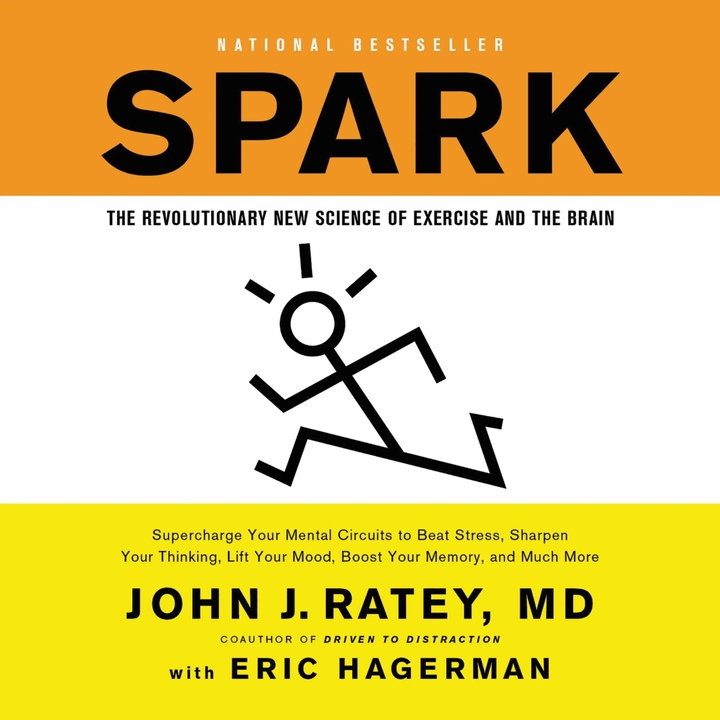
There is a particular kind of book that arrives in your life at exactly the moment you need it, and for a lot of readers, Spark is that book. John Ratey - a Harvard Medical School psychiatrist who has spent his career sitting across from anxious, depressed, and distractible patients - wrote it because he kept noticing the same pattern. The patients who moved their bodies got better faster, stayed better longer, and often needed less medication than the ones who did not. Spark is his attempt to explain why, and to make the case that we have been catastrophically underprescribing the most accessible mental health intervention on the planet.
What the book covers
Ratey opens not in a clinic but in a high school. Naperville Central, just outside Chicago, ran a PE programme that swapped traditional gym class for an early-morning cardio session designed to put students in a learning-ready state before first period. The results, depending on which metric you take, range from impressive to staggering - and Ratey uses the story to set up the central argument of the book: aerobic exercise is not just good for your heart, it is structurally good for your brain.
From there he walks through the neuroscience in chapter-length deep dives on stress, anxiety, depression, ADHD, addiction, hormonal change, and ageing. The throughline is BDNF - brain-derived neurotrophic factor - the protein Ratey famously dubs Miracle-Gro for the brain. Exercise floods the brain with it. BDNF helps neurons survive, grow new branches, and form the connections that underpin learning and emotional regulation. Ratey doesn't just tell you this is true; he walks you through the mechanism so completely that by chapter four you find yourself genuinely irritated that no one mentioned this in school.
The book also pulls in human stories - the woman who walked her way out of a panic disorder, the executive who treated his ADHD with a rowing machine, the older adults whose decline slowed dramatically once they started lifting weights. The science serves the story, and the story makes the science stick.
Who should read this
This book is for the person who knows, intellectually, that they should exercise but cannot get themselves to do it. It is also for the person who is on antidepressants and wondering what else might help, the parent watching a teenager struggle with focus and mood, the runner who wants to understand why their long Sunday loop feels like therapy, and anyone in their forties or fifties starting to think seriously about cognitive longevity. It is not for readers looking for a workout plan - Ratey gives broad guidance, not programming. Pair it with something practical if that is what you need.
If you have ever rolled your eyes at a doctor telling you to exercise more, this book reframes the advice from nag to neuroscience. That reframe matters. A lot of people start moving after reading Spark not because they have new willpower but because they finally have a reason that lands.
Strengths and weaknesses
The strength of Spark is its clarity. Ratey is a clinician first and a writer second, and you can feel both - the prose is plain and the metaphors do real work. He never lets the science get away from him into jargon. When he describes what a stressed amygdala is doing, you actually picture it. When he explains how exercise mimics the action of an SSRI on serotonin pathways, you understand why people often describe a long run as feeling like a chemical reset. This is rare in popular neuroscience writing, and it is the main reason the book has stayed in print and on recommended-reading lists for over fifteen years.
The weakness is the same weakness that haunts a lot of popular science books: the confidence sometimes runs ahead of the evidence. Several of the studies Ratey cites are small, animal-based, or correlational, and his enthusiastic tone occasionally papers over how preliminary the findings really are. Reviewers in the academic press - Greater Good's Leif Hass among them - have flagged this politely but firmly. None of it invalidates the core argument, which is well supported by the broader literature, but it does mean you should treat some of the more dramatic specifics as directional rather than gospel. The book also repeats itself. By the time you reach the chapter on ageing, you have heard the BDNF explanation enough times to recite it, and a tighter edit would have served the material well.
A 4.0 feels right. The central thesis is correct, important, and changes how readers behave - which is the highest bar a book of this kind can clear. The slight overconfidence and the padding are real, but they do not undo what Ratey has built.
Why this matters for mental health
If Mind Wobble has a single recurring message, it is that proactive wellness is not a luxury - it is the cheapest, most evidence-based mental health intervention most of us have access to. Spark is the book that makes the strongest possible case for the exercise pillar of that argument. Ratey is not selling supplements or a six-week programme. He is making a structural claim: that the human brain evolved in a body that moved, and that when we stop moving, the brain does not just lose fitness, it loses function. For anyone managing low mood, anxiety, ADHD, or just the diffuse cognitive fog of a sedentary life, that reframe is genuinely useful.
Final verdict
Spark is the book to give the friend who keeps saying they will start exercising next week. It is the book to read on the morning you cannot face going outside. It is, fifteen years after publication, still the most persuasive single-volume case for treating movement as medicine, and the small caveats about overstated claims do not change that. Read it once for the science, then keep it on the shelf and re-read the depression chapter the next time you are sliding. Few books earn that kind of return visit. This one does.