What the Book Covers
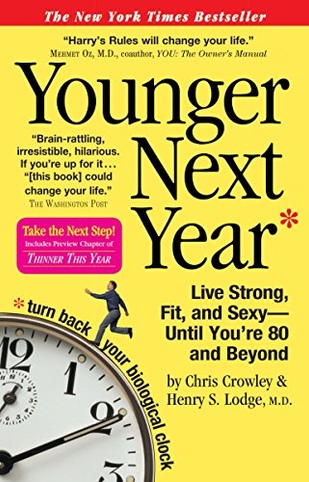
"Younger Next Year" is a straightforward, jargon-free blueprint for staying young at heart and body. Written by Dr. Henry S. Lodge and his 73-year-old patient Chris Crowley, the book combines cutting-edge aging science with real-world testimony. The authors present "Harry's Rules" (exercise six days a week, eat well, and stay socially connected) as the foundation for reversing the normal decline associated with aging.
The book divides into two halves: Lodge provides the science (why our bodies age, how exercise fights decline), while Crowley offers the practical, motivational voice of someone who's actually doing this at an advanced age. Together, they argue that you can prevent or reverse up to 70% of the physical problems normally associated with aging: weakness, bad joints, poor balance, and eliminate 50% of serious disease and injury.
The program emphasizes aerobic exercise and strength training, with specific guidance on frequency, intensity, and type of movement. It tackles nutrition in straightforward terms and stresses the surprising importance of staying connected to others: relationships, community, and purpose are treated as vital as any workout.
Who Should Read This
This book is essential reading for anyone over 50 who wants to stop accepting age as an excuse for decline. If you're noticing your body slowing down, your strength fading, or your energy dropping, this book speaks directly to you. It's also genuinely useful for people in their 60s, 70s, and beyond who've already noticed they don't have to age the way their parents did.
You'll get the most from this book if you're ready to commit to regular exercise, not a casual gym visit once a month, but a real commitment to moving your body most days. The authors aren't offering shortcuts or miracle supplements; they're asking for consistency and effort. If that resonates with you, this book will feel like permission and a roadmap all at once.
It's less suited for people with serious mobility limitations or chronic pain conditions that make vigorous exercise unsafe (though many of those readers will still find valuable adaptation tips). It also assumes you have reasonable access to exercise facilities, though the principles apply to walking, bodyweight exercises, and low-tech movement.
Strengths and Weaknesses
What works beautifully: The science is solid without being intimidating. Lodge explains how muscles atrophy, how bones weaken, and how inactivity accelerates aging: all in language that makes you want to get up and move. The real-world proof from Crowley (a man who skis better in his 70s than in his 40s) makes the science feel possible, not theoretical.
The book's biggest strength is its optimism grounded in reality. You're not trying to look like you're 25; you're trying to function like a healthy 50-year-old well into your 80s. That's achievable, and the authors prove it works across hundreds of success stories. The emphasis on social connection and purpose alongside fitness is also refreshing: many exercise books forget that your mind matters as much as your muscles.
The weaknesses are real: The prose can feel repetitive. Both authors circle back to the same points chapter after chapter, and some readers report getting frustrated waiting for the book to end. The two different voices, while initially refreshing, sometimes create a jarring tone shift that breaks the flow.
There's also an implicit assumption that readers have gym access, some baseline fitness, and the ability to exercise intensely. Real limitations (arthritis, joint replacement recovery, severe deconditioning) deserve more targeted guidance than the book provides. And while the nutrition section is practical, it's somewhat brief; readers hoping for detailed meal plans or recipes will be disappointed.
Exercise, Aging, and Mental Health
Here's what the book doesn't emphasize enough: physical fitness is one of the most powerful levers for mental health in aging. The science is unambiguous. Regular aerobic exercise reduces depression and anxiety risk in older adults by roughly 30%, and strength training adds another layer of psychological benefit: the simple fact of feeling stronger, more capable, and more in control of your body ripples into your emotional life. Exercise also builds the cognitive reserve that protects against cognitive decline and Alzheimer's risk.
And then there's the social element. Group fitness (a class, a walking group, a gym buddy) keeps you connected to others. Loneliness is a significant risk factor for depression, cognitive decline, and early mortality in older adults. The authors' insistence that exercise happens in community, not isolation, is actually profound mental health advice dressed up as fitness guidance. You're not just building muscle; you're building resilience, connection, and a sense of agency over your own aging.
Final Verdict
This is a book that delivers exactly what it promises. If you follow even 80% of what Crowley and Lodge recommend, you will almost certainly feel and function better. The science holds up, the examples are inspiring without being unrealistic, and the program is actually doable for most readers.
The main question isn't whether the advice works: it does. The question is whether you're ready to do it. This book won't motivate everyone; some readers will feel discouraged by the commitment it requires. But if you're already thinking about getting stronger and want permission plus a roadmap, "Younger Next Year" is genuinely valuable. It's a book that could genuinely change your life, and millions of readers have proven it.
Recommended for anyone who suspects they're capable of more than they're currently doing, and brave enough to find out.