What the book covers
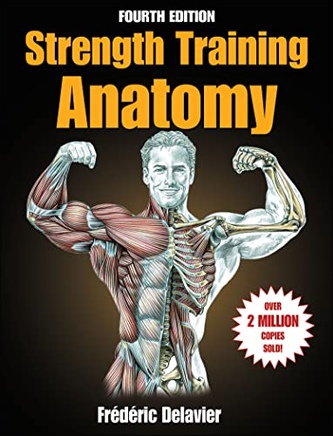
Strength Training Anatomy is exactly what its title promises: a comprehensive visual and practical guide to 231 strength exercises, organized by muscle group and illustrated in exquisite anatomical detail. Each exercise entry shows the primary muscles worked alongside the full cast of supporting structures (bones, ligaments, tendons, connective tissue) in both surface and deep layers. You get the anatomically complete picture: superficial muscles, deep layers, and how everything connects.
The book is organized into seven sections: Arms, Shoulders, Chest, Back, Legs, Buttocks and Abdomen. For each exercise, Delavier provides clear instructions, cues on setup and execution, warnings about common mistakes, and guidance on how different body morphologies may shift the emphasis of the movement. The fourth edition (2022) refreshed the illustrations with 90 new drawings and added new exercises and stretches, keeping the resource current and comprehensive.
What makes this book different from generic fitness guides is the marriage of art and science. The illustrations aren't stylized or simplified: they're anatomically precise renderings that show actual muscle fiber direction, origin and insertion points, and how joints articulate during movement. This matters because it lets you understand not just what works, but why it works.
Author Frederic Delavier brings serious credentials to the work. He studied morphology and anatomy for five years at the École des Beaux-Arts in Paris and dissection for three years at the Paris Faculté de Médecine. He's also a former French powerlifting champion, former editor of the French strength sports publication PowerMag, and contributor to Men's Health Germany. The book reflects both his artistic mastery and deep knowledge of human movement. This isn't someone guessing; it's someone who understands human anatomy at a surgical level and has spent decades in iron.
Who should read this
This is a must-have for personal trainers, strength coaches, and anyone serious about understanding the mechanics behind their training. If you're curious about which muscles really work during an exercise, or if you're trying to optimize an exercise to target a specific area, this book is invaluable.
Gym enthusiasts and intermediate-to-advanced lifters will find it endlessly useful as a reference, not necessarily a read-straight-through book, but one you'll flip through regularly during program design or when troubleshooting form. If you're visual learner, the illustrations alone are worth the price.
Beginners might find it slightly overwhelming at first, but it's still accessible and will serve you for years as you progress. However, if you're looking for a complete periodized training program, this isn't it; it's a reference library, not a workout manual.
Strengths and weaknesses
The obvious strength is Delavier's artwork. These aren't generic anatomical diagrams: they're rendered with surgical precision and artistic beauty. You can genuinely see how the muscle fibers align, where the origins and insertions are, and how the body aligns during each movement. That clarity transforms a dry reference into something you'll actually want to study. Once you've seen how the shoulder girdle works in a lateral raise versus an incline press, you never forget it. The visual knowledge sticks.
The practical details are equally strong. Delavier doesn't just show you the exercise; he tells you what to watch for, which variations work better for different body types, and how to avoid injury. You'll find real-world tips like how to prevent hamstring tears through intelligent post-injury rehabilitation, or why training arms before back can compromise your pull development. That's hard-won knowledge from years in the iron game, and it shows on every page.
The organization is logical and user-friendly. Want to know how to train your lats? Flip to the back section, find the lat exercises, and you're done. No unnecessary fluff, no marketing noise, just dense, useful information organized for quick reference during workout design or troubleshooting.
But there are limits. The book leans heavily toward isolation exercises and bodybuilding-style training splits. If you're a powerlifter focused on the squat, bench, and deadlift, you'll find detailed breakdowns of dozens of accessory movements, but the foundational lifts themselves get less attention. This isn't a weakness for bodybuilders or physique athletes, but it's worth noting if you're following a pure strength-focused program.
It also doesn't teach you how to program. You won't find chapters on periodization, progression schemes, deload strategies, or how to build a complete training week. It's a reference for what to do, not a guide on when or how often to do it. For that, you'll need other resources: this is the execution manual, not the strategy guide.
Finally, while most illustrations are crystal clear, a few complex multi-joint movements are a bit dense on the page: it's hard sometimes to distinguish between overlapping structures. It's a minor complaint, but it happens occasionally with the more intricate regional anatomy.
The mental health connection
It's easy to think of strength training as purely physical, but the mental health benefits are profound and well-established. Regular resistance training has been shown in multiple studies to reduce anxiety and depression on par with pharmaceutical intervention. Beyond the neurochemistry, there's something deeper: understanding how your body works (truly understanding it, not just going through the motions) builds self-efficacy and control. When you can open a book and see exactly why a muscle responds to a certain angle or tempo, you move from guess-and-check to intentional practice. That shift from passive to active agency, from confusion to clarity, is therapeutic in itself. Strength Training Anatomy gives you that clarity, transforming your relationship with your own body from something mysterious to something you can master and trust.
Final verdict
Strength Training Anatomy is the gold standard for exercise reference books, and for good reason. The illustrations alone justify the purchase price, but the practical, anatomically grounded guidance takes it from pretty picture book to essential resource. This is a book that lives on your shelf, gets consulted regularly, and proves more valuable over time as you deepen your training.
If you're serious about strength training (whether as a lifter, coach, or enthusiast), this belongs in your library. It's not a program, it's not a philosophy, and it's not a complete system. But as a reference for understanding how your body moves and how to optimize your training, it's unmatched. Frederic Delavier has created something that endures because it's built on timeless anatomy and hard-won practical wisdom.
At nearly 30 dollars, it's an investment. But it's one you'll recoup in smarter training, fewer injuries, and the confidence that comes from actually understanding what your body is doing when you lift.
Recommended for: Serious lifters, coaches, anatomy enthusiasts, visual learners, anyone training for longevity.
Skip if: You want a complete workout program, or if you're not willing to reference a book while training.