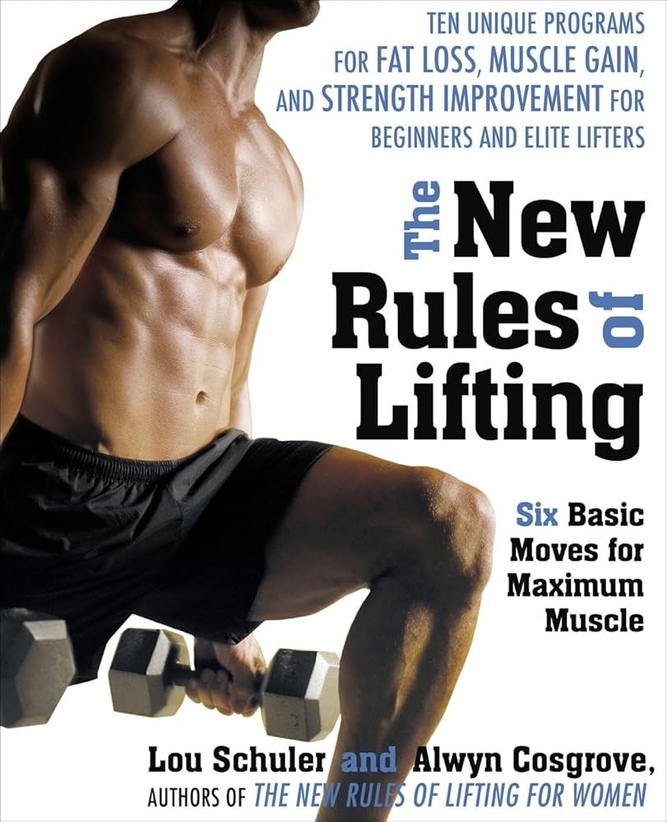
What the Book Covers
Lou Schuler and Alwyn Cosgrove's "The New Rules of Lifting" strips strength training down to its essentials. Rather than overwhelming readers with dozens of exercises, the authors focus on six fundamental movement patterns: the squat, the deadlift (bend), the lunge, the push, the pull, and the rotational twist. These aren't flashy compound lifts designed for Instagram: they're the movements your body was literally built to perform.
The book opens with a refreshing reality check. Most people don't need complicated routines; they need consistency with compound movements that activate multiple muscle groups simultaneously. Schuler and Cosgrove break down the biomechanics of each movement, explaining exactly what's happening in your muscles, joints, and nervous system. Then they deliver three complete, ready-to-use programs spanning 12 weeks each: one for fat loss, one for muscle gain, and one focused on pure strength development.
Each program is built on periodization principles: varying volume, intensity, and exercise selection over time to avoid plateaus and injuries. The workouts are realistic: three sessions per week, under an hour each. No one's spending two hours in the gym here. The book also covers nutrition basics, recovery importance, and the psychology of staying consistent, though it wisely acknowledges that diet deserves its own dedicated resource.
Who Should Read This
This book is an ideal entry point for anyone starting a formal strength training journey. If you've done some casual gym work but lack a structured plan, or if you're intimidated by the complexity of training programs, this book meets you exactly where you are. The authors write with warmth and humor: they're coaches first, not academic researchers, which makes technical concepts feel approachable rather than intimidating.
Experienced lifters may find the exercise selection too narrow, but intermediate lifters will appreciate the systematic approach and the freedom from decision paralysis. If you've been doing random exercises or following Instagram fitness influencers, Schuler and Cosgrove's evidence-based simplicity will feel like permission to stop overcomplicating things.
The book also speaks directly to people juggling busy lives. You don't need hours at the gym. You don't need fancy equipment. You need compound movements, progressive overload, and consistency.
Strengths and Weaknesses
What Works Well
The core insight, that six movement patterns form the foundation of effective training, is both scientifically sound and psychologically liberating. Readers stop wondering whether they should do cable flyes or Smith machines and start mastering the fundamentals. The three complete programs are genuinely useful; you can open the book and start tomorrow without analysis paralysis.
The explanations of biomechanics and muscle physiology are accessible without being dumbed down. When the authors explain why a squat builds more total muscle than a leg press, or why deadlifts create systemic hormonal responses, they're teaching you why not just what. That knowledge sticks.
The writing style is conversational and occasionally funny. Schuler and Cosgrove feel like actual coaches rather than textbook authors. You want to keep reading.
What Could Be Better
The exercise variety is intentionally limited, which is a strength philosophically but feels constraining for some readers. If you want detailed progressions for single-leg work, loaded carries, or advanced core training, you'll need supplementary resources.
Nutrition guidance is deliberately minimal. The authors acknowledge that "you can't out-train a bad diet," but the nutrition section is more philosophy than practical guidance. Most readers will need a dedicated nutrition resource to complement this book.
Advanced trainees will outgrow this quickly. If you already understand periodization and have years of consistent training, this book's fundamental approach may feel too basic, though experienced lifters often benefit from returning to fundamentals.
The Strength Training and Mental Health Connection
While "The New Rules of Lifting" focuses on building muscle and losing fat, the mental health benefits of strength training deserve mention. Research consistently shows that resistance training reduces symptoms of depression and anxiety, often as effectively as some pharmaceutical interventions. The mechanism works through multiple pathways: resistance training increases brain-derived neurotrophic factor (BDNF), reduces cortisol and systemic inflammation, and perhaps most importantly, builds self-efficacy through the tangible experience of getting stronger. When you can lift more weight each week, you're not just building muscle: you're building belief in your ability to improve. That psychological shift often extends far beyond the gym.
Final Verdict
"The New Rules of Lifting" is one of the rare books that earns its reputation through simplicity rather than complexity. In a fitness landscape cluttered with overcomplicated programs and contradictory advice, Schuler and Cosgrove deliver clarity. The six movements work. The periodized programs work. The philosophy (consistency over perfection, fundamentals over novelty) works.
This isn't the book if you want an exhaustive 1,000-page encyclopedia of every lift variation. But if you want permission to ignore the noise, a scientifically grounded foundation, and three concrete programs to build actual strength and muscle, this book delivers exactly what you need. The fact that you can complete one of these programs in 12 weeks and immediately move to the next means you have roughly a year of guided training ahead of you.
For beginners and intermediate lifters seeking clarity and consistency, this is essential reading. It's the antidote to decision paralysis disguised as a simple strength book.
Score: 4.0/5.0
Ideal for anyone ready to build strength through fundamental movements and scientifically-backed programming. The simplicity is the strength.