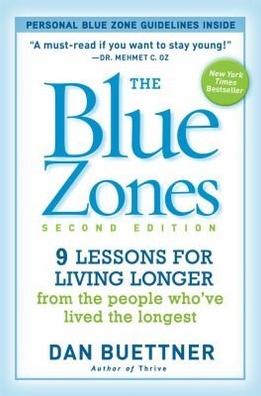
The Blue Zones started as a National Geographic feature in 2005 and has since become one of the more durable frameworks in the popular longevity genre. Dan Buettner, the journalist and explorer behind the project, set out with a team of demographers and researchers to find the handful of places on earth where people routinely live to one hundred, and then to understand how they were doing it. The book is the result of that fieldwork - five communities, nine common lessons, and a gentle argument that longevity is less about any single intervention and more about an ecosystem of small, sustained habits. Fifteen years later, most of its central claims have aged well, even as the specific demographic data underlying the identification of the zones has been contested in places. A Mind Wobble recommendation comes with caveats, but on balance it is warm.
What the book covers
Buettner profiles five communities: the mountain villages of Ogliastra in Sardinia; the Nicoya Peninsula of Costa Rica; the Seventh-day Adventist community of Loma Linda, California; the island of Ikaria in Greece; and the island of Okinawa in Japan. Each of these places has, or had at the time of the research, unusual concentrations of centenarians, low rates of heart disease and dementia, and patterns of daily life substantially different from most modern Western living. The book walks through each community in detail - who lives there, what they eat, how they move, how they relate to each other, what they believe, and how they spend their days.
From the five communities Buettner distils what he calls the Power 9 - nine common lifestyle features that show up across all of them despite the differences in climate, religion, and cuisine. Move naturally throughout the day, rather than in concentrated exercise sessions. Have a sense of purpose. Manage stress through daily rituals. Stop eating at roughly eighty percent full. Eat mostly plants, with legumes as a staple. Drink moderately and in company, if at all. Belong to a faith-based or values-based community. Put family first. Surround yourself with people who live the same way. The overlap across cultures is the central observation of the book - five different ecosystems are producing the same outcome through substantially the same pathways.
The diet chapter in particular has aged well. The Blue Zone diets are overwhelmingly plant-heavy, legume-centred (beans in some form every day is one of the most consistent features), low in ultra-processed food, and include meat more as a flavour than as a main event. This maps closely onto what the Mediterranean-diet literature, the PREDIMED family of trials, and the MIND diet research have continued to find about diet and long-term health.
Who should read this
This is for the reader who wants a more integrated picture of what a good life for the body and mind looks like, rather than a diet-only or exercise-only framework. For the person who has suspected that community and purpose matter for health and is looking for a careful treatment of that idea rather than a vague hand-wave. For the reader interested in how different cultures arrive at similar answers, and what that convergence might mean. And for anyone who wants longevity advice that does not reduce to either a specific food list or a specific supplement protocol.
It is less useful for a reader who wants tight scientific rigour. Buettner is a journalist, not an epidemiologist, and the book is reported rather than peer-reviewed. The Power 9 framework is clean in a way that the underlying cultures are not, and some of the original demographic data has been challenged by later researchers (Saul Newman's work in particular has questioned whether some of the reported centenarian rates hold up under closer examination). None of this invalidates the book, but it should be read as an observational, journalistic synthesis rather than as a set of proven causal claims.
Strengths and weaknesses
The strength is the synthesis. Most longevity books pick a single lever - diet, or exercise, or fasting, or supplementation - and argue that lever is the main story. Buettner picks up the ecosystem and shows that the places where people actually do live to a hundred are not doing any one thing heroically; they are doing a set of small, sustained things together. The diet is plant-heavy, but the community is also tight. The movement is constant, but the purpose is also strong. The food is seasonal, but the meals are also shared. The framework respects the integrated nature of actual lives, which is rarer than it should be in this genre.
A second strength is the prose. Buettner writes warmly, the interviews are vivid, and the reader comes away with a sense of specific people in specific places rather than of abstract dietary principles. The book is a pleasure to read in a way that most nutrition-and-health writing is not.
The weaknesses are real but modest. The Power 9 framework can feel neat to the point of smoothing over cultural differences - the Seventh-day Adventists of Loma Linda are not the shepherds of Ogliastra, and compressing both into the same list loses some texture. The centenarian-demographic pushback is worth knowing about, though it tends to affect the rank-ordering of the zones more than the broader pattern, which is well-supported by independent evidence. And the book, inevitably, was written before the global expansion of the Blue Zones brand and its commercial ecosystem, which has since muddied some of the early claims.
A 4.0 is right. The core observations are sound, the integration is unusual and useful, and the half-point held back is for the methodological softness and the way the framework occasionally outruns the underlying data.
Why this matters for mental health
Several of the Power 9 principles are as much mental-health interventions as physical ones. Purpose - ikigai in the Okinawan framing - has been repeatedly associated in independent research with lower rates of depression and better cognitive outcomes in older adults. Belonging to a strong community protects against loneliness, which the research has increasingly identified as a major risk factor for both mental and physical health. Daily rituals for stress management track closely with what contemplative and behavioural-therapy research recommends. And the dietary pattern the Blue Zones share aligns with the SMILES trial and the Mediterranean-diet literature on mood and cognitive health. For the Mind Wobble reader, the book is as much a mental-wellness book as a longevity book - the lesson is that the two are not really separable.
Final verdict
The Blue Zones is a book to keep on the shelf and return to when the nutrition and longevity conversation gets too narrow. It is warm, well-reported, and grounded in the insight that a long healthy life is an ecosystem rather than a hack. Read it alongside The Diet Myth or Food Rules for the nutrition science, and alongside any contemplative or community-of-practice book you trust for the purpose-and-belonging side. The Power 9 is a better framework than most single-lever longevity books offer, and the stories behind it are worth the price of admission on their own.