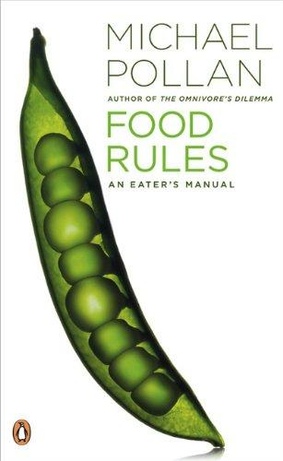
Food Rules is a small book that holds a lot. Michael Pollan - journalist, professor, and the writer who did more than almost anyone to move food and farming into the cultural mainstream - distilled the argument of his longer works into sixty-four short rules and published it as a pocket-sized hardback in 2009. A decade and a half later it has aged better than most of the nutrition books published in the same window. Where much of the genre has been taken apart by later evidence or by shifts in the research consensus, Food Rules has, if anything, been quietly vindicated. A Mind Wobble recommendation for this one is easy.
What the book covers
Pollan opens with the argument he has spent most of his career making, in its shortest possible form. Eat food. Not too much. Mostly plants. Everything in the book unfolds from those seven words. The sixty-four rules that follow are grouped into three sections - what to eat, what kind of food to eat, and how to eat - and each rule is no more than a paragraph. Some are aphoristic (if it came from a plant, eat it; if it was made in a plant, do not). Some are practical (avoid food products that make health claims). Some are cultural (eat at tables, not at desks or in cars). Taken together they amount to a framework that is easier to live with than almost any other nutrition advice on the shelf.
The deeper argument, running under the surface of the rules, is that the single biggest problem in modern eating is ultra-processed food. Pollan does not spend a lot of time on the biochemistry, because he does not need to. By the time you have followed twenty of his rules, you have already cut most of the ultra-processed products out of your diet as a side effect, and the rest of the rules are there to help you eat the whole foods that remain in a way that serves both your body and your relationship to eating. The later illustrated edition, with paintings by Maira Kalman, adds a warmth to the book that the text alone does not quite reach - worth looking up if the original feels too spare.
Who should read this
Nearly everyone. This is the book to give someone who has never thought seriously about nutrition and wants a short, sensible place to start. It is also the book to give someone who has read too many nutrition books and is now confused by the cross-currents of competing claims. Pollan cuts through the noise not by arguing harder but by arguing less, and the result is advice that has held up where more elaborate frameworks have not.
It is less useful for a reader looking for a deep scientific tour of the evidence base. Pollan is a journalist, not a researcher, and the book is deliberately aphoristic rather than rigorous. If you want the evidence in full, read The Diet Myth by Tim Spector or look at the PREDIMED and MIND diet literature directly. But for daily use - for the reader who wants a set of rules they can actually apply at a supermarket, a restaurant, or their own kitchen table - Food Rules is as useful a book as the nutrition genre has produced.
Strengths and weaknesses
The strength of the book is restraint. Pollan has the research chops and the cultural platform to have written a much longer, much more polemic book, and he repeatedly chose not to. The rules are short. The reasoning is compressed. The reader is trusted to fill in the rest. That restraint is also what has let the book age so well - there are very few specific scientific claims to be overtaken by later research, and most of the rules are heuristics that point in the same direction the best evidence has continued to point.
A second strength is applicability. Almost every rule in the book can be acted on the next time you go to a shop. Avoid products with more than five ingredients. Avoid products whose ingredients you cannot pronounce. Do not eat anything your great-grandmother would not recognise as food. These are rules a tired, busy, distracted reader can actually use, which is more than can be said for most nutrition advice. The book also handles culture and ritual better than most of the genre - several of the how-to-eat rules are about the social context of eating, and they turn out to matter for both physical and mental health in ways that more reductive frameworks miss.
The weaknesses are minor. A few rules lean slightly harder on traditional-diet nostalgia than the evidence strictly requires - the great-grandmother test is memorable but not quite airtight, given that traditional diets were not uniformly healthful. And for a reader who wants the research apparatus behind the advice, the book does not supply it. These are small caveats against a book that otherwise earns its place on any nutrition shelf.
A 4.5 is right. This is one of the most durable and quietly powerful nutrition books of the last twenty years. The half-point held back is for readers who want more depth than this pocket-sized format can provide - for them, pair it with something longer.
Why this matters for mental health
The connection between diet and mental health is real, and it is strongest for exactly the pattern Pollan describes - whole foods, mostly plants, eaten slowly and in company when possible. The SMILES trial, the PREDIMED trial, and the broader nutritional-psychiatry literature all support an approach that maps cleanly onto Food Rules. Beyond the specific diet, several of Pollan's how-to-eat rules address the social and ritual aspects of eating - sharing meals, eating at tables, cooking for yourself - that the loneliness and food-environment research has since identified as genuinely important for mood and wellbeing. The book does not frame itself as a mental health book, but it is closer to one than most of the nutrition-and-mental-health shelf.
Final verdict
Food Rules is the book to buy if you are going to buy one nutrition book. It is short enough to read in an afternoon, memorable enough to change how you shop the next day, and sensible enough that it is unlikely to lead you astray. Pair it with something with more scientific depth if you want the full evidence base, but for daily use this is the one. Pick it up, keep it on the kitchen shelf, and return to it whenever a louder nutrition trend tries to convince you that eating well is complicated. It is not. Pollan said it in seven words. The rest of the book is just commentary.