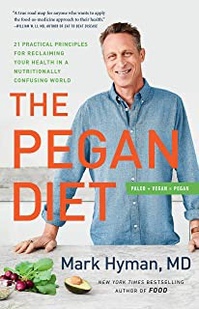
The Pegan Diet is Mark Hyman's attempt to cut through two decades of nutrition culture war by taking what works from paleo and what works from vegan and calling the result something new. Hyman, a practicing physician who leads the Cleveland Clinic's Centre for Functional Medicine, has been writing nutrition books for twenty years - this is his fifteenth or so - and the Pegan framework has become something of a signature. The 2021 book crystallises the approach into twenty-one practical principles, which is a useful structure for a genre that often collapses into either rigid rules or vague platitudes. The book is readable, mostly sensible, and worth reading with a bit of critical distance.
What the book covers
Hyman opens with the observation that paleo advocates and vegan advocates actually agree about most of what makes a healthy diet. They both argue for whole foods, lots of vegetables, minimal sugar, minimal ultra-processed food, good fats, and attention to food quality. Where they differ - mainly on animal products and grains - is a smaller area than the cultural volume would suggest. Hyman's move is to build a framework from the shared middle ground, adding a light touch of high-quality animal protein for those who want it and a permissive stance on whole grains and legumes in moderation.
The twenty-one principles are the heart of the book. They include things like eat mostly plants, choose quality protein, eat good fats, avoid flour and sugar, stay hydrated, eat in a time-restricted window, and pay attention to how food makes you feel. Taken together they amount to a reasonable, evidence-adjacent set of guidelines that most mainstream nutritionists would accept in outline if not in every detail. Hyman illustrates each principle with clinical examples from his practice, and the book is genuinely practical - you could hand it to someone who has never thought about food quality and they would come away with workable next steps.
The second half of the book moves into application. Meal planning, shopping lists, how to stock a pegan kitchen, and a set of recipes that are more accessible than those in many of Hyman's earlier books. There is a useful chapter on how to think about food as a political act - where and how food is grown, the environmental costs of different protein sources, and the relationship between food systems and public health.
Who should read this
This is for the reader who wants a sensible whole-foods framework without subscribing to a specific tribal identity. For the person who has bounced off paleo for being too restrictive with grains or off vegan for being too restrictive with protein, and who is looking for a middle path that is still coherent. For the reader who likes a set of clear principles rather than a complicated meal plan. And for anyone who has been following Hyman casually through podcasts and wants the consolidated version.
It is less useful for a reader who wants a deep scientific tour of the evidence base. Hyman's writing is practical rather than academic, and the references to nutritional science are often more suggestive than comprehensive. If you want that depth, look at books like The Diet Myth (Tim Spector) or In Defense of Food (Michael Pollan) for a more rigorous treatment.
Strengths and weaknesses
The strength of the book is the pragmatism. Hyman has been in clinical practice for a long time, and the twenty-one principles read like advice from someone who has actually watched patients try to implement dietary change rather than just argued about it on the internet. The middle-ground framing also serves the reader well - pegan is essentially a way of saying eat mostly whole foods, quality animal protein if you want it, low sugar, low processed, which is where the bulk of the real nutritional evidence points.
The weaknesses are where Hyman leans on functional-medicine framing that mainstream medicine does not endorse. Some of the specific health claims - about detoxification, specific supplement protocols, and certain food-as-medicine framings - go beyond what the current evidence supports. Readers who take the strongest claims at face value can end up spending money and energy on interventions with weaker backing than Hyman implies. The book is also, honestly, a repackaging of advice he has given in earlier books. Readers who have read Food Fix or The Blood Sugar Solution will find much that is familiar.
A 3.0 is right. The core advice is sensible, the framework is useful, and the functional-medicine overlay pulls the overall recommendation down from where a stricter version of the same advice would sit.
Why this matters for mental health
Diet and mental health are linked in ways that are becoming better understood. Diets high in ultra-processed foods, sugar, and industrial seed oils have been associated in observational studies with higher rates of depression and anxiety, and diets high in whole foods, vegetables, and high-quality fats have been associated with lower rates. The evidence is not as tight as popular nutrition would suggest - correlation, confounds, and reverse causation are all real issues - but the direction of the signal is consistent enough to take seriously. Hyman's core advice, if not all of his framing, aligns well with the SMILES trial and the Mediterranean-diet literature that anchors most of the current mental-health-and-nutrition research. For the Mind Wobble reader wanting a practical starting point, this book is a reasonable on-ramp.
Final verdict
The Pegan Diet is a useful and readable middle-ground nutrition book with some framing issues. If you are looking for an accessible set of principles to organise your eating around, and you can take the more speculative functional-medicine chapters with a pinch of salt, the book will serve you well. Pair it with something more scientifically rigorous if you want the evidence base in full, and use the twenty-one principles for what they are at their best - practical, memorable, and mostly right.