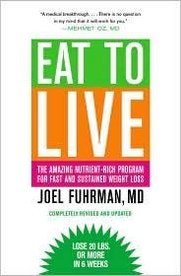
Eat to Live is Joel Fuhrman's signature book, first published in 2003 and revised in 2011, and it has become one of the foundational texts of the nutrient-dense plant-based movement. Fuhrman, a family physician with a long clinical practice, built the book around a simple and powerful idea: the nutritional value of food should be measured not by calories alone but by the density of micronutrients per calorie consumed. From that starting point he constructs a six-week programme that is, by most standards, dramatically restrictive - and, to many readers, dramatically effective. The book has sold well over a million copies and inspired a devoted following. It has also drawn criticism for pushing further than the evidence strictly requires.
What the book covers
Fuhrman's framework centres on what he calls the ANDI score - Aggregate Nutrient Density Index - which ranks foods by the ratio of micronutrients (vitamins, minerals, phytochemicals, antioxidants) to calories. At the top of the scale sit dark leafy greens, cruciferous vegetables, and berries. At the bottom sit refined grains, added sugars, and processed meats. The practical implication is a diet that looks roughly like this: enormous quantities of vegetables (a pound of raw and a pound of cooked per day is the target), generous fruit, beans and legumes as the primary protein source, modest whole grains, a small amount of nuts and seeds, and very little animal product, oil, or processed food of any kind.
The six-week plan is the operational core. For six weeks, the reader is asked to eat almost exclusively from the top of the ANDI scale - vegetables, fruit, beans, whole grains, and a small daily ration of nuts and seeds. Animal products are minimised to near zero. Oil is eliminated. Sugar and processed food are eliminated. The promise is rapid weight loss and, in many of the case studies, improvement or reversal of chronic conditions including type 2 diabetes, high blood pressure, and autoimmune disease.
The revised 2011 edition adds a chapter on what Fuhrman calls toxic hunger - his framework for understanding the difference between genuine physiological hunger and the discomfort that comes from eating a nutrient-poor diet and then going without. The idea is that a body accustomed to high-calorie, low-nutrient food experiences withdrawal-like symptoms between meals, and that switching to a nutrient-dense diet gradually eliminates those symptoms. This is plausible in outline if somewhat under-evidenced in the specific framing Fuhrman gives it.
Who should read this
This is for the reader drawn to a plant-heavy approach who wants a clear, structured programme with a strong intellectual framework. For the reader who has already tried moderate dietary changes and is looking for something more ambitious. For anyone interested in the nutrient-density lens as a way of evaluating food choices - the ANDI score concept, whatever one thinks of the specific programme, is a genuinely useful addition to how people think about what they eat.
It is less useful for a reader who finds restrictive diets counterproductive, for a reader with a history of disordered eating (the level of restriction can reinforce unhelpful patterns), or for a reader looking for a balanced take on the role of animal products. Fuhrman's position on animal foods is that they should be minimised to near zero for optimal health, which is considerably further than the mainstream evidence supports. Readers who want a plant-heavy approach without the all-or-nothing framing will be better served by The Diet Myth, Food Rules, or the broader Mediterranean-diet literature.
Strengths and weaknesses
The strength of the book is the nutrient-density framework itself. The idea that food should earn its place on the plate not just by calorie count but by what it delivers per calorie is sound, and it has aged well. The emphasis on vegetables, legumes, and fruit as the foundation of a healthy diet aligns closely with what the strongest observational and interventional evidence supports. And for readers who respond to structure and ambition, the six-week programme is clear enough to actually follow.
The weaknesses are in the distance between the framework and the programme. The nutrient-density idea is moderate and defensible; the six-week plan is extreme. Near-elimination of all animal products, all oils, and all processed food simultaneously is a high bar that goes further than the evidence requires. Some of the health claims - particularly around disease reversal - lean on clinical anecdotes and observational data rather than on the kind of randomised trials that would support the strength of the claims. The tone, while motivating for some readers, can shade into moral certainty in a way that creates dietary anxiety rather than alleviating it. And the book has the recurring problem of the plant-based genre: it tends to present the most optimistic reading of the plant-based evidence and the most pessimistic reading of the evidence on animal products, rather than engaging with the full picture.
A 3.0 is right. The framework is useful, the emphasis on vegetables and legumes is sound, and the programme pushes further than the evidence supports in ways that are not costless for many readers.
Why this matters for mental health
Diet and mental health are connected, and the direction the best evidence points - whole foods, lots of vegetables, legumes, fruit, minimally processed - overlaps substantially with what Fuhrman recommends. The Mediterranean-diet literature, the SMILES trial, and the PREDIMED family all support a pattern that is plant-heavy and minimally processed. Where the mental health concern arises is with the level of restriction. Highly restrictive diets, even plant-based ones, can create the kind of food preoccupation, social difficulty, and dietary anxiety that undermines the mental health benefits the diet itself might provide. For the Mind Wobble reader, the nutrient-density insight is worth keeping; the question is whether you need the full six-week programme to get the benefit, and for most readers the answer is probably not.
Final verdict
Eat to Live contains a genuinely useful idea - nutrient density as a lens for food choices - wrapped in a programme that is more restrictive than most readers need. Take the ANDI framework, apply it loosely, eat a lot more vegetables and legumes, and you will capture most of the benefit without the costs of the full programme. If you want that in a gentler package, Food Rules or The Diet Myth will serve you better. If you want the ambitious version and you are emotionally steady around food, the book will work - just know that the distance between the evidence base and the specific programme is wider than Fuhrman lets on.