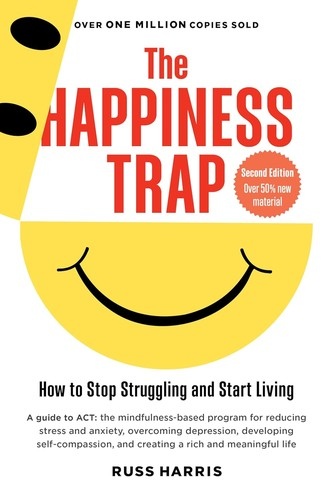
The Happiness Trap is the book that put Acceptance and Commitment Therapy into the hands of ordinary readers. Russ Harris, an Australian GP who trained under Steven Hayes (the psychologist who co-developed ACT), wrote the first edition in 2008 and the substantially expanded second edition in 2022. Across both editions the book has sold over a million copies, been translated into more than thirty languages, and become a standard recommendation from therapists who want their clients to do the reading before the first session. If you have only heard of CBT, this book is your introduction to the quieter, differently-shaped cousin that a lot of contemporary clinicians now prefer.
What the book covers
Harris opens with the trap itself. We have been told, more or less continuously since birth, that happy is the default setting for a healthy human being, and that anything else - anxiety, sadness, boredom, frustration - is a malfunction to be fixed. The fixing, it turns out, is the problem. The more we fight uncomfortable feelings, the more we amplify them, and the more our lives shrink around the effort to feel better. Harris's opening argument is that the war on painful feelings is itself the condition most readers are trying to treat.
From there the book walks through the six core processes of ACT, which Harris packages into a framework called psychological flexibility. Defusion - learning to see your thoughts as passing events rather than literal truths. Acceptance - making room for difficult feelings without trying to drive them out. Contact with the present moment - noticing what is actually here, rather than where your mind has wandered. Self-as-context - the stable observing self that is not defined by any particular thought or feeling. Values - what actually matters to you, at a level deeper than goals. Committed action - taking steps in the direction of your values even when your mind is objecting. Each of these is introduced through metaphors, explained with examples, and then drilled through practical exercises the reader is expected to actually do.
The second half of the book is structured around application. How to use the framework when anxiety is driving you. How to apply it to low mood, to relationships, to work you have been avoiding, to habits you want to change. The second edition in particular has substantially expanded material on self-compassion, trauma-informed application, and working with difficult relationships, which the original book touched more lightly. Harris is generous with case material, and the worked examples are specific enough to actually follow. This is a book designed to be used, not just read.
Who should read this
This is for the reader who has been caught for years in the feel-better loop - the person who has tried every self-help framework and noticed that the effort to not feel bad has become its own source of suffering. It is for the high-functioning anxious reader who looks fine on paper, the perfectionist who cannot tolerate their own mistakes, and the person whose life has quietly narrowed around avoidance. It is also unusually useful for readers who have found CBT helpful but partial - ACT works with a lot of the same territory and goes somewhere the more cognitive approach does not.
It is less useful for a reader in acute crisis. The tone is brisk and cheerful, the exercises assume a baseline of stability, and someone currently in a deep depressive episode or in active trauma symptoms will probably need therapeutic support alongside. For pretty much anyone else, the book is a useful companion, often ahead of or alongside therapy rather than as a replacement for it.
Strengths and weaknesses
The strength of the book is the combination of accessibility and evidence. ACT has an unusually strong research base for a therapy that gets filed under self-help adjacent - it has been studied across anxiety disorders, depression, chronic pain, OCD, and a range of other conditions with meta-analytic support that holds up well. Harris translates the framework into plain language without losing the clinical precision, which is harder than it sounds. The exercises are the other strength. Almost every chapter gives you something specific to try, and the practice actually compounds in the way Harris promises.
The weaknesses are modest. The tone can feel relentlessly upbeat for readers who are in real distress, and some of the metaphors - the famous passengers on the bus exercise, for instance - either click immediately or never quite do. Readers who do not warm to the metaphorical style tend to bounce off the book, which is a shame because the underlying framework is strong. A reader in that camp might prefer Steven Hayes's A Liberated Mind or Kelly Wilson's Mindfulness for Two as a more clinically grounded entry point. But those books are longer and harder, and most readers do better starting here.
A 4.5 is right. The book does what it sets out to do with rare clarity, the framework genuinely helps a lot of people, and the evidence base behind it is as strong as popular self-help gets.
Why this matters for mental health
The reframe at the heart of ACT - that psychological health is not about eliminating painful feelings but about living a meaningful life alongside them - is one of the more important contemporary moves in therapy. It addresses a specific weakness in the dominant CBT model, which can inadvertently train people to believe that all negative thoughts and feelings must be challenged or restructured. For a lot of anxious readers, that project becomes another version of the trap. Harris's book teaches the skill of changing your relationship to difficult inner experience rather than trying to argue it away. That skill is, for many readers, the piece that was missing. For the Mind Wobble reader working on anxiety, low mood, or chronic avoidance, The Happiness Trap is one of the most useful books in the whole category.
Final verdict
The Happiness Trap is one of the rare self-help books that reliably does what its cover promises. Harris writes clearly, the exercises deliver, and the framework underneath is clinically serious. If you are going to read one popular therapy book this year, this is a strong candidate. Work through it slowly, actually do the exercises, and expect the shift - if it comes - to be gradual and quietly transformative rather than dramatic.