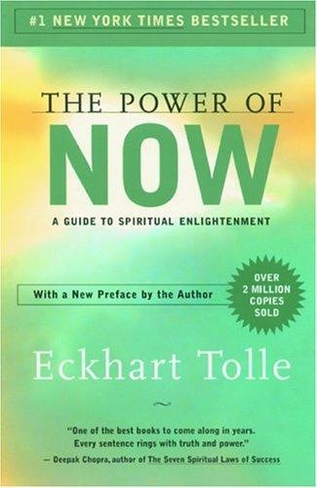
The Power of Now is one of the most-read spiritual books of the last thirty years, and also one of the most divisive. Eckhart Tolle, a German-born contemplative teacher living in Canada, published it in 1997 to a tiny initial audience, watched it build quietly by word of mouth for four years, and then in 2002 found it selected by Oprah for her book club, after which it sold millions of copies and established Tolle as a household name in the contemplative category. The book has converted readers and irritated them in roughly equal measure, and any honest review has to account for both reactions. It is, on careful reading, a genuinely useful book for the right reader - and an actively frustrating one for the wrong reader. Knowing which one you are is most of the decision.
What the book covers
Tolle's central claim is simple and old - older than Tolle, older than the twentieth century, older than most of the traditions people come to through him. The thinking mind, he argues, is compulsive. It generates a near-continuous stream of commentary about past and future, mostly negative, and we have come to mistake that commentary for ourselves. Most psychological suffering is produced by this compulsive thinking. And the way through it is not better thinking or more insight into the thinking, but the cultivation of presence - the capacity to step out of the stream, however briefly, and experience the actual moment that is actually happening. The book is structured as a long Q&A between Tolle and an unnamed interlocutor, walking through this core idea from many angles.
He introduces several concepts that have become durable in the contemporary contemplative vocabulary. The observing self - the part of you that can notice thinking without being the thinking. The pain-body - his name for the accumulated emotional residue from past wounds, which behaves almost like an entity and seeks reactivation. The difference between situations and the stories we tell about them. The idea that the present moment is the only place life actually happens and that almost all of our psychological pain is produced by refusing it. Each of these, stripped of the cosmic register, is recognisable as a version of things contemporary mindfulness research has been converging on for decades.
The practical instructions in the book are modest and quite traditional. Notice when you are thinking. Notice the body as a way into the present. Notice the breath. Notice the space between thoughts. Do this repeatedly, throughout the day, in ordinary moments - waiting for a kettle, walking between rooms, listening to another person - and let the practice slowly change your relationship to the mind. There is nothing exotic here, and a reader familiar with Mindfulness-Based Stress Reduction will recognise the underlying mechanism.
Who should read this
This is for the reader drawn to the contemplative tradition and willing to tolerate a teacherly voice. For the reader who has already tried secular mindfulness and found it thin, wanting something with a bit more depth even if the language is more elevated. For the person in a period of genuine suffering who has been told by almost everyone in their life to think their way through it and is wondering whether thinking is part of the problem. And for the reader willing to take what is useful and leave what is not.
It is not the right book for someone who needs evidence-based framing or who flinches at cosmic language. Tolle makes claims about consciousness, awakening, and the nature of mind that are not scientifically testable, and readers who need their mental health reading grounded in clinical research will struggle. For those readers, Russ Harris, Jon Kabat-Zinn, or Dan Harris will serve better. This is a book from inside the contemplative tradition, written by a teacher who means what he says about it, and it should be read on those terms or not at all.
Strengths and weaknesses
The strength of the book is the core teaching. Tolle is pointing at something real. The capacity to notice thinking as thinking, to step back from the stream of mental commentary, and to return attention to the present moment is one of the more durable psychological skills a person can develop. The research on mindfulness-based interventions has been converging on this for decades, and Tolle is teaching it with a certain quiet force that some readers find uniquely landable. The pain-body concept, in particular, has proved unexpectedly useful for readers working on reactive emotional patterns - it gives them a name for something that was previously just a weather system.
The weaknesses are real. Tolle writes in a declarative spiritual voice that can read as authoritative to one reader and condescending to another, and the Q&A format, while traditional in contemplative writing, occasionally feels stilted in English prose. He also makes claims about the nature of mind and consciousness that outrun the available evidence - claims about universal awakening, about the specialness of the present historical moment, about the cosmic significance of the reader's inner work - that will either resonate or annoy, with little middle ground. A cautious reader needs to know that the useful psychological core of the book is substantially smaller than the book itself, and that a lot of the surrounding metaphysics can be set aside without losing the practice.
A 3.5 is right. The core is durable and useful; the packaging is not for everyone. Readers who can take what works and leave the rest will get substantial value. Readers who cannot will bounce hard off the voice and should find another door into the same territory.
Why this matters for mental health
The underlying practice Tolle is pointing at - present-moment awareness, disidentification from compulsive thinking, noticing the body - is one of the best-studied psychological skills in the contemporary literature. Mindfulness-based interventions have a robust evidence base for anxiety, depression, chronic pain, and general wellbeing, and the core mechanism is substantially the one Tolle is teaching. Read this way, the book is a contemplative-tradition framing of a skill that clinical research has spent thirty years confirming. For the Mind Wobble reader curious about the contemplative side of mindfulness rather than the secular MBSR version, this is one of the more accessible entry points.
Final verdict
The Power of Now is a book to approach with a specific kind of reader in mind - the one willing to let the useful core work on them without getting stuck on the voice. If that is you, the book genuinely delivers, and the practice it points at is one of the most quietly powerful things you can build into an ordinary day. If the voice is a problem, try Jon Kabat-Zinn or Pema Choedroen instead - you will meet the same practice through a different door. Tolle has earned his place on the shelf. Whether he belongs on yours depends largely on how much latitude you can give the register.