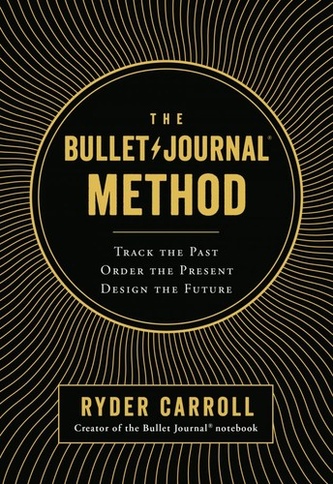
If you have ever stared at a to-do app so cluttered it gave you a little jolt of dread, Ryder Carroll wrote this book for you. The Bullet Journal Method is the definitive guide to the analog system Carroll quietly invented to manage his own attention difficulties, then accidentally launched into a global movement of dotted notebooks and washi tape. What makes it worth your shelf space is that it is not really a book about pretty spreads. It is a book about slowing down enough to live on purpose, with a notebook as the tool that gets you there.
What the book covers
Carroll splits the book into clear movements. The first explains the why - the case for putting pen to paper in a world that keeps trying to do your thinking for you. Then comes the how: the surprisingly simple mechanics that anyone can start with a blank notebook and five minutes. You learn Rapid Logging, his shorthand of bullets and symbols for capturing tasks, events, and notes without fuss. You learn the four core collections - the Index, the Future Log, the Monthly Log, and the Daily Log - that give the system its spine. And you learn Migration, the monthly habit of copying forward only what still matters, which is where a lot of the method's quiet magic lives.
The back half is where Carroll surprises people. Rather than pile on more techniques, he turns reflective, drawing on Stoicism, mindfulness, and a scattering of philosophy from across history to talk about goal-setting, gratitude, and meaning. He wants you to use the notebook not just to get more done, but to notice whether the things you are doing are worth doing at all. As he puts it, often all it takes to live intentionally is to pause before you proceed.
Who should read this
This is a near-perfect first book for the chronically overwhelmed - the frustrated list-maker, the person juggling six half-finished apps, the creative who craves a little structure without a rigid system boxing them in. If digital planners leave you cold and you suspect the problem is too much input and not enough reflection, the method will feel like a window opening. It is also a lovely fit for anyone curious about journaling but intimidated by the blank page, because Rapid Logging gives you a gentle, low-stakes way in.
It is a weaker pick if you want a pure, no-nonsense productivity manual. Carroll lingers on the philosophical material, and readers who only want the mechanics sometimes find that thread a touch repetitive. And if you are already deep in the bullet journal community, be honest with yourself: much of the core technique is free on Carroll's website and YouTube channel.
Strengths and weaknesses
The method's great strength is its flexibility. One notebook bends to fit your life rather than forcing your life into someone else's template, and there is something genuinely freeing in that. Carroll writes warmly and clearly, and because he built the system to manage his own restless attention, the advice carries the credibility of lived experience rather than theory. Reviewers and readers have responded in kind - the book holds a solid rating north of four stars across tens of thousands of reader ratings, with heavyweights like David Allen of Getting Things Done and Cal Newport of Deep Work lending praise. Newport went as far as calling it one of the most elegant and effective productivity systems he has encountered.
The weaknesses are real but modest. The reflective, occasionally self-help tone can tip into repetition; Carroll returns to intentionality so often that one or two critics found it a little earnest. And the value question is fair - you are partly paying for the philosophy and the polished, all-in-one explanation rather than for secret techniques. The ebook also fares poorly compared with print, since the method is fundamentally about a physical notebook and the digital version loses something in translation. Weighing the genuine usefulness and warmth against those caveats, this lands at a confident 4.0. It is excellent at what it sets out to do, just not flawless or essential for everyone.
Why this matters for mental health
Here is the part that earns this book a place on a wellness shelf rather than just a productivity one. So much modern anxiety comes from carrying everything in our heads - the unfinished tasks, the vague worries, the sense that we are perpetually behind. Getting it all out onto paper, and then deliberately deciding what deserves your energy, is a quietly powerful act of mental decluttering that can take real pressure off an overloaded mind. The method's emphasis on pausing, reflecting, and acting with intention overlaps meaningfully with mindfulness practice, turning the notebook into a small daily ritual for noticing how you actually feel and what you actually want. It is not therapy, and Carroll never pretends it is, but for everyday overwhelm it offers a gentle, structured way to feel more in control.
Final verdict
The Bullet Journal Method is one of those rare productivity books that leaves you calmer rather than more frantic. It hands you a system simple enough to start tonight with a pen and any notebook you already own, then quietly nudges you toward a more deliberate, less cluttered way of living. Yes, you can piece the basics together online for free - but having Carroll walk you through both the how and the why, in one warm and well-made book, is the kind of head start that actually gets you to stick with it. If you have been craving a way to quiet the noise and reclaim a sense of direction, treat yourself to the full method. Pick up a copy, grab a notebook, and give your overloaded brain somewhere to finally set everything down.