What the book covers
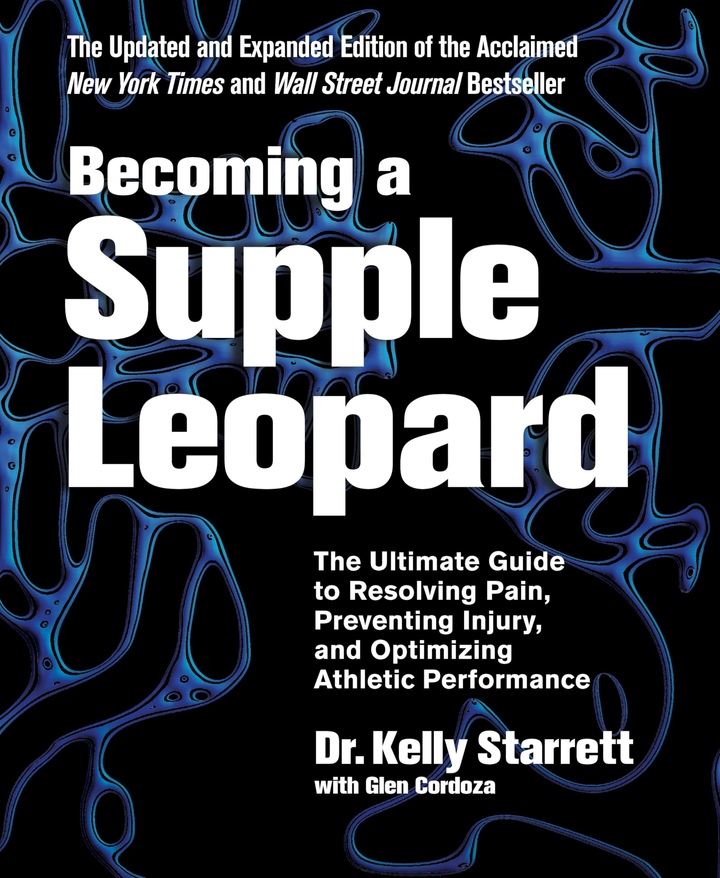
"Becoming a Supple Leopard" is Kelly Starrett's manifesto on human movement capacity and pain resolution. The book is structured as part philosophy, part practical manual. Starrett, a CrossFit coach and Doctor of Physical Therapy, argues that chronic pain and injury are not inevitable: they're the result of movement dysfunction accumulated over years of poor posture, sedentary habits, and misaligned movement patterns.
The first two sections establish the biomechanical foundation: how the spine should brace, how the pelvis should position, what neutral alignment means, and why maintaining it matters. Starrett walks you through the concept of "torque": creating rotational tension in the shoulder and hip to stabilize joints, and explains how most people move in patterns that actually load their joints destructively.
The middle sections cover lifestyle factors: how sitting ruins your hips, how high heels shorten your calves, how desk posture cascades into neck and shoulder pain. The author doesn't just say "fix your posture"; he teaches you to assess your own movement, identify where you're broken, and understand why.
The final chapters are the payoff: detailed, photo-illustrated mobility protocols organized by body region. Self-assessments teach you to find your own limitations, then progressions show you how to restore capacity. Everything is designed for daily practice. Starrett recommends 10 to 15 minutes a day, every day, to maintain mobility.
Who should read this
Athletes and coaches will find this indispensable. CrossFitters especially cite this book as foundational; Starrett is a fixture in the CrossFit community, and the book's joint-by-joint approach directly shapes how many boxes program warm-ups and mobility work.
Anyone with chronic pain or recurring injury should read this. Whether you're a desk worker with lower back pain, a runner with tendinitis, or a lifter with shoulder impingement, the self-assessment and mobility protocols here offer practical, evidence-based paths forward: often without needing to pay for a physical therapist.
People who sit a lot (which is most of us) will recognize themselves in these pages. If you spend 8 hours a day at a desk, you need this book's posture and mobility work to counteract the damage.
Movement enthusiasts and body-curious people benefit from the depth of anatomical understanding. The book makes you smarter about how your body works.
This is less suitable for those who prefer quick-fix, low-effort wellness. Starrett's message is clear: mobility takes time, consistency, and attention. If you want magic, look elsewhere.
Strengths and weaknesses
Strengths
The book's photography is exceptional. Hundreds of full-color photos show proper positioning and progressions with clear anatomical callouts. You don't have to guess what "neutral spine" looks like; you see it. This visual clarity is the book's biggest strength: complex biomechanics become concrete and learnable.
The scope is impressive. Starrett doesn't isolate the shoulder or knee; he teaches you to assess and address movement quality holistically. The joint-by-joint model (foot, knee, hip, spine, shoulder, elbow, wrist) is systematic without being rigid. It gives you a mental map for self-diagnosis.
The content is immediately practical. This isn't theoretical. You can open the book, find a protocol for your problem, and start the next day. The accessibility for self-treatment is huge: not everyone can see a physical therapist, but this book puts real expertise in your hands.
The philosophy matters too. Starrett's insistence on quality over quantity is counter to much fitness culture. The idea that doing 100 reps of bad movement is worse than 20 reps of good movement is powerful and shifts how thinking athletes approach training.
Weaknesses
The front-loaded structure is frustrating. Two-thirds of the book is foundational theory. While valuable, many readers want to jump straight to "here's what's wrong with my shoulder" and "here's how to fix it." The book forces you to earn that knowledge.
The absence of an index is a glaring omission. A 480-page reference book without an index? Frustrating. You flip through trying to find the ankle protocol when a simple index would take seconds.
The systematic approach assumes one correct way to move, which isn't true. Skeletal variation is real; what constitutes "neutral spine" differs by individual structure. Starrett acknowledges this briefly but doesn't deeply explore how to adapt protocols for different body types. Some readers feel prescribed rather than prescribed-to.
There's no built-in screening protocol to help individual readers figure out which issues apply to them. The book gives you the tools but not always the map for which tool to use first. Beginners might feel overwhelmed.
The mobility protocols, while effective, can feel repetitive and tedious. Daily mobility practice is essential to results, but the book doesn't always make the daily grind feel rewarding or connected to larger fitness goals.
The mental health angle
Here's where mobility connects to mental health: chronic pain is insidious. It reduces motivation, disrupts sleep, erodes confidence, and creates a negative feedback loop of avoidance and deconditioning. By resolving pain through movement quality and consistent mobility work, Starrett's approach also relieves the psychological burden pain carries. When your body stops hurting, your mood and motivation improve.
Additionally, the practice of mobility work (understanding your body, assessing yourself, taking agency over your recovery) builds body confidence and reduces anxiety around movement. Instead of fearing you'll re-injure, you feel competent and in control. That shift from helplessness to agency has real mental health benefits.
Final verdict
"Becoming a Supple Leopard" is essential reading for anyone who cares about moving well and staying pain-free. It's not a quick read, and it demands practice, but the payoff is substantial. The photography is world-class, the content is research-informed and practical, and Starrett's philosophy, that quality and consistency matter more than intensity and volume, is both refreshing and true.
The book is strongest as a reference manual you return to repeatedly, less suitable as a cover-to-cover read. Its scope and depth make it invaluable for athletes, coaches, and anyone recovering from or preventing chronic pain. The lack of an index and occasional one-size-fits-all tone are real flaws, but they don't undermine the core value.
The reality is that "Becoming a Supple Leopard" works because Starrett meets readers where they are: in pain, stuck, frustrated with conventional fitness culture that prizes volume over mechanics. He offers a clear framework: assess, understand, practice, and the tools to execute it yourself. That agency matters. Too many people treat their bodies as mysteries to be fixed by expensive therapists; this book says, "Actually, you can understand this. You can own your recovery."
The mobility culture has evolved considerably since 2013, and newer books have refined some of Starrett's concepts. But the fundamentals here remain sound. If anything, the book has aged well because it prioritizes principles over trends. That durability is a mark of lasting value.
If you're tired of pain, frustrated with movement limitations, or simply want to understand your body better, this book pays dividends. It's earned its reputation as a classic in the fitness and mobility world. Consider it an investment in decades of pain-free movement, and the peace of mind that comes with knowing you understand your own body.
Recommended for: CrossFit athletes, runners, strength athletes, desk workers, chronic pain sufferers, coaches, anyone serious about longevity, and people who want ownership of their recovery.
Skip if: You want quick fixes, prefer passive treatments, or need highly personalized medical advice (see a PT for that: this book is best used alongside professional care, not as a replacement).