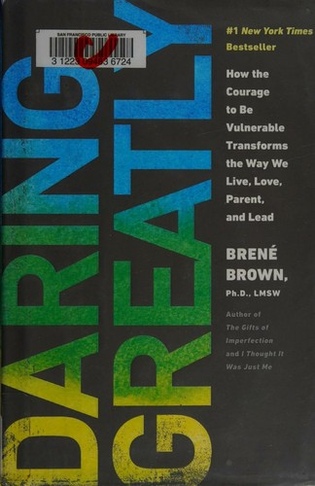
By the time Daring Greatly arrived in 2012, Brene Brown had already given the TED talk that would eventually cross sixty million views, and readers who knew her from The Gifts of Imperfection were expecting a sequel. What they got instead was the book that most fully articulates the core of her research - a careful, specific, twelve-years-of-data argument that vulnerability is the birthplace of almost everything we actually want from a life, and that our collective refusal to accept this is costing us more than we realise. The title comes from Theodore Roosevelt's 1910 speech about the man in the arena, and Brown's whole project is effectively a field manual for getting into the arena without bleeding out.
What the book covers
Brown is a research professor at the University of Houston, and the book is grounded in years of qualitative interviews with thousands of participants. She opens by dismantling the myth that vulnerability is weakness. Vulnerability, in her definition, is the experience of uncertainty, risk, and emotional exposure - and it is the precondition for courage, connection, love, and creative work. You do not get the upside without the downside. The reason most of us spend our lives avoiding vulnerability is that our culture has told us it is something to be ashamed of, and we have internalised that lesson so deeply that we mistake the armour for the self.
From there she moves into shame, which is the real engine of the book and the area where her research is strongest. Shame, in Brown's careful distinction, is the feeling that I am bad. Guilt is the feeling that I did something bad. The first is corrosive; the second is useful. Shame thrives in secrecy, silence, and judgment, and it dies in the presence of empathy - which is why the work of building what she calls shame resilience is fundamentally relational. This middle section of the book is where readers most often report a physical sensation of relief, because Brown is naming a force most of us have felt working on us for years without a vocabulary for it.
The second half of the book applies the framework outward. There are chapters on what Brown calls the vulnerability armoury - the specific strategies people use to avoid being seen, from perfectionism to numbing to foreboding joy. There is a useful chapter on what engagement looks like in relationships, a chapter on parenting that argues the single most important thing you can do is stop performing parenthood and start being seen by your child, and a closing chapter on leadership that reframes what a courageous workplace actually looks like. The later sections are thinner than the core, but the core is strong enough to carry the book on its own.
Who should read this
This is for the reader who has spent a long time performing a version of themselves. The high-functioning professional who has everything together on paper and is exhausted in a way they cannot quite articulate. The parent who wants to be different with their kids than their parents were with them and is not sure how. The person who freezes in conflict, or in honesty, or in asking for what they need, and keeps wondering why relationships feel harder than they should.
It is also, specifically, for the reader who has tried mainstream self-help and bounced off it. Brown's tone is warm but not saccharine, her argument is research-based rather than aspirational, and her examples are drawn from interviews rather than invented vignettes. If you are the kind of reader who needs to know the evidence is there before you will engage, this is the book that tends to get past your defences.
Strengths and weaknesses
The strength of the book is the clarity of the central arguments. Brown is, first and last, a researcher, and the way she distinguishes shame from guilt, vulnerability from weakness, and connection from performance is the kind of conceptual clarity that sticks for years. The material on shame resilience in particular has quietly reshaped how a generation of therapists, coaches, and teachers talk about the topic - including people who have never read the book but have absorbed the vocabulary through the culture.
The weaknesses are modest. The book is structurally discursive, and readers who want a tight protocol can find themselves wondering when Brown is going to stop telling stories and give them the list. Her answer, implicitly, is that the stories are the method. A reader who accepts that will do fine; a reader who does not will grumble. The later chapters on parenting and workplace culture are useful but less rigorous than the core research - they are more extrapolation than data - and some readers find the personal-anecdote density in places a bit heavy. None of this undermines the central contribution.
A 4.5 is right. The book has held up unusually well for a decade-plus-old self-help title, the core ideas have moved into clinical vocabulary, and the read-it-twice-a-year reader base is large and sincere.
Why this matters for mental health
A substantial slice of therapeutic work - particularly in trauma, attachment, anxiety, and depression - ends up orbiting the same questions Brown is asking. What am I hiding? Who am I hiding it from? What would it cost to be seen? The quiet toll of performing a false self is one of the better-understood drivers of chronic anxiety and low-grade depression, and the specific corrosive effect of unacknowledged shame on mental health is well-established in the clinical literature. Brown does not replace therapy, and she does not claim to. What she does is give the reader a framework and a language for work that is often hard to start without one. For the Mind Wobble reader trying to understand why they feel the way they do, Daring Greatly is one of the most genuinely useful entry points in the whole category.
Final verdict
Daring Greatly is a book that most people remember the first time they read it. Brown's argument is specific, her evidence is real, and her tone manages the rare trick of being emotionally direct without collapsing into sentimentality. Fourteen years after publication it still shows up on therapist reading lists, still gets passed between friends, and still converts sceptical readers within the first fifty pages. If you have been circling the book for a while, this is your sign. Read it slowly, take the shame chapter seriously, and expect to recognise yourself more than is entirely comfortable.