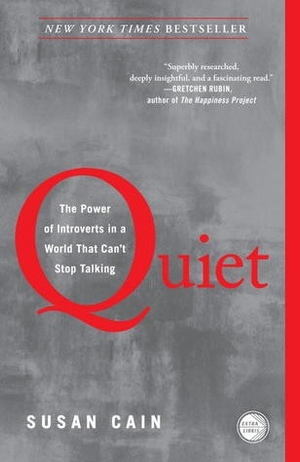
Quiet arrived in 2012 and changed the cultural conversation about personality almost single-handedly. Susan Cain, a former corporate lawyer who spent seven years researching introversion, wrote the book after realising how many of her clients, colleagues, and friends were quietly exhausted by a world that had decided extroversion was the default setting for a successful human being. The book went on to spend years on the New York Times bestseller list, spawn a TED talk watched by tens of millions, and become the text that roughly a third of the people you know will point to as the book that finally helped them make sense of themselves.
What the book covers
Cain opens with a history lesson. She traces the rise of what she calls the Extrovert Ideal through twentieth-century American culture - the shift from a character-based idea of virtue to a personality-based idea of success, the explosion of self-help books teaching people to project confidence, the transformation of schools and workplaces into environments that reward the loudest voice in the room. The historical section is worth the price of the book on its own. It is rare to read something that reframes the water you have been swimming in so clearly.
From there she moves into the science. Drawing on the work of Jerome Kagan at Harvard, Elaine Aron on highly sensitive people, and a wide swathe of personality psychology, Cain walks through what we actually know about introversion. It is not shyness, not social anxiety, not a failure of personality - it is a measurable difference in how the nervous system responds to stimulation. Introverts are not broken extroverts; they are differently wired, with their own strengths in deep focus, careful analysis, and sustained creative work.
The middle of the book is a tour through the consequences of misunderstanding this. Cain visits open-plan offices, corporate brainstorming sessions, evangelical mega-churches, and Harvard Business School to show how relentlessly the Extrovert Ideal has been baked into the institutions that shape modern life. The effect on introverts is exhausting and, in some cases, professionally damaging. The final third of the book turns practical - how introverts can build careers and relationships that fit them, how parents can raise introverted children without trying to fix them, and how extroverts and introverts can understand each other better.
Who should read this
This is for the introvert who has spent their life being told to speak up more, network harder, stop overthinking, and come out of their shell. It is for the parent of a quiet child who is worried their kid is being left behind. It is for the manager who keeps wondering why some of their most thoughtful team members go silent in group meetings. And it is for the extrovert who loves an introvert and would like to understand what is happening when they disappear into a book for three hours after a dinner party.
It is not a book that will transform someone already comfortable in their temperament - that reader already knows most of what Cain is arguing. But for the reader who needs to hear it, the book lands hard.
Strengths and weaknesses
The strength of Quiet is its synthesis. Cain is a careful reporter and a genuinely elegant writer, and she weaves personal stories, historical context, and psychological research into something that feels less like a thesis and more like a conversation. The book is persuasive because it is specific - the open-plan office chapter names names, the education chapter visits actual classrooms, the religious chapter sits inside a Saddleback Church service. Concrete observation does most of the argumentative work, and the tone never tips into polemic.
The weaknesses are modest but worth naming. The binary introvert-extrovert framing is cleaner than the underlying research, which mostly sees these traits as dimensions rather than categories. Most people sit in the ambivert middle, and the book occasionally speaks as if the world divides cleanly into two types. Cain acknowledges this in passing but leans on the binary for narrative reasons, and it can flatten the picture. A few of the cultural generalisations - particularly in the Asian-American chapter - have aged a little awkwardly. None of this undermines the book's core argument, but a more recent reader may notice the edges.
A 4.5 is right. The book is one of the best popular psychology books of the last fifteen years, and its cultural impact is real. The minor simplifications do not meaningfully dent the achievement.
Why this matters for mental health
The relationship between temperament and mental health is tighter than most people realise. A substantial number of readers who arrive in therapy with vague anxiety or low-grade depression are, underneath that, simply introverts who have spent years trying to live as extroverts. The resulting chronic overstimulation, social exhaustion, and self-doubt is not a clinical disorder so much as a bad fit between a person and the environment they have been told they must succeed in. Understanding your temperament is not a substitute for therapy, but for a lot of readers it removes the background noise that was making the real work harder. For the Mind Wobble reader, Quiet is genuinely useful self-knowledge - and self-knowledge, as therapists like to say, is where most of the work starts.
Final verdict
Quiet is the book you give to the introvert in your life who still apologises for being one. It will give them a framework, a vocabulary, and the quiet relief of realising they were never broken to begin with. For extroverts, it is a compact education in how a third of the people around them actually experience the world. Fifteen years after publication it still holds up, still gets recommended, and still shows up on bedside tables. Few psychology books earn that kind of shelf life. This one has.