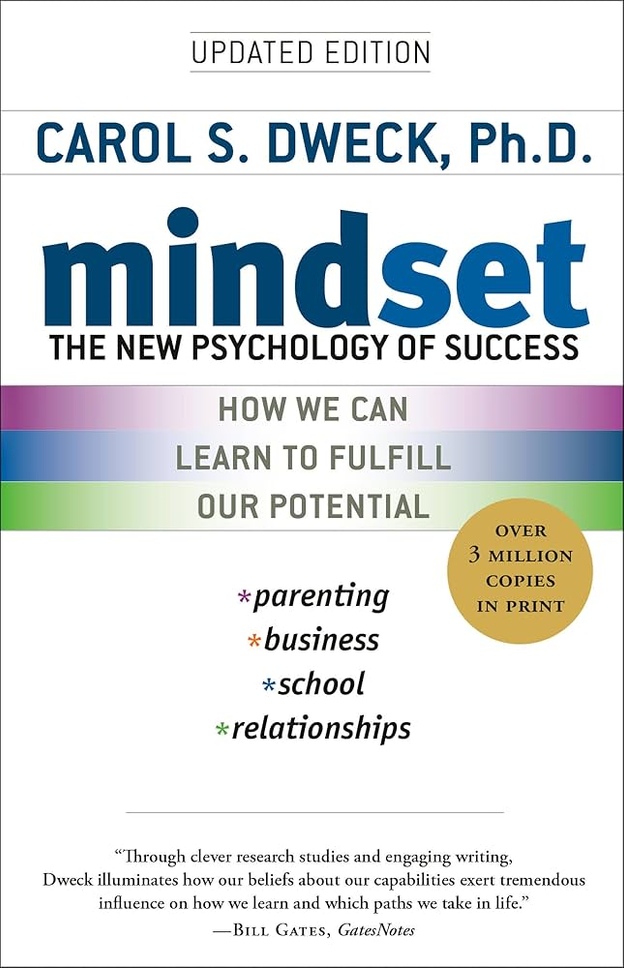
Few ideas have escaped the psychology lab and entered the bloodstream of everyday life as completely as Carol Dweck's growth mindset. Originally published in 2006 and revised in 2016, Mindset is the book that explains the research, illustrates it with case studies from schools to sports to marriages, and offers a deceptively simple reframe of how we think about our own abilities. The concept has been adopted by Silicon Valley, by school districts, by corporate leadership programmes, and by parents trying to figure out how to talk to their children about failure. That kind of ubiquity brings both influence and scrutiny, and the book deserves both.
What the book covers
Dweck, a Stanford psychologist who spent decades studying motivation and achievement, opens with the core distinction. People with a fixed mindset believe their intelligence, talent, and personality are essentially set - you either have it or you do not. People with a growth mindset believe those qualities are buildable through effort, strategy, and practice. The framing sounds simple, and in a sense it is, but Dweck spends the rest of the book showing how much work the distinction does once you start looking for it.
She walks through domain after domain - classrooms, sports, business, relationships, parenting - and in each she shows the same pattern. Fixed-mindset individuals avoid challenges that might expose them, interpret setbacks as evidence of inadequacy, and tend to cap their own growth to protect their self-image. Growth-mindset individuals treat challenge as information, setbacks as data, and effort as the price of getting better. The case studies are memorable - John McEnroe at the peak of his career, a CEO who treated every critique as a personal attack, a tennis coach teaching a struggling kid how to fail - and each makes the abstract framework feel concrete.
The second half of the book moves into application. How do you identify your own mindset triggers? How do you praise a child in a way that builds growth rather than fragility? What does it look like to run a school, a team, or a marriage from a growth-oriented stance? Dweck is careful to note that no one has a pure growth mindset - we are all a mix, and the work is noticing when the fixed version shows up and choosing differently. The revised edition adds a useful chapter on what Dweck calls false growth mindset - the well-meaning but shallow version that has colonised corporate training decks without actually changing much about how organisations behave.
Who should read this
This is for the parent struggling to figure out how to respond to a child's failure, the manager who keeps wondering why their feedback is landing poorly, the perfectionist who cannot separate their performance from their self-worth, and the person who has always secretly believed they are just not a maths person, a creative person, a social person. Dweck's framework is especially useful for anyone whose self-talk has a hard ceiling built into it - the quiet belief that you have already found the limits of what you can do.
It is also, honestly, a useful book for anyone in therapy. A lot of cognitive behavioural work ends up touching on the same territory Dweck maps, and having her framework in your back pocket makes that work land harder.
Strengths and weaknesses
The strength of Mindset is the reframe itself. Whether or not you buy every detail of Dweck's research, the distinction between fixed and growth thinking is genuinely useful - and it is the kind of idea that sticks, which matters more than most popular psychology acknowledges. A concept that readers remember six months later is a concept that has a chance of changing behaviour. Most do not survive that long. This one does.
The weaknesses are worth naming clearly. Since the book's publication, the empirical record on growth mindset interventions has become more complicated than the confident tone suggests. Several high-profile replication attempts have shown smaller effects than the original studies, and a few have failed to find effects at all. This does not invalidate the core distinction, which is well-supported by broader motivational research, but it does mean the dramatic claims about classroom interventions should be read with a pinch of scientific salt. Dweck herself has engaged with these critiques more thoughtfully than most authors in her position, and the revised edition is honest about the complexity. Readers should still know it is there.
A 3.5 feels right. The central idea is durable and genuinely useful; the evidence base on the most dramatic claims is shakier than the book implies. The middle third is repetitive, and a tighter edit would have served the material. Useful, important, imperfect.
Why this matters for mental health
Self-efficacy - the belief that your actions matter and that you can grow - is one of the better-established predictors of mental health outcomes across the board. Fixed mindset thinking functions, functionally, a lot like depressive rumination. It says the game is over before it starts, that effort is humiliating rather than instructive, and that failure is evidence rather than information. Dweck's book offers a language for catching that voice and answering it. For anyone working on their mental health, the growth framing pairs beautifully with cognitive work and behavioural activation. It will not cure a clinical condition, but it will give you a useful counter-voice on the days you need one.
Final verdict
Mindset is a flawed but genuinely important book. The core idea will likely stick with you long after you have forgotten the individual case studies, and the reframe is the kind that quietly changes how you talk to yourself. Read it with an awareness of the scientific debates, skim the repetitive middle, and take the central framework seriously. Few popular psychology books have earned their cultural footprint. This one largely has.