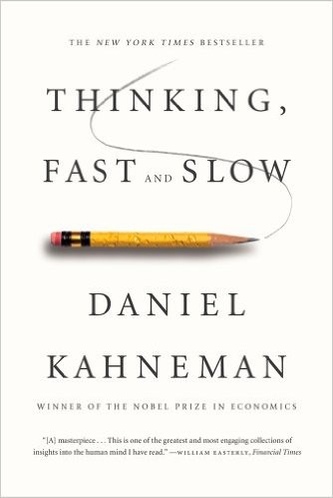
There are very few books that genuinely earn the phrase intellectual event, and Thinking, Fast and Slow is one of them. Daniel Kahneman - a Nobel laureate in economics despite being a psychologist by training, and one of the founding figures of the field that came to be called behavioural economics - spent more than fifty years studying how humans actually make judgments and decisions. The book, published in 2011 when Kahneman was in his late seventies, is his attempt to synthesise that career into a single accessible volume. It is long, demanding, and imperfect. It is also one of the most quietly important popular science books of the last quarter century.
What the book covers
Kahneman organises the book around a simple conceit: your mind runs on two systems. System 1 is fast, automatic, intuitive - it recognises faces, drives familiar routes, completes sentences, and leaps to conclusions. System 2 is slow, deliberate, effortful - it works through a long multiplication problem, considers a complicated decision, or holds several possibilities in mind at once. Most of the time, System 1 runs the show and System 2 signs off on its conclusions without really checking. This sounds trivial. It is not. The rest of the book is an extended tour of what goes wrong when we let fast thinking do work that slow thinking should be doing.
Kahneman walks through the major findings of his career. Anchoring - how an arbitrary number nearby pulls your estimates toward it. Availability - how easily you can bring an example to mind shapes how likely you think it is. Loss aversion - how losing a hundred pounds hurts roughly twice as much as gaining a hundred feels good. Framing - how the exact same decision, described in different words, produces different choices. Each chapter works the same way. Kahneman describes the finding, illustrates it with a clean experiment, and then shows you where you are probably running the same error in your own life.
The final third of the book shifts gears. Here Kahneman moves from decision-making into something more philosophical - the distinction between the experiencing self, which is living through each moment, and the remembering self, which constructs a narrative afterward and is the self that actually makes decisions about the future. This section is quieter than the earlier chapters but in many ways the most interesting. It raises questions about what happiness actually is, whose happiness we are optimising for when we plan a holiday or a career, and why memories of a medical procedure can be almost unrelated to how the procedure actually felt minute to minute.
Who should read this
This is for the reader who wants to understand their own mind better - not in a therapeutic sense, but in a mechanical one. It is for anyone who makes decisions under uncertainty, which is to say, anyone. It is particularly useful for managers, clinicians, investors, teachers, and negotiators, but Kahneman's frame applies equally to the everyday choices most people do not even notice making. If you have ever been surprised by how confidently wrong you were about something, this book will give you a vocabulary for why.
It is not a light read. The book is roughly five hundred pages of dense, example-rich argument, and readers who try to sprint through it come away with less than readers who take it a chapter at a time. Pace yourself.
Strengths and weaknesses
The strength of the book is Kahneman himself. He writes with the unhurried authority of someone who has spent fifty years thinking about these problems, and the prose is clean without being simplified. He is also, unusually for a scientist of his stature, honest about the limits of his own certainty. He tells you when the evidence is strong and when it is thinner, when the effect is robust and when it might be smaller than the confident telling suggests. This intellectual humility is rare and it makes the book more trustworthy, not less.
The weaknesses are now well-documented. The opening chapters on priming - the idea that subtle cues in the environment can shape behaviour in surprisingly large ways - draw heavily on a body of research that has not held up well through the replication crisis. Kahneman himself, to his credit, has publicly acknowledged that he placed too much faith in some of these underpowered studies. The good news is that the core Kahneman-Tversky findings on heuristics and biases, which make up most of the book, have replicated robustly. The bad news is that a reader who does not know the history will take some of the flashier opening examples more seriously than the evidence now warrants. Read the priming chapters with a pinch of salt, and the rest of the book with the seriousness it deserves.
A 4.0 is right. The book is flawed in specific, identifiable ways, and it remains one of the best popular science books ever written. Both things can be true.
Why this matters for mental health
Mental health work is, in many ways, metacognitive work - noticing what your mind is doing and choosing how to respond to it rather than simply running on autopilot. Kahneman's two-system model gives you a clean framework for that noticing. Anxious thoughts, depressive spirals, catastrophising, and many of the thinking traps that CBT targets are all, in Kahneman's vocabulary, System 1 running unchecked. The book is not a self-help manual, and Kahneman would bristle at being filed as one. But the skill it trains - pausing long enough to notice that a fast automatic judgment has just been made - is precisely the skill most therapeutic work is trying to build.
Final verdict
Thinking, Fast and Slow is a book to own, mark up, and return to. It is too long to read in a sitting, too dense to skim, and too important to skip. Read it with awareness of its flaws, pace yourself through the five hundred pages, and come back to it every few years. Few books will change how you think about thinking. This one does.