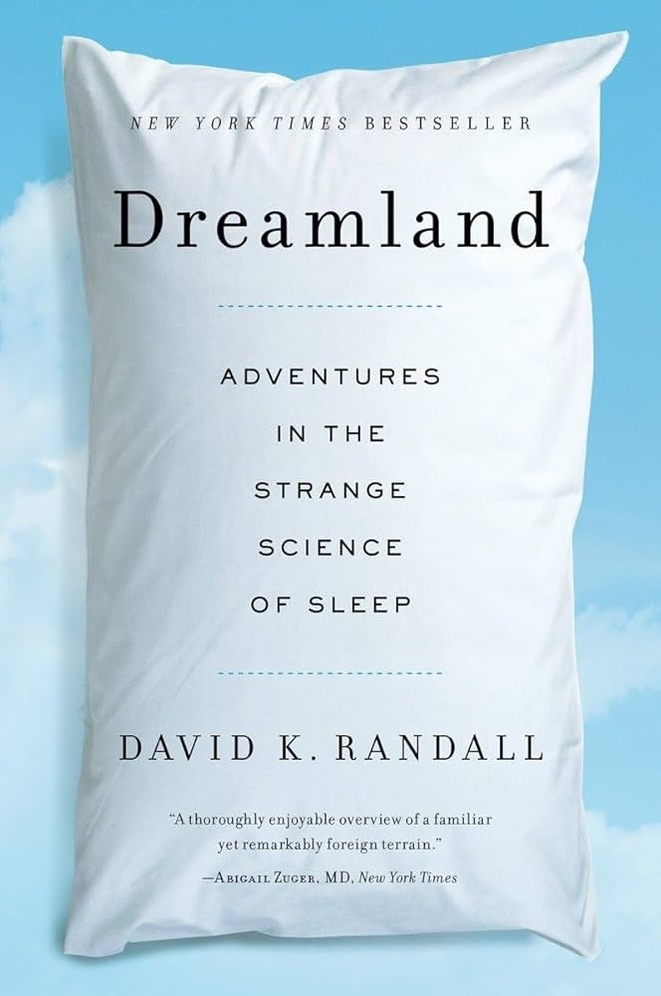
What the book covers
"Dreamland" reads like a conversation with an intelligent friend who's been digging into sleep research. David K. Randall, a journalist, began sleepwalking one night: a collision with a hallway wall sent him on a mission to understand why we sleep and what happens when it goes wrong. This personal trigger becomes the perfect entry point into a fascinating world most of us ignore.
The book unfolds across 13 chapters, each tackling a different slice of sleep science. Randall takes you from Olympic training camps to military bases to children's bedrooms, showing that sleep is far more complex than "just rest." You'll learn why your brain actually needs REM sleep to consolidate memories and spark creativity, why some people commit crimes while sleepwalking (and whether that counts as criminal responsibility), how your circadian rhythms affect your ability to catch a football, and why the siesta isn't just a Spanish luxury: it's a nearly universal human rhythm that modern life has nearly destroyed.
The research feels current and grounded. Randall weaves in studies from sleep labs alongside stories of real people: Olympic athletes who nap strategically, shift workers battling their own biology, kids whose parents are desperately trying to get them to sleep. The book answers practical questions too: how to overcome insomnia without pills, combat snoring, encourage better sleep in children, and even how to predict which football teams will win on Monday nights based on travel fatigue.
What makes this work is that Randall doesn't overwhelm you with jargon. He explains the stages of sleep, dreams, sleep debt, and circadian biology in ways that stick. The narrative moves briskly, which means you won't get lost in technical weeds, though some purists might wish for deeper dives.
Who should read this
If you've ever wondered why you're cranky on Monday mornings, why you dream, or whether your 11 PM coffee is sabotaging your sleep, this book is for you. It's perfect for:
- People struggling with insomnia or poor sleep quality who want to understand the science before trying fixes
- Parents wrestling with their kids' sleep routines
- Anyone interested in how the body actually works
- People who work shift work or travel frequently and want practical strategies
- Those curious about sleep but intimidated by textbooks
This isn't a clinical reference manual: it's science writing at its best. You don't need a biology background. The only requirement is basic curiosity.
Strengths and weaknesses
What works exceptionally well:
Randall's conversational voice is the secret weapon here. He's genuinely curious and doesn't pretend to have all the answers. The personal story, his own sleepwalking and the crash that sent him down this rabbit hole, gives the book stakes. You care about what he finds.
The diversity of examples is also a real strength. You get stories about baseball pitchers optimizing naps, researchers discovering that women sleep differently than men, the history of sleep in human culture, and the surprisingly dark corners of sleep disorders. Each chapter feels distinct. It never feels repetitive.
The practical payoff is significant. By the end, you understand enough to make real changes: going to bed at a consistent time isn't just "good habits," it's respecting your circadian rhythm; napping isn't laziness, it's biological necessity; and sleep debt is real and consequential.
Where it falls short:
Some readers and critics have noted that Randall is lighter on citations than a rigorous academic treatment would be. If you're the type who wants to chase down every study and read the original research, you'll be frustrated. The book prioritizes readability over exhaustive sourcing.
There are moments where the science gets oversimplified. Complex neurochemical processes get reduced to digestible explanations, which is necessary for general audiences but can feel slightly reductive if you have background knowledge.
Finally, while Randall covers a lot of ground, some specific areas could be deeper: the genetics of sleep, for instance, gets less attention than circadian rhythms, and the diversity of research sources cited skews toward certain labs and researchers.
Final verdict
"Dreamland" succeeds at what it sets out to do: make sleep science accessible and persuasive. It won't replace a neuroscience textbook, and it's not meant to. What it does is make you care about sleep in a way you probably didn't before. You'll finish it thinking about your own sleep differently: less as something you have to squeeze into your schedule and more as an essential, non-negotiable biological process.
The 3.7-star Goodreads rating reflects its strength as popular science: most readers find it engaging and useful, but some want more rigor or depth. The book has genuine appeal. NPR called it "a thoroughly enjoyable overview," and Salon praised it as "the most diverting and consistently fascinating book on the topic ever."
If you're looking for an entry point into sleep science that won't feel like work, grab this. It's the rare book that teaches you something real while you're genuinely enjoying the read.
Verdict: A solid, engaging introduction to why we sleep and what modern life gets wrong about it. Best for curious minds who want science that doesn't feel like homework.