What the book covers
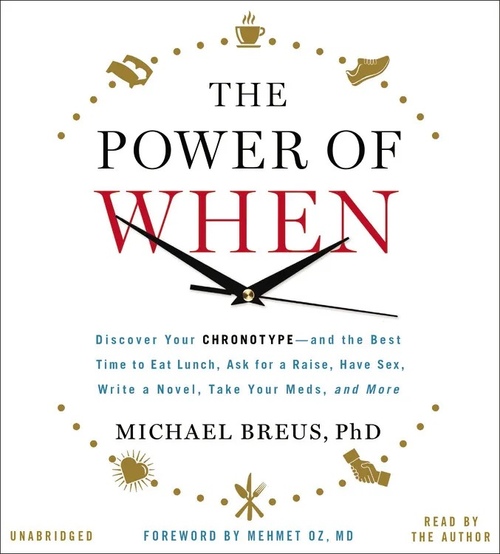
"The Power of When" is Dr. Michael Breus's manifesto for the chronotype-conscious life. The central thesis is refreshingly simple: you're not lazy, unproductive, or broken if you struggle to align with the world's standard schedule. You're just working against your biology.
Breus, a clinical psychologist and sleep specialist with 15+ years in the field, walks you through the science of circadian rhythms and introduces his four-category chronotype system: Bears (about 50% of the population), Lions (15-20%), Dolphins (10%), and Wolves (15-20%). Each type has distinct sleep windows, peak performance hours, and optimal timing for everything from taking your vitamins to having sex.
The core value is practical. After determining your chronotype through a simple quiz, you get specific recommendations for over 50 activities: when to drink coffee (timing matters), when to exercise (different for each type), when to schedule that crucial work meeting or difficult conversation. Breus provides evidence-based timing windows backed by sleep science, hormonal research, and his clinical observations.
The book isn't just theory. It's a manual: organized, digestible, and designed to be consulted repeatedly as you navigate your week. There's even a section on how chronotypes interact in relationships and workplaces, which is oddly useful when you're negotiating with a Wolf partner who doesn't understand why you're exhausted at 9 PM.
Who should read this
This book is for anyone who's ever felt trapped by conventional schedules or suspected their productivity dips at times others seem to peak. If you work a standard 9-to-5 but feel sharpest at midnight, or if you're a natural early riser stuck in a late-starting culture, "The Power of When" speaks directly to your experience.
It's equally valuable for parents trying to understand their kids' sleep resistance, managers wondering why afternoon meetings kill productivity, or anyone battling chronic fatigue and wondering if it's actually just misalignment. People managing sleep disorders, irregular schedules, or shift work will find the underlying science helpful, though the book's prescriptive recommendations work best for those with some schedule flexibility.
If you're skeptical of self-categorization or prefer nuance over typologies, proceed with healthy skepticism. This is a book that trades some complexity for accessibility and actionability.
Strengths and weaknesses
Strengths shine brightest in the book's pragmatism. Breus doesn't just explain circadian science: he immediately tells you what to do with it. The Bio-Time Quiz is intuitive, the four categories feel intuitive (not arbitrary), and the recommendations are specific enough to actually implement. His 15 years of clinical experience grounds the advice in real-world observation, not just lab findings. The writing is warm and conversational, never condescending, and the organization makes it easy to dip in and reference specific sections.
The strongest chapters apply chronotype thinking to common life friction: relationships, work negotiations, exercise timing, meal composition. Breus acknowledges that a Lion's 5 AM wake-time and a Wolf's midnight alertness create genuine friction in shared lives, and he offers practical negotiation frameworks. That alone might improve someone's relationship.
Weaknesses center on execution and oversimplification. The book repeats findings frustratingly often: the same studies about cortisol, melatonin, and alertness cycles appear multiple times, sometimes in nearly identical language. It's as if the editor had a light hand. Some readers will appreciate the reinforcement; others will find it padding.
More substantively, the four-type system, while helpful, can feel constraining. Human biology is messier than Bears, Lions, Dolphins, and Wolves. Genetic variations, medications, stress, shift work, parenting schedules, and cultural pressures all complicate the neat categorization. Breus acknowledges some edge cases but doesn't deeply explore how to adapt his recommendations when your job, family, or health conditions demand flexibility.
The specificity of his recommendations also creates a potential problem: perfect implementation isn't realistic for most people. If you work in an office, have kids, or have any non-standard schedule element, you won't hit every timing window perfectly. The book could do more to help readers prioritize which recommendations matter most or how to optimize within realistic constraints.
Final verdict
"The Power of When" is a genuinely useful book that lands somewhere between pop-science and practical manual, and it executes both roles reasonably well. If you've ever suspected that your circadian rhythm might be at odds with your schedule, or if you're curious about the science of optimal timing, it delivers real value. The chronotype framework is intuitive enough to stick with you, and the recommendations are specific enough to try.
The repetition is annoying, and the typology has limitations, but the underlying premise is sound: your body runs on a clock, and honoring that clock matters. Whether you implement 5% of Breus's suggestions or 50%, you'll likely notice a difference. That's the real power of this book: it's not asking you to overhaul your life, just to make small, intentional changes that align with your biology.
If you're struggling with sleep, productivity, or life-schedule friction, this book belongs on your shelf. If you're just looking for a feel-good wellness read, the repetition might wear thin. But for anyone willing to see their chronotype as useful information rather than a constraint, "The Power of When" offers a refreshing, evidence-based roadmap.
Score: 3.5 out of 5.0. Practical, accessible, and grounded in real sleep science, with the caveats that oversimplification and repetition keep it from being exceptional.