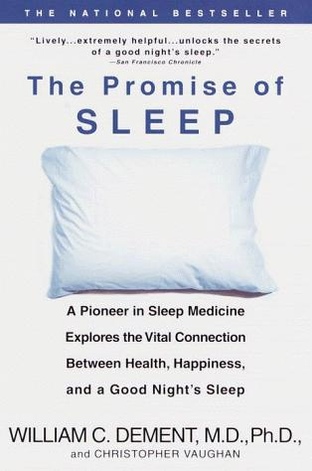
What the Book Covers
William C. Dement was the founding father of sleep medicine: literally. He discovered REM sleep in 1953 and spent five decades at Stanford Sleep Research Center studying what happens when we close our eyes for a third of our lives. The Promise of Sleep is his magnum opus, a sweeping argument that we've been getting sleep wrong.
The book is divided into three main movements. First, Dement walks you through the basic neuroscience of sleep: what it is, why we need it, how our bodies regulate it. He explains the difference between REM and non-REM sleep, circadian rhythms, and the architecture of a healthy night. None of it feels like a textbook: he writes with warmth and humor, occasionally confessing his own sleep struggles.
The middle section tackles sleep disorders head-on: sleep apnea (which can literally kill you in your sleep), insomnia, restless leg syndrome, narcolepsy, sleepwalking. For each, Dement explains what's actually happening in the brain and body, why it matters, and what works to fix it. This is where the book gets personal for many readers: they recognize themselves or a loved one and finally understand why they've been suffering.
The final section is part manifesto, part call-to-arms. Dement argues that modern society has become catastrophically sleep-deprived. He points to the Exxon Valdez disaster, the space shuttle Challenger explosion, and countless traffic accidents all traceable to fatigue. He laments the culture of hustle that treats sleep as laziness, and he marshals evidence that sleep is as important to longevity as diet, exercise, or genetics.
Who Should Read This
If you're struggling with sleep (whether it's waking at 3 a.m., falling asleep in meetings, or your partner says you sound like a broken chainsaw), this book is for you. Dement takes the shame out of sleep disorders and puts the onus on biology, not willpower.
But the book isn't just for the desperate. If you're sleeping "fine" but running on six hours, caffeinated and chronically tired, Dement will make you reconsider what "fine" actually means. If you're curious about how your brain works, or you're interested in science written with real humanity, you'll find it here.
Parents will recognize their teenagers' sleep needs in these pages. Shift workers will see their struggles validated. Anyone who's ever nodded off driving will understand why sleep medicine matters as much as cardiology.
The book is accessible enough for a lay reader but substantive enough that even healthcare providers can learn from it. It's that rare thing: both popular science and legitimate authority.
Strengths and Weaknesses
Strengths: Dement's credibility is unassailable: he literally invented this field. His voice carries the weight of four decades of research plus genuine care for his patients. The writing is conversational and sometimes funny, which is no small feat when discussing narcolepsy and apnea. He peppers the book with striking, memorable facts that stick with you. The diagnosis-and-treatment sections are genuinely useful. And there's real urgency to his message: if even half of what he says about sleep deprivation and its consequences is true, we should all be paying attention.
Weaknesses: The book repeats its central thesis (that we're not sleeping enough and it's killing us) frequently. Some readers finish feeling preached to rather than persuaded. At 528 pages, it's dense; you can't skim it. And the publication date (1999) shows in places. Dement discusses treatments and statistics that have been superseded by newer research. The book reads more as passionate advocacy than as an exhaustive clinical reference, if you want the latest on, say, specific medications for restless leg syndrome, you'll need to look elsewhere.
There's also a quality-of-writing variability. Dement is a sleep scientist, not a professional writer, and sometimes the prose feels workmanlike. But this also gives the book authenticity: you're hearing from the guy who actually discovered REM sleep, not a ghostwriter polishing his thoughts.
Final Verdict
The Promise of Sleep is a landmark book that deserves its reputation. It's not the most beautifully written book you'll read, and it's not the most current: the field has moved on in some respects. But it remains the most authoritative, most human, and most urgently relevant exploration of why sleep matters. Dement writes like someone who has spent his entire professional life trying to convince the world of something obvious: we need sleep. Really, truly, non-negotiably need it.
If you struggle with sleep, this book may change your life. If you think you're fine on six hours, it will unsettle you. And if you've ever wondered why you're so tired despite "getting enough rest," Dement has answers. The writing may not be polished, and the science may not be bleeding-edge current, but the core argument is bulletproof: sleep is not a luxury. It's infrastructure. And we've been neglecting ours.
Read this if: You suspect you have a sleep disorder. You're curious about sleep science from the person who literally founded the field. You want to understand why our 24/7 culture is slowly killing us.
Skip this if: You want only the latest 2020+ research. You prefer highly literary science writing. You're looking for a quick self-help book: this is a commitment.