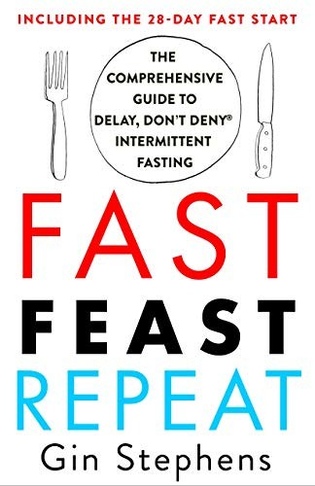
Fast. Feast. Repeat. is the 2020 book that took Gin Stephens from a popular blog and podcast host into the nutrition-book mainstream. Stephens is not a clinician - she is a former teacher who built her platform through her own intermittent-fasting experience and a large, active online community - and the book has the strengths and weaknesses that come with that background. It is warm, practical, and unusually attentive to the lived experience of trying to fast. It is also, in places, more confident about the specific physiological benefits of fasting than the current evidence supports. A Mind Wobble review has to hold both honestly.
What the book covers
Stephens's central premise is that when you eat matters as much as what you eat, and that time-restricted eating - confining food intake to a defined window and fasting through the rest of the day - is a sustainable, flexible approach to both weight management and general health. The book walks through the major fasting patterns (sixteen-eight, eighteen-six, one-meal-a-day, alternate-day fasting) and spends most of its practical chapters on a twenty-eight-day protocol called the FAST Start, designed to transition a reader from three-meals-a-day eating into a fasting rhythm they can sustain. The protocol is gradual, forgiving, and structured in a way that most readers can actually complete.
The second half of the book is a tour through the claimed benefits of fasting. Weight loss, improved metabolic flexibility, reduced inflammation, autophagy (the cellular cleanup process that has become the fasting community's favourite mechanism), improved insulin sensitivity, better sleep, clearer cognition, and a long list of secondary effects. Stephens draws heavily on the work of Jason Fung, Satchin Panda, and Valter Longo, mixing peer-reviewed research with anecdotes from her community. The tone is conversational, the stakes are framed generously, and the book is clearly built to keep a reader engaged rather than to survive independent scrutiny.
Where the science stands
Intermittent fasting is a legitimate tool with a real, if modest, evidence base. Time-restricted eating has been shown in randomised trials to produce weight loss comparable to simple calorie restriction, largely because narrowing the eating window tends to reduce overall intake without requiring conscious calorie counting. For some people this is easier to sustain than traditional dieting, and that alone is a meaningful benefit. Eating later into the evening has been associated with worse glycaemic and cardiometabolic outcomes, and shifting the eating window earlier has some modest independent effects.
Beyond this core, the evidence gets thinner. The autophagy claims that have become central to popular fasting discourse rest mostly on animal studies, on cellular-level work, and on a small number of human studies that do not clearly show the cellular-renewal effects the popular version of the story implies. The metabolic switching narrative is more plausible than definitive. Some of the stronger claims about insulin resistance and fasting - many of which trace back to Jason Fung - run ahead of what the randomised-trial evidence supports. Stephens does cite the research, but selectively, and with more certainty than a cautious reading of the literature would allow.
The other honest concern is population fit. Fasting is probably not the right tool for everyone. Readers with a history of disordered eating, pregnant or breastfeeding readers, readers with type 1 diabetes or other conditions affecting glucose regulation, and readers on certain medications should either avoid fasting or undertake it with clinical supervision. The book does mention these caveats but in a lighter register than the subject deserves.
Who should read this
This is for the reader curious about intermittent fasting who wants a friendly, practical introduction and is comfortable filtering the stronger claims against other sources. For the person who has tried conventional dieting and found the constant food-logging exhausting, and who suspects that a simpler structure - eat in this window, do not eat outside it - might be easier to sustain. For the reader who values community; the Delay, Don't Deny platform and associated Facebook groups are a substantial part of the appeal here, and the book slots into that ecosystem rather than standing alone.
It is not the right book for a reader with a history of restrictive or disordered eating, for whom adding a fasting window can reinforce patterns that are already unhelpful. Nor is it the book for a reader who wants a sober scientific tour. For that, Satchin Panda's The Circadian Code and Mark Mattson's academic work are better grounded, and will leave you with a more accurate picture of where the evidence currently sits.
Strengths and weaknesses
The strengths are accessibility and community. Stephens is a warm, direct writer, the FAST Start protocol is a sensible four-week on-ramp, and the book is effective at keeping a reader engaged long enough to actually try the approach. For the right reader, that is a real contribution - a lot of nutrition advice fails because people never get past the first week, and this book is well-designed to get people there. The practical tips on dealing with hunger, social pressure, work situations, and the first uncomfortable days are all drawn from a lot of lived experience and are useful.
The weaknesses are the familiar ones of the popular nutrition genre. Specific mechanistic claims - autophagy, metabolic switching, insulin signalling - are presented with more certainty than the evidence supports. The Jason Fung lineage shows in the treatment of insulin, which leans harder on a particular model than the current research justifies. The book underweights the risks for readers with disordered-eating history, which is a real and not uncommon population. And the community framing, while a strength for many readers, can tip into the kind of food-identity thinking that is not always healthy in the long run.
A 3.0 is right. The practical value is real, the FAST Start works for many readers, and the overreach on specific mechanisms and the underweighting of the disordered-eating risk pull the overall recommendation down from where a more cautious version of the same book would sit.
Why this matters for mental health
The relationship between fasting and mental health is genuinely mixed. For some readers, a structured eating window can reduce the cognitive load of constant food decisions and support a calmer relationship with eating. For others - particularly readers prone to perfectionism, anxiety, or disordered eating - the same structure can reinforce rigidity and unhelpful food identity. The evidence on fasting and mood is early and limited, with some short-term reports of clearer focus and better energy once the initial adjustment passes, but not enough long-term randomised-trial data to make strong claims. For the Mind Wobble reader considering fasting, the most important question is not whether fasting can work, but whether it is a healthy fit for you specifically - and the honest answer to that question lives outside this book.
Final verdict
Fast. Feast. Repeat. is a useful on-ramp to a legitimate tool, surrounded by oversold specifics. If you are the right reader - curious, emotionally steady around food, willing to try a structured window for a month - the book will serve as a practical starting point, and the FAST Start is a reasonable way to begin. Pair it with Satchin Panda's The Circadian Code for a better-grounded version of the underlying science, and pay attention to how your body and your mood respond. Used this way, the book earns its place. Taken uncritically, it promises more than the research can deliver.