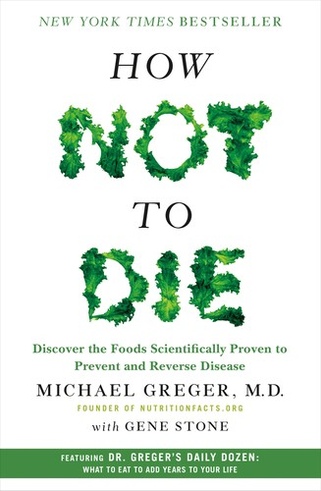
How Not to Die is the maximalist version of the plant-based nutrition argument. Michael Greger, a physician and the founder of the NutritionFacts.org website, published it in 2015 with Gene Stone, and at 576 pages with thousands of references it is one of the most densely cited nutrition books in print. The book walks through the fifteen leading causes of death in the United States and argues, for each one, that a whole-food plant-based diet can prevent, arrest, or reverse the disease in question. It then provides a practical framework - the Daily Dozen, a checklist of food groups to include every day - that serves as a usable distillation of the argument. The book has sold enormously well and has become the reference text for the evidence-based wing of the vegan movement. It is also more selectively framed than the enormous bibliography suggests, and a Mind Wobble review has to engage with that honestly.
What the book covers
The first half of the book is organised by disease. Heart disease, lung disease, brain disease, digestive cancers, infections, diabetes, high blood pressure, liver disease, blood cancers, kidney disease, breast cancer, suicidal depression, prostate cancer, Parkinson's disease, and iatrogenic causes. For each, Greger surveys the epidemiological, clinical, and mechanistic evidence linking dietary patterns to disease outcomes, and in each case the conclusion is the same: a whole-food plant-based diet is protective, and animal products in various forms are implicated. The citations are extensive, the prose is energetic, and the book reads like a very long, very enthusiastic medical lecture.
The second half pivots to the practical. Greger introduces the Daily Dozen - a checklist of food categories to include every day: beans, berries, other fruit, cruciferous vegetables, greens, other vegetables, flaxseeds, nuts and seeds, herbs and spices, whole grains, beverages, and exercise. The Daily Dozen is the most practically useful part of the book, and it has become widely adopted even by readers who do not follow Greger's diet in full. As a simple heuristic for ensuring dietary diversity, it works.
Where the science stands
The density of citations creates an impression of overwhelming evidence, and in one sense it is accurate - there is an enormous amount of observational and mechanistic research linking plant-rich diets to better health outcomes. Where the critique begins is in the curation. Greger consistently presents the evidence that supports the plant-based position prominently and minimises or omits evidence that complicates it. Studies showing benefits of moderate animal-product consumption, populations that include animal products and have excellent health outcomes (the Mediterranean pattern, several Blue Zones populations), and the methodological limitations of the observational evidence he relies on are all under-represented.
The subtitle - Discover the Foods Scientifically Proven to Prevent and Reverse Disease - is a stronger claim than the evidence supports. Observational studies show associations, not proof. The randomised trials that exist (the PREDIMED family, the SMILES trial) support a diet that is plant-heavy but not exclusively plant-based. And the clinical studies on disease reversal (Dean Ornish's work on heart disease, for example) involved comprehensive lifestyle changes - exercise, stress management, social support - alongside dietary change, making it difficult to attribute the effect to diet alone.
None of this means the core advice is wrong. A diet centred on whole plant foods, legumes, vegetables, fruit, whole grains, nuts, and seeds is very well-supported by the broadest reading of the evidence. The question is whether the evidence supports the further claim that all animal products are harmful and should be eliminated entirely, and on that specific point the picture is considerably more mixed than the book suggests.
Who should read this
This is for the reader who wants a comprehensive, disease-by-disease tour of the plant-based evidence and is comfortable with the advocacy framing. For the reader already inclined towards a vegan or near-vegan diet who wants the scientific case laid out in full. For anyone who wants the Daily Dozen as a practical framework - it is worth the book on its own.
It is less useful for a reader who wants a balanced assessment. Greger is a passionate advocate, and the book is structured accordingly. Readers who want the plant-heavy message with better methodological balance should look to The Diet Myth, which covers similar ground with more honesty about the limits of the evidence.
Strengths and weaknesses
The main strength is scope and reference density. No other popular nutrition book covers as many diseases with as many citations. The Daily Dozen is a genuinely useful practical tool. Greger is a real physician-researcher who engages with the primary literature rather than summarising secondary sources, and the book reflects a depth of reading that most popular nutrition writers cannot match.
The weaknesses are in the framing. The evidence is curated to build a case rather than surveyed to find the truth. The impression of scientific certainty the dense bibliography creates is not matched by the actual state of the evidence, which is more debated than the book lets on. The relentless optimism - the sense that diet can fix almost anything - may serve some readers well but will lead others to overestimate what dietary change alone can accomplish. And for the reader prone to dietary absolutism, the book can reinforce the kind of all-or-nothing thinking that is not always healthy.
A 3.0 is right. The core advice is sound, the Daily Dozen is excellent, and the selective framing and overconfident claims prevent a higher score.
Why this matters for mental health
Greger includes a chapter on depression, which makes the book one of the few popular nutrition volumes to address mental health directly. The evidence he cites - linking plant-rich diets to lower rates of depression and better mood outcomes - is real and aligns with the broader nutritional-psychiatry literature. The SMILES trial, the PREDIMED findings on depression, and the observational work on diet and mood all support a pattern that is plant-heavy and minimally processed. The caution for the Mind Wobble reader is the same as elsewhere: the evidence supports a plant-heavy diet, not necessarily a plant-exclusive one, and the absolutist framing can create dietary anxiety that undermines the mental health benefits the diet itself might provide.
Final verdict
How Not to Die is the encyclopaedia of the plant-based evidence case - dense, impressive, and more selectively argued than the bibliography implies. Take the Daily Dozen, which is excellent. Take the emphasis on whole plant foods, which is well-supported. Hold the stronger claims about animal products with appropriate scepticism, and read alongside The Diet Myth or Food Rules for a more balanced perspective. Used this way, the book is a genuine resource. Taken uncritically, it tells you less than it appears to.