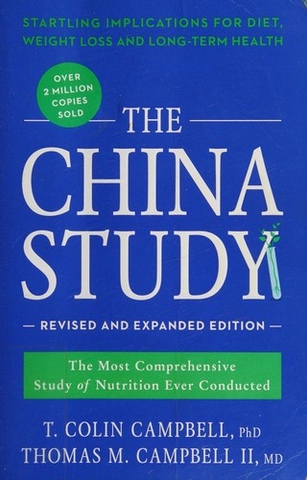
The China Study is the book that built the intellectual foundation of the modern whole-food plant-based movement. T. Colin Campbell, a nutritional biochemist at Cornell who spent decades studying the relationship between diet and disease, co-wrote it with his son Thomas in 2005, and the revised and expanded edition followed in 2016. The book draws on the China-Cornell-Oxford Project - a large-scale ecological study of diet and disease across rural China conducted in the 1980s - alongside Campbell's own laboratory work on casein and cancer growth, to argue that a whole-food plant-based diet is the optimal human diet and that animal protein in any significant quantity is a driver of cancer, heart disease, and chronic illness. The book has sold over a million copies and been cited by every major plant-based advocate since. It has also been methodologically contested by epidemiologists, nutritional scientists, and independent analysts in ways the book does not adequately address.
What the book covers
Campbell's argument unfolds in three parts. The first traces his own research journey, from early work on aflatoxin and liver cancer in the Philippines through his laboratory studies showing that casein (the primary protein in milk) could promote tumour growth in rats under specific experimental conditions. The second is the China Study itself - the China-Cornell-Oxford Project, which collected dietary, lifestyle, and disease data from sixty-five counties across rural China and analysed the correlations between them. The third is a broader argument, drawing on additional research, that a whole-food plant-based diet is protective against cancer, heart disease, diabetes, autoimmune conditions, and a wide range of other chronic diseases, and that animal protein is causally implicated in all of them.
The book is ambitious in scope. Campbell does not argue merely that eating more plants is good - a position the evidence strongly supports - but that animal protein in any meaningful quantity is harmful, that the mechanisms linking it to disease are well-established, and that the medical and nutritional establishments have failed to act on this evidence because of industry influence and institutional inertia. The tone is confident, the claims are sweeping, and the book has the feel of a researcher who believes he has found something important and is frustrated that the world has not listened.
Where the science stands
The China-Cornell-Oxford Project is a genuine achievement of nutritional epidemiology, and Campbell deserves credit for the scale and ambition of the research. The critique is not of the data collection but of the conclusions drawn from it. Ecological studies - which compare populations rather than individuals - are useful for generating hypotheses but are among the weakest designs for establishing causation, because they are subject to a long list of confounding variables that cannot be controlled. Campbell treats the ecological correlations in the China data as more definitive than this design permits.
Independent analysts who have examined the same dataset have reached more mixed conclusions. Denise Minger's detailed statistical re-analysis, published online in 2010, found that many of the correlations the book emphasises either weaken or reverse when additional variables are included, and that some of the strongest correlations in the data point in the opposite direction of Campbell's thesis. Academic epidemiologists have made similar points more quietly: the data is interesting, but it does not demonstrate what the book claims it demonstrates.
The laboratory work on casein and cancer is real but more specific than the book implies. Casein promoted tumour growth under particular experimental conditions (high doses, after aflatoxin initiation, in rat models). Extrapolating from this to a population-wide claim about all animal protein and all cancer is a larger leap than the evidence supports. Other animal proteins tested in similar models did not produce the same effects, and the human evidence is substantially more complicated than the rat models.
The broader claim - that a whole-food plant-based diet is optimal - is partially supported by independent evidence. Populations eating plant-heavy diets do tend to have lower rates of many chronic diseases. But disentangling plant-heavy from other factors (lower smoking, more physical activity, less processed food, different socioeconomic conditions) is methodologically difficult, and the evidence does not support the strong version of the claim - that any animal protein is harmful at any dose.
Who should read this
This is for the reader who wants to understand the intellectual origins of the plant-based movement and is prepared to read critically. For the reader who is considering a plant-based diet and wants to understand the strongest case for it, alongside its limitations. For anyone interested in nutritional epidemiology and the challenges of drawing causal conclusions from observational data.
It is not the right book for a reader looking for a balanced assessment. Campbell is an advocate, not a referee, and the book is structured accordingly. Readers who want the plant-heavy message with better methodological grounding should look to The Diet Myth or the Mediterranean-diet literature, both of which support a substantially plant-based pattern without the absolute claims about animal protein.
Strengths and weaknesses
The strength is scope. Campbell draws on a genuinely impressive range of research, and the book covers more ground than almost any other single nutrition volume. The emphasis on whole plant foods as the foundation of a healthy diet is well-supported and aligns with the strongest independent evidence. Campbell is also a genuine researcher, not a popular-science tourist, and the book reflects decades of serious work.
The weaknesses are methodological. The ecological-study design of the China-Cornell-Oxford data cannot support the causal conclusions the book draws. The casein-cancer extrapolation goes beyond the experimental evidence. The broader argument is structured as advocacy rather than as a balanced assessment, and evidence that complicates the thesis is either minimised or absent. Independent re-analyses have found the picture more mixed than the book implies.
A 2.5 is right. The book is intellectually ambitious and historically important. The conclusions drawn exceed what the evidence supports, and readers who take the strongest claims at face value will end up with a more confident picture than the data warrants.
Why this matters for mental health
A plant-heavy whole-food diet is well-supported by the nutritional-psychiatry literature for mood, anxiety, and cognitive health. The SMILES trial, the PREDIMED work, and the broader Mediterranean-diet research all support a pattern that is rich in plants, minimally processed, and moderate in its inclusion of animal products. Where the mental-health concern arises with The China Study specifically is in the absolutism. An all-or-nothing framework around animal protein can create the kind of dietary identity and food anxiety that is counterproductive for mental health, particularly for readers already prone to rigid thinking about food. For the Mind Wobble reader, the useful takeaway is the emphasis on whole plant foods. The absolute claim about animal protein is less helpful and less well-supported.
Final verdict
The China Study is a book to read for context rather than to follow as gospel. It tells you where the plant-based movement came from and what the strongest version of its argument looks like. It does not give you a balanced picture of the evidence, and readers who want that should look elsewhere. Take the plant-heavy emphasis, which is sound. Hold the absolute claims about animal protein with the scepticism they deserve. And pair this book with The Diet Myth, Food Rules, or the Blue Zones literature for a more complete and more honest map of the nutrition landscape.