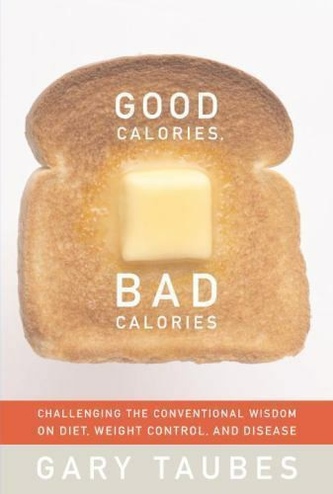
Good Calories, Bad Calories is the book that launched a thousand low-carb arguments. Gary Taubes, a science journalist with a track record of long-form investigative work, published it in 2007 to immediate controversy. At 640 pages of densely argued revisionist history, it set out to dismantle the consensus that dietary fat was the primary driver of obesity and heart disease, and to replace it with an alternative hypothesis centring carbohydrates and insulin. The book was praised by some researchers as a much-needed corrective and attacked by others as a selectively argued polemic. Nearly two decades later, it remains the intellectual origin text of the modern low-carb movement - and a book that subsequent research, including studies Taubes himself helped fund, has partially undermined. A Mind Wobble review has to hold both of those facts at once.
What the book covers
Taubes's project is enormous in scope. The first half of the book is a forensic history of how the low-fat dietary consensus was established in the United States between the 1950s and the 1980s. Taubes traces the political, institutional, and scientific dynamics that led Ancel Keys's diet-heart hypothesis - the idea that dietary saturated fat raises cholesterol, which causes heart disease - to become national policy despite, Taubes argues, evidence that was considerably weaker than the policy implied. This historical section is the strongest part of the book. The story of how a hypothesis with genuine evidential gaps became enshrined in dietary guidelines through a combination of institutional momentum, strong personalities, and political expediency is a genuinely important piece of science history.
The second half builds Taubes's alternative. Carbohydrates, not fat, are the primary driver of obesity, heart disease, diabetes, and a range of other chronic conditions. The mechanism is insulin: dietary carbohydrates elevate blood sugar, which elevates insulin, which drives fat storage and inhibits fat burning. The corollary is that a low-carb, higher-fat diet should be the default for health, and that the population-wide shift to low-fat, high-carb eating that followed the dietary guidelines has been a catastrophic public-health error.
The argument is presented with extraordinary detail. Taubes cites hundreds of studies, walks through the biochemistry in real depth, and constructs a narrative that is internally coherent and, for many readers, convincing. The prose is dense but clear, and the book rewards careful reading even when one disagrees with the conclusions.
Where the science stands
The historical critique has held up reasonably well. The low-fat consensus was indeed built on evidence weaker than its proponents claimed, and the subsequent decades have broadly supported the view that dietary fat per se is a less important driver of chronic disease than was believed in the 1980s. This is now mainstream rather than controversial, and Taubes deserves some credit for saying it early and loudly.
The alternative hypothesis has fared less well. The carbohydrate-insulin model of obesity has been tested more directly in the years since the book was published, and the results have been mixed at best. The NuSI initiative, which Taubes co-founded specifically to fund rigorous testing of the hypothesis, produced studies (notably Kevin Hall's metabolic-ward trials) that did not support the strong version of the insulin model. Low-carb diets produce weight loss, but not through the specific insulin-mediated mechanism Taubes describes, and not meaningfully more than isocaloric diets with different macronutrient compositions when food intake is carefully controlled. The energy-balance model Taubes attacks turns out to be more resilient than he predicted, even if it is not the whole story.
Taubes has also been criticised for selective citation. Researchers whose work is cited in the book have pointed out that Taubes emphasises findings that support his thesis and minimises or omits findings that complicate it. This is a common problem in popular science, but it matters more in a book that frames itself as a corrective to exactly this kind of selectivity in the opposing camp.
Who should read this
This is for the intellectually ambitious reader who wants to understand how the low-carb movement got started and why the nutrition-science establishment became so polarised. For the reader interested in the politics and sociology of science as much as in the science itself. For anyone who wants the full-length version of the argument that Taubes later condensed into the more accessible Why We Get Fat.
It is not the right book for a general reader looking for practical dietary guidance. At 640 pages it is an enormous commitment, and the practical take-home (eat fewer refined carbohydrates) does not require the full historical apparatus to justify. Readers who want the argument without the depth should read Why We Get Fat instead. Readers who want the most current and balanced picture of obesity science should read Stephan Guyenet's The Hungry Brain, which engages with many of the same questions from a broader evidential base.
Strengths and weaknesses
The strength is the history. Taubes is a skilled investigative journalist, and the first half of the book is as good a piece of science-policy history as the nutrition genre has produced. The story of how the low-fat consensus was built is genuinely worth understanding, and Taubes tells it with detail and force.
The weaknesses are in the second half. The alternative hypothesis is presented as more settled than it is. The evidence is curated to build a case rather than surveyed to find the truth. And the book's own standard - that scientific consensus should be based on rigorous evidence rather than institutional momentum - has been turned against it by subsequent research that has not confirmed the strong insulin model.
A 2.5 is right. The book is intellectually important and historically valuable, and the central alternative hypothesis has not held up as well as Taubes predicted. Read it for the history. Hold the prescription lightly.
Why this matters for mental health
The practical advice embedded in the book - eat fewer refined carbohydrates, eat more whole foods, be sceptical of processed low-fat products - aligns with what the nutritional-psychiatry literature supports. Diets high in ultra-processed carbohydrates have been associated with worse mental health outcomes, and replacing them with whole foods tends to improve mood and energy. The concern, as with several books on this list, is not the practical advice but the theoretical framework. A single-cause model of a complex condition can create the kind of rigid, all-or-nothing dietary thinking that is itself a risk factor for poor mental health. For the Mind Wobble reader, the useful kernel is the dietary advice, not the comprehensive theory.
Final verdict
Good Calories, Bad Calories is an intellectually ambitious book that is more valuable as history than as science. The critique of the low-fat consensus is durable and worth reading. The alternative hypothesis is provocative but has been partially undermined by subsequent research. Read it if you want to understand how the nutrition wars began. Do not treat it as the final word on what to eat - the field has moved on, and the balanced picture is available elsewhere.