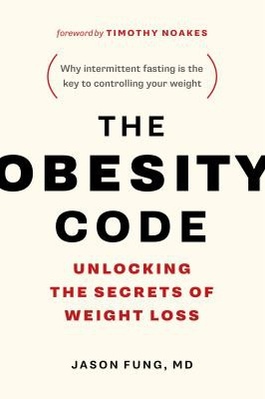
The Obesity Code is Jason Fung's bestselling argument that obesity is fundamentally a hormonal problem rather than a caloric one, and that the key hormone is insulin. Fung, a Canadian nephrologist who treats patients with kidney disease and the metabolic conditions that often accompany it, published the book in 2016 to substantial commercial success and has since become one of the most visible voices in the fasting and low-carb communities. The book is readable, well-structured, and genuinely thought-provoking in places. It is also more contested than its confident tone suggests, and a Mind Wobble review has to engage with that gap honestly.
What the book covers
Fung opens with a systematic demolition of the calories-in-calories-out model of obesity - the idea that weight gain is simply the result of eating more than you burn. He argues, with some force, that this model is incomplete. It cannot explain why different macronutrients produce different metabolic responses. It cannot explain why some people gain weight on diets that leave others lean. It cannot explain the consistent failure of calorie-restriction diets over the long term. On these points, Fung is broadly right, and the early chapters are among the book's strongest.
From this foundation, Fung builds an alternative model. Obesity, he argues, is primarily driven by chronically elevated insulin. Foods that spike insulin - refined carbohydrates, sugar, frequently consumed meals - drive fat storage and maintain it. The solution, therefore, is to lower insulin: eat fewer refined carbohydrates, eat less frequently, and fast periodically to give insulin levels time to drop. The book walks through the hormonal mechanisms in accessible detail, cites a range of research, and arrives at a practical prescription centred on intermittent fasting, reduced carbohydrate intake, and whole-food eating.
The second half of the book is a tour through the fasting evidence and practical guidance on how to implement it. Fung draws on historical and observational data on fasting practices, short-term clinical data, and anecdotes from his own practice. The tone throughout is confident and clear, and the book is effective at making a complex metabolic argument feel intuitive.
Where the science stands
The insulin model of obesity is a real hypothesis with real scientific proponents, and Fung is right that insulin plays a genuine and under-appreciated role in fat storage and appetite regulation. Where the book runs into trouble is in the distance between insulin plays a role and insulin is the primary driver. The mainstream obesity-research community - including researchers who take insulin seriously - considers the picture considerably more complicated than Fung presents it. Kevin Hall's metabolic-ward studies at the NIH, for example, have directly tested the insulin model and found that low-carb diets do not produce meaningfully more fat loss than isocaloric low-fat diets when food intake is carefully controlled, which is difficult to square with a model in which insulin is the primary driver.
Fung also tends to present the evidence selectively. Studies that support the insulin thesis are cited prominently; studies that complicate it are mentioned briefly or not at all. The fasting evidence is presented with more certainty than the randomised-trial base supports, particularly for the long-term outcomes that matter most. And the calorie model is attacked as if it were the whole of mainstream obesity science, when in practice most researchers hold a more nuanced position that includes hormonal, neural, environmental, and behavioural components alongside energy balance.
None of this means the book is without value. The practical advice - reduce refined carbohydrates, eat whole foods, avoid constant snacking, consider time-restricted eating - is broadly sensible and will serve most readers well. The question is whether you need the specific theoretical framework to arrive at that advice, and the answer is probably not.
Who should read this
This is for the reader interested in the insulin model of obesity who wants an accessible introduction and is prepared to read the pushback alongside. For the reader who has tried calorie counting and found it miserable and ineffective, and who is looking for an alternative framework. For anyone curious about why the low-carb and fasting communities have coalesced around this particular model.
It is less useful for a reader who needs the balanced picture. For that, Stephan Guyenet's The Hungry Brain gives a more multi-causal and evidence-careful account of why we overeat. For the reader who wants fasting-specific advice, Satchin Panda's The Circadian Code is more carefully grounded. And for the reader who wants to understand the food environment that makes all of this harder, Salt Sugar Fat tells the other half of the story.
Strengths and weaknesses
The strengths are accessibility and provocation. Fung writes clearly, the arguments are well-structured, and the early chapters on the failures of the calorie model are genuinely compelling. The book is effective at shaking a reader loose from the assumption that weight management is simply about eating less and moving more, which is a useful thing to shake.
The weaknesses are in the gap between the provocation and the evidence. The insulin model is presented as the answer rather than as a model with significant explanatory power and significant gaps. The evidence is curated rather than surveyed. The fasting prescription is stated with more confidence than the trial base supports. And the book, by focusing so tightly on insulin, misses the environmental, psychological, and neural dimensions of obesity that are at least as important for most readers.
A 2.5 is right. The book is thought-provoking and contains a useful corrective to simplistic calorie thinking. It is also more one-sided than the evidence supports, and readers who take it as the complete picture will end up with a distorted map of a complicated territory.
Why this matters for mental health
The relationship between metabolic health and mental health is genuine. Insulin resistance has been associated with higher rates of depression and cognitive decline, and diets that improve metabolic markers tend to improve mood and energy alongside. The practical advice in the book - eat whole foods, reduce refined carbohydrates, consider time-restricted eating - aligns with what the nutritional-psychiatry literature supports. The concern for the Mind Wobble reader is the framing, not the advice. A model that reduces a complex, multi-causal condition to a single hormone can produce the kind of rigid, all-or-nothing thinking that is not good for mental health. Take the practical advice. Hold the theoretical framework lightly.
Final verdict
The Obesity Code is a useful provocation wrapped in more certainty than the evidence supports. Read it for the challenge to calorie-counting orthodoxy, which is a real and worthwhile challenge. Read it alongside The Hungry Brain for the more complete picture. Take the practical advice on whole foods and reduced refined carbohydrates, which is sound. And hold the insulin-is-everything framework with the same scepticism you would apply to any single-cause model of a complex condition.