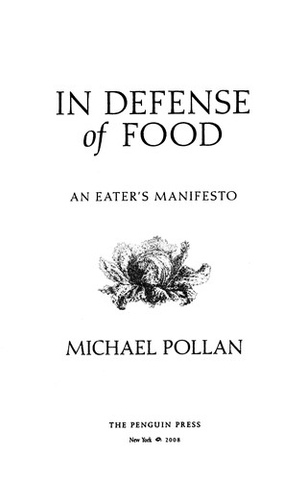
In Defense of Food is Michael Pollan's answer to the question his previous book raised. The Omnivore's Dilemma showed where our food comes from and how the industrial food system works. In Defense of Food, published two years later, asks the next question: given all of that, what should we actually eat? Pollan's answer has become one of the most quoted sentences in food writing: Eat food. Not too much. Mostly plants. The rest of the book is, in Pollan's words, an elaboration of those seven words - and the elaboration turns out to be one of the most original and durable contributions to the nutrition conversation in decades.
What the book covers
Pollan's central argument is not about nutrients, macros, or supplements. It is about an ideology he calls nutritionism - the reductive habit of thinking about food in terms of its individual chemical components (fat, carbohydrates, vitamins, antioxidants) rather than as whole foods embedded in cultures, traditions, and ecosystems. Nutritionism, Pollan argues, has been the dominant framework of the American food conversation since at least the 1980s, and it has made us less healthy rather than more. By reducing food to nutrients, it has opened the door for the food industry to engineer products that satisfy nutritional check-boxes while bearing no resemblance to the foods human beings evolved to eat. Low-fat cookies. Fortified breakfast cereals. Vitamin-enhanced water. The supermarket is full of products that are nutritionally optimised on paper and metabolically disastrous in practice.
The alternative Pollan proposes is to stop thinking about nutrients entirely and start thinking about food. Real food - the kind your great-grandmother would recognise, the kind that does not arrive with a health claim on the package, the kind that has been part of some human food culture for generations. The book walks through the history of nutritionism, the political dynamics that produced the low-fat era, the failure of nutrient-level thinking to improve public health, and the evidence that traditional food cultures - whether Mediterranean, Japanese, French, or any number of others - have sustained human health in ways the industrial diet has not.
The second half of the book is practical. Pollan offers a set of heuristics for navigating the food environment: eat food that will eventually rot, avoid products with ingredients you cannot pronounce, shop the perimeter of the supermarket, pay more and eat less, eat meals rather than snacks, eat at tables rather than in cars. These heuristics were later distilled into Food Rules, but they appear here in a longer, more argued form with the intellectual context that makes them stick.
Who should read this
Everyone who reads nutrition books should read this one first, or at least early. It is the book that reframes the conversation from what nutrients should I eat to what food should I eat, and that reframing is more useful than any macronutrient calculation. For the reader confused by contradictory nutrition advice, this is the book that explains why the advice is contradictory and offers a way out that does not require a PhD in biochemistry.
It is also the book to read if you have just finished one of the more partisan entries on the nutrition shelf - Grain Brain, The China Study, The Obesity Code - and want to step back to a level of analysis that does not depend on any particular macronutrient theory. Pollan's framework is compatible with almost any whole-food diet, which is its strength.
It is less useful for the reader who wants a specific meal plan or the reader who wants a deep tour of the clinical evidence. For those readers, Food Rules (the short practical version) and The Diet Myth (the scientific-depth version) are better companions. In Defense of Food is the philosophy. The others are the practice.
Strengths and weaknesses
The main strength is the nutritionism critique, which is one of the most original contributions to the food conversation in the last two decades. By naming the ideology and showing how it has been used by the food industry to sell engineered products under the cover of health claims, Pollan gave readers a framework for seeing through the noise. The term itself has entered the vocabulary of food writers, nutritionists, and public-health researchers, and it has proved remarkably durable. The seven-word summary has also proved durable - it is hard to think of another sentence in nutrition writing that has been quoted as widely or has held up as well.
The prose is, as always with Pollan, a strength. The book is a pleasure to read, the arguments are well-paced, and the historical sections are vivid without being dense. Pollan writes for the intelligent general reader with genuine respect for the audience, and the book rewards careful reading.
The weaknesses are modest. The traditional-food-culture argument can tip into a romanticisation of premodern diets that understates their real limitations (shorter lifespans, nutritional deficiencies, seasonal scarcity). Pollan acknowledges these in passing but does not engage with them deeply. The book is also more manifesto than manual - readers who finish it wanting specific guidance will need Food Rules or another practical companion.
A 4.5 is right. One of the most important nutrition books of the century. The half-point held back is for the lack of specific practical guidance and the occasional romanticisation of traditional food cultures.
Why this matters for mental health
The nutritionism critique has a direct mental health dimension. The constant, anxiety-producing cycle of nutritional advice - fat is bad, then fat is fine, carbs are fine, then carbs are bad, this nutrient is essential, that supplement is dangerous - is itself a source of dietary confusion and food anxiety that the Mind Wobble reader will recognise. Pollan's framework cuts through the anxiety by stepping above the nutrient-level debate entirely. Eat food. Not too much. Mostly plants. Those seven words produce less anxiety than the latest macro-tracking protocol, and the evidence suggests they produce at least as good an outcome. For the reader whose relationship with food has been complicated by too much conflicting information, this book is a reset.
Final verdict
In Defense of Food is the nutrition book to read before all the others. It will not give you a meal plan or a supplement protocol. It will give you something more durable: a way of thinking about food that cuts through the noise, holds up across decades, and does not depend on any particular macronutrient theory being correct. Eat food. Not too much. Mostly plants. Pair this with Food Rules for the short practical version and The Omnivore's Dilemma for the full systems picture, and you will have a foundation that outlasts every trend on the shelf. Essential reading. One of the most important food books of our time.