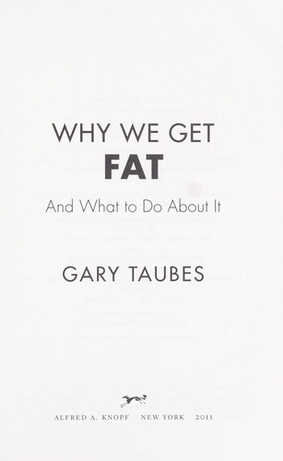
Why We Get Fat is the short version. Where Good Calories, Bad Calories ran to 640 dense pages of revisionist science history, this 2010 follow-up compresses the same core argument into a brisk 272 pages aimed squarely at the general reader. Gary Taubes strips away most of the historical apparatus and focuses on the central claim: we get fat because of the carbohydrates we eat, specifically because of their effect on insulin, and the way to get lean is to eat fewer of them. The book is more accessible, more direct, and more practical than its predecessor. It is also subject to the same evidential critique, and the years since publication have not been kind to the strong version of the thesis.
What the book covers
Taubes opens with the same challenge to the calorie model that anchored Good Calories, Bad Calories, but in a fraction of the space. The conventional wisdom, he argues, is that obesity is caused by eating more calories than you burn. This model implies that the solution is to eat less and move more, and that people who fail to lose weight are simply lacking in discipline. Taubes argues that this is not just unkind but scientifically wrong. Different macronutrients have different metabolic effects. Carbohydrates elevate insulin. Insulin drives fat storage. Therefore the type of calories matters more than the quantity, and the calories most responsible for fat gain are carbohydrates.
The book walks through this argument in clear, accessible steps. Taubes explains the role of insulin in fat metabolism, describes how refined carbohydrates produce blood-sugar spikes that drive insulin up and lock fat in storage, and argues that a population-wide shift from fat to carbohydrates in the wake of the dietary guidelines has been a primary driver of the obesity epidemic. The practical prescription is straightforward: cut carbohydrates, particularly refined ones, and replace them with fat and protein. Do not count calories. Trust that the hormonal correction will take care of the rest.
The book is effective as a piece of persuasion. Taubes writes clearly, the argument builds logically, and the reader finishes feeling that they have understood something the conventional wisdom has missed. The question is whether that feeling is well-founded.
Where the science stands
The same caveats that apply to Good Calories, Bad Calories apply here, but more concisely. The carbohydrate-insulin hypothesis has been directly tested since this book was published, and the results have been mixed. Kevin Hall's metabolic-ward studies at the NIH found that when food intake is carefully controlled, low-carb diets do not produce meaningfully more fat loss than isocaloric low-fat diets - a finding that is difficult to reconcile with the strong version of Taubes's model. The NuSI initiative, which Taubes co-founded to fund rigorous testing of the hypothesis, produced results that did not confirm the predictions. Low-carb diets work for many people, but they appear to work primarily by reducing appetite and total intake rather than through the specific insulin-mediated mechanism Taubes describes.
Taubes is also more selective in this book than the footnotes suggest. The evidence that complicates the insulin model - populations that eat high-carb diets without becoming obese, the role of the brain's reward and satiety circuits in driving overeating, the environmental and psychological dimensions of obesity - is either briefly noted or absent. For a reader who takes this as the complete picture, the map will be significantly distorted.
Who should read this
This is for the reader who wants the accessible version of the carbohydrate-insulin argument and does not want to commit to 640 pages. For the reader curious about why the low-carb community argues what it argues. For anyone who has found calorie counting miserable and wants to understand the intellectual case for an alternative.
Read it alongside The Hungry Brain by Stephan Guyenet, which engages with many of the same questions from a broader and more evidence-balanced perspective. And treat the thesis as one model among several rather than as the settled answer it presents itself as.
Strengths and weaknesses
The strength is accessibility. This is a well-written, well-paced book that makes a complex metabolic argument feel intuitive. The challenge to the oversimplified eat-less-move-more model is genuine and useful. The practical advice to reduce refined carbohydrates is sound.
The weaknesses mirror those of Good Calories, Bad Calories in condensed form. The thesis is more confident than the evidence supports. The citation is selective. The model is single-cause in a way that does not do justice to a multi-causal condition. And the book has aged poorly against the subsequent research base.
A 2.5 is right. The book is a useful and readable provocation, and it should not be taken as the final word on why people gain weight.
Why this matters for mental health
The same mental-health considerations apply here as to The Obesity Code and Good Calories, Bad Calories. The practical advice - reduce refined carbohydrates, eat whole foods - is aligned with what the nutritional-psychiatry literature supports. The risk is the framing: a single-cause model that encourages rigid, all-or-nothing thinking about carbohydrates can create dietary anxiety rather than resolve it. For the Mind Wobble reader, take the practical kernel and leave the comprehensive theory.
Final verdict
Why We Get Fat is the short, sharp version of an argument that has not aged as well as its author hoped. Read it for the challenge to calorie orthodoxy, which remains useful. Do not read it as the complete picture of obesity, because it is not. Pair it with something broader and more current - The Hungry Brain, The Diet Myth, or the mainstream consensus literature on energy balance and hormonal regulation - and you will come away with a more accurate map than either camp alone can provide.