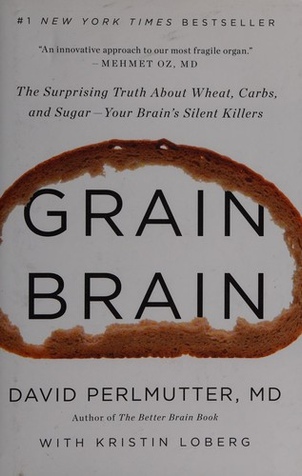
Grain Brain arrived in 2013 and spent a long time on the New York Times bestseller list. David Perlmutter, a practicing neurologist, argued that modern grains and carbohydrates - not just ultra-processed ones, but whole grains and everyday carbs - are a largely unrecognised driver of dementia, Alzheimer's, ADHD, depression, and a long list of other brain and mood conditions. The book sold more than a million copies, launched a sequel and a brand, and helped popularise a particular version of gluten anxiety that clinicians still deal with in practice. It has also been sharply contested by neurologists, nutrition researchers, and registered dietitians writing in venues like the Washington Post, Scientific American, and the Columbia University Irving Medical Center blog. A Mind Wobble review has to engage with that contest honestly.
What the book covers
Perlmutter's argument runs roughly like this. Modern grains - especially those containing gluten - are inflammatory. Dietary carbohydrates in general produce blood-sugar excursions that damage the brain over time. Cholesterol, contrary to decades of popular nutrition advice, is protective, and a high-fat, low-carb, grain-free diet is what the human brain evolved to thrive on. From this foundation he builds a framework in which carbs of almost any kind are implicated in dementia, Alzheimer's is recast as a kind of brain-specific diabetes (the Type 3 diabetes framing), and a whole catalogue of chronic and psychiatric conditions become, in his telling, downstream of dietary grains and sugar.
The prescription is strict. Cut grains - all grains, not just wheat. Cut most fruit. Cut starchy vegetables. Eat meat, eggs, fish, non-starchy vegetables, nuts, seeds, and high-fat dairy in substantial quantities. Supplement according to a specific protocol, much of which maps to a product line. The book walks through case studies from Perlmutter's clinical practice, cites a range of research papers, and presents a confident narrative in which the whole pattern of modern chronic brain disease is traceable to the grain-and-sugar-heavy diet.
Where the science stands
The pushback has been pointed. Columbia's neurology and nutrition faculty, the Washington Post's health section, and a number of academic reviewers have noted that Perlmutter systematically overstates what the cited research supports. The claim that whole grains and gluten in non-coeliac populations drive dementia and Alzheimer's is not supported by the mainstream evidence base. Observational studies of populations with the lowest rates of dementia (the Mediterranean pattern, several of the Blue Zones populations, long-lived rural Japanese) consistently include substantial whole-grain intake. The randomised trials that have looked at diet and cognitive decline (the PREDIMED family, for example) support a Mediterranean pattern rich in whole grains, legumes, fruit, vegetables, fish, and olive oil - closer to the opposite of what Grain Brain prescribes.
The Type 3 diabetes framing for Alzheimer's is a real area of research, but it is a specific hypothesis about insulin signalling in the brain, not a license to rebrand normal carbohydrate intake as neurotoxic. The cholesterol claims in the book tend to flatten a complicated cardiovascular literature into a single preferred narrative. And the mechanistic certainty throughout the book - the move from plausible biological pathway to confident clinical recommendation - is exactly the move that academic reviewers have flagged most consistently.
The one place the book aligns with the evidence is coeliac disease and diagnosed gluten sensitivity, where avoiding gluten is medically necessary. Perlmutter is right about this small group. The problem is the extrapolation to everyone else.
Who should read this
This is, honestly, not a book Mind Wobble can recommend. If you have coeliac disease or a diagnosed wheat sensitivity, you already need to avoid gluten, and coeliac-specific resources will serve you better than this book. If you are worried about your long-term brain health, the evidence-based answer is closer to the MIND diet - a Mediterranean-DASH hybrid that includes whole grains, legumes, leafy greens, berries, nuts, fish, and olive oil - than to anything in Grain Brain.
If you do read the book, read it alongside the pushback. The Columbia University neurology blog, the Harvard T.H. Chan School of Public Health's nutrition pages, and Examine.com's coverage of the specific claims are all useful counterweights. A reader who engages with both will come away with a more accurate picture than a reader who takes the book on its own terms.
Strengths and weaknesses
The strengths are rhetorical. Perlmutter writes clearly, the case studies are vivid, and the book is effective at motivating behaviour change in readers already inclined to cut carbs. Reducing ultra-processed foods and added sugar - which the programme does as a side effect - is a defensible move in its own right, and some of the benefits readers report come from that subset of the restrictions rather than from the grain-specific framing.
The weaknesses are substantial. The central scientific claims outrun the evidence. The restrictions remove foods that the strongest long-term evidence associates with better cognitive outcomes, not worse. The confidence of the narrative is not matched by the state of the underlying research. And the book has contributed to a broader climate of gluten anxiety that clinicians - including gastroenterologists who diagnose coeliac disease - spend real time correcting. For a reader prone to health anxiety or disordered eating, this register can make things worse.
A 1.5 reflects the honest assessment. The book is well-written and influential, and it is also more misleading than helpful for the typical reader.
Why this matters for mental health
Diet and brain health are genuinely connected, and the Mind Wobble audience rightly takes an interest in what to eat for mood, anxiety, and long-term cognitive resilience. The best current evidence - the PREDIMED trial, the MIND diet research, the SMILES trial on depression - converges on a pattern that includes whole grains, legumes, fruit, vegetables, nuts, fish, and olive oil. This is almost exactly the pattern Grain Brain argues against. Adopting a restrictive framework built on contested claims is not a mental-health-positive move for most readers, especially readers prone to dietary anxiety. The gap between what the book prescribes and what the best evidence supports is wide enough that the book cannot serve as a reliable guide for readers interested in the nutrition-and-mental-health link.
Final verdict
Grain Brain is a book to understand as a cultural phenomenon rather than to follow as a guide. The central claims are not supported by mainstream neurology or nutrition science, the restrictions remove foods the best evidence supports, and the confidence of the narrative is not matched by the underlying research. Skip it. If you want a serious book on diet and brain health, pick up The Diet Myth by Tim Spector, or read about the MIND diet, or look at the PREDIMED literature directly. Those will serve your brain - and your mental health - better than this book will.