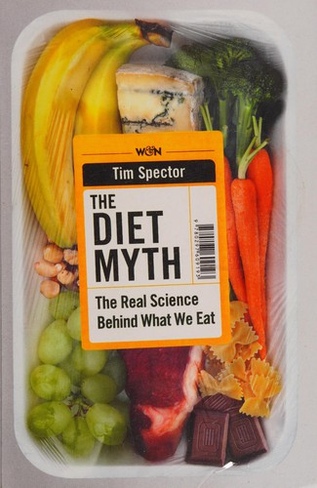
The Diet Myth is the nutrition book most often recommended by other nutrition writers, and for good reason. Tim Spector is a practicing academic - Professor of Genetic Epidemiology at King's College London and the principal investigator on the TwinsUK cohort - whose day job is producing the kind of evidence the rest of the nutrition genre argues over. The 2015 book distilled what his and adjacent research had started to show about diet, the gut microbiome, and individual variation in response to food, and set the intellectual foundation for the ZOE personalised-nutrition programme he later co-founded. A decade on it remains one of the most reliable nutrition books you can put on a shelf, and a useful corrective to almost everything louder and more restrictive.
What the book covers
Spector's central argument is that the dominant model of nutrition - in which foods have fixed properties and everyone should respond the same way to the same diet - is wrong, or at least so incomplete as to be misleading. The missing piece is the gut microbiome. The trillions of bacteria and other microbes that live in the human gut vary substantially between individuals, metabolise food differently, and interact with the immune system, the nervous system, and the brain in ways the nutrition research of the previous century largely ignored. Once the microbiome is in the picture, a lot of the puzzles of nutrition research stop being puzzles. Why two people on the same diet have such different responses. Why weight-loss interventions work for some and fail for others. Why specific foods that seem clearly healthful in one study seem unhelpful in another.
The book walks through the major macronutrient categories - fats, carbohydrates, proteins, fibre, sugar, dairy, alcohol - and in each case shows what the microbiome-aware evidence is starting to show. Some of the findings overturn older advice. Saturated fat is a less simple story than the twentieth-century consensus held. Artificial sweeteners are not the free pass they were sold as. Low-fat processed foods have often done more harm than good. Others reinforce older advice with a clearer mechanism. Diversity of whole plant foods is one of the most consistent predictors of microbiome health and of better outcomes across a range of markers. Fibre, which the microbiome ferments into short-chain fatty acids, matters more than earlier nutrition advice appreciated.
The book also addresses individual variation directly. Spector's own TwinsUK work, and the PREDICT studies that followed, have shown that postprandial responses - how people's blood sugar and blood fats respond to the same food - vary enormously between individuals, in ways not predicted by standard nutrition advice. This is the foundation the ZOE programme was built on, and the book sets it out clearly for a lay reader.
Who should read this
This is for the reader who wants to understand what the current evidence actually supports. For the person who has been through several trend diets and is now suspicious of simple universal claims. For the reader interested in the gut-brain connection and looking for a rigorous entry point. For anyone curious about why the nutrition research often seems to contradict itself - the microbiome story is a large part of the answer, and Spector tells it with unusual clarity. It is also the book to give someone who wants evidence-based grounding before they approach anything else on the nutrition shelf.
It is less useful for a reader who wants a simple prescriptive plan. The book is exploratory rather than directive, and it does not hand you a meal plan or a seven-day reset. The practical prescription, such as it is, is modest - eat a wide diversity of whole plant foods, mostly unprocessed, fermented foods if you can tolerate them, and pay attention to how your own body responds. If you want that prescription turned into a programme, Spector's later work (Food for Life, the ZOE platform) does that more directly. If you want the foundation in one book, this is it.
Strengths and weaknesses
The main strength is rigour. Spector is careful about the limits of the evidence, quick to acknowledge where the science is still uncertain, and unusually honest about where earlier nutritional orthodoxies have been found wanting. He is also a genuine researcher in the field, which matters. The book cites work that is current (as of 2015) and engages with it substantively rather than selectively. A reader comes away knowing more about what the evidence actually shows - and, just as importantly, about the shape of the uncertainties - than almost any other nutrition book will leave them.
The weaknesses are honest ones. The microbiome field has moved on since 2015 in places, and some of the specifics in the book have been updated by later work, including Spector's own. A reader coming to it fresh in 2026 should read it alongside the more recent Food for Life, which incorporates the last decade of PREDICT data. There are also places where the prose is denser than the genre norm, and readers looking for a light tour of nutrition may find it heavier going than Pollan or Hyman. These are small caveats against a book that is otherwise unusually trustworthy.
A 4.5 is right. The half-point held back is for the freshness issue - for a reader wanting the most current version of Spector's thinking, Food for Life is the later word. The foundational book, though, still earns its place.
Why this matters for mental health
The gut-brain axis is one of the more active frontiers in psychiatric research, and the microbiome sits at the centre of it. Diets that support a diverse, fibre-fed gut microbiome have been associated with lower rates of depression and anxiety, and the mechanism - short-chain fatty acids, vagal signalling, immune modulation, serotonin precursor availability - is increasingly well-mapped. Spector's book is the best general-audience entry point for readers interested in this territory, and the dietary pattern it points towards (diverse whole plants, fermented foods, minimally processed) overlaps closely with what the nutritional-psychiatry literature (the SMILES trial, the PREDIMED trial, the MIND diet work) has converged on for mood and cognitive outcomes. For the Mind Wobble reader interested in the nutrition-and-mental-health link, this is one of the most rigorous starting points available.
Final verdict
The Diet Myth is a book to own, read slowly, and return to. It is the antidote to the confident single-answer nutrition books that make up most of the shelf, and it is the foundation Spector built his later work on. Pair it with Food for Life for the most current version of the science, and with Food Rules for the short practical version. But if you can only keep one nutrition book with real scientific depth, this is a strong candidate for it. The evidence it anchors you in will serve you better, over decades, than any trend-driven programme - and your gut, your body, and your mood will all thank you for it.