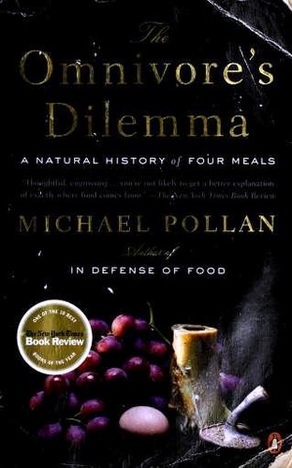
The Omnivore's Dilemma is, by any reasonable accounting, one of the most important food books of the twenty-first century. Michael Pollan, then a journalism professor at UC Berkeley, published it in 2006 and it did something that no nutrition book before or since has quite managed: it made the food system itself visible. Not the nutrients, not the calories, not the macros - the system. The industrial corn complex, the feedlot, the organic-industrial compromise, the pastoral farm, and the forest. Pollan traces four meals from origin to plate, and in doing so gives the reader a way of thinking about food that is deeper and more durable than any set of dietary rules. The book won the James Beard Award, was named one of the ten best books of the year by the New York Times, and has sold millions of copies. It has aged superbly.
What the book covers
The book is structured around four meals, each representing a different food chain. The first is industrial - a McDonald's meal eaten in the car, traced backward through the fast-food supply chain, through the feedlot, through the corn processing plant, and ultimately to the Iowa cornfield that produced the commodity corn underlying almost every ingredient. This section is the most revelatory for most readers. Pollan demonstrates, with careful reporting, that the modern industrial food system runs on corn in ways the consumer never sees: corn-fed beef, high-fructose corn syrup, corn-derived food additives, corn-fed chicken, corn-based packaging materials. The meal in the car is, from a certain angle, a corn meal in disguise.
The second food chain is industrial organic - a meal from Whole Foods, traced back through the organic supply chain. Pollan visits large organic operations and finds that industrial organic, while genuinely better in some respects (fewer pesticides, no synthetic fertilisers), replicates many of the structural features of conventional industrial agriculture: monocultures, long supply chains, centralised processing, and marketing that implies a pastoral reality that does not exist. This section is a useful corrective to the assumption that organic automatically means small, local, or sustainable.
The third food chain is pastoral - a meal sourced from Polyface Farm in Virginia, Joel Salatin's operation, which practices a form of rotational grazing and polyculture that Pollan describes in loving detail. This is the section that comes closest to advocacy, and it is the section that has been most criticised for romanticising a farming model that, whatever its virtues, cannot feed a population of eight billion at current consumption levels.
The fourth is the hunted-and-gathered meal - a dinner Pollan assembles from wild boar he hunts, mushrooms he forages, and produce from his own garden. This section is more personal and reflective, and it serves as a meditation on the relationship between the eater and the eaten that the industrial food system has made almost entirely invisible.
Who should read this
Nearly everyone. This is the book to read before you read any other nutrition book, because it gives you the context that makes nutritional advice meaningful. Understanding that the food system is designed to maximise calorie production from commodity corn, not to maximise human health, transforms how you hear every piece of dietary advice. Understanding the gap between the organic label and the pastoral image it evokes helps you make better choices at the supermarket. Understanding that the question what should I eat is inseparable from the question what kind of food system am I supporting gives you a framework that outlasts any specific diet trend.
It is especially useful for the reader who has felt overwhelmed by contradictory nutrition advice and wants to step back to a more fundamental level. Pollan does not tell you what to eat in this book - that is what Food Rules is for. He tells you where your food comes from, and that knowledge turns out to be as useful as any set of macronutrient targets.
Strengths and weaknesses
The strengths are extraordinary. Pollan is one of the finest nonfiction prose stylists working in English, and the book is a pleasure to read at the sentence level as well as the structural level. The reporting is thorough, careful, and vivid. The four-food-chain structure gives the reader a comparative framework that makes the differences between food systems viscerally clear. And the book manages something rare in food writing: it is critical of industrial food without being preachy, appreciative of alternatives without being naive, and honest about the difficulty of eating well in a system designed for a different purpose.
The weaknesses are modest. The pastoral-farming section romanticises Polyface Farm and small-scale agriculture in ways that do not fully reckon with the scalability problem. Feeding the world's population with Polyface-style methods is a challenge the book acknowledges in passing but does not seriously engage with. The hunter-gatherer section, while beautifully written, is more personal essay than journalism and may feel indulgent to some readers. And the book is about the food system rather than about personal nutrition - readers who finish it wanting to know what to eat next will need Food Rules or The Diet Myth to answer the question it so effectively raises.
A 4.5 is right. One of the best food books ever written. The half-point held back is for the pastoral romanticism and the lack of direct nutritional guidance - both of which are features, not bugs, but they do limit the book's usefulness for the reader looking for immediate practical advice.
Why this matters for mental health
The food system Pollan describes - industrial, corn-based, ultra-processed, designed to maximise consumption - is the same system the nutritional-psychiatry literature has identified as harmful to mental health. Diets high in ultra-processed food have been associated with higher rates of depression and anxiety, and the food environment that produces those diets is the one Pollan traces from cornfield to car. Understanding the system is not, by itself, a mental health intervention. But it is the context that makes individual dietary change more comprehensible and more sustainable. For the Mind Wobble reader, this book does not replace the nutrition advice - it explains the world in which that advice has to operate.
Final verdict
The Omnivore's Dilemma is the food book to read first. Before you read about macros, before you read about diets, before you read about fasting or the microbiome or lectins or ketosis, read this. It will give you a systems-level understanding of where your food comes from and why the modern food environment is the way it is, and that understanding will make every subsequent nutrition decision more informed. Pair it with Food Rules for the practical follow-through, and you will have a foundation that outlasts any trend. Essential reading.