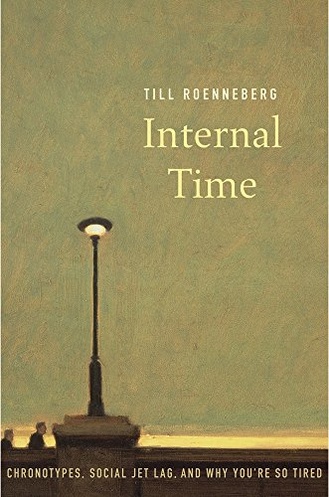
What the Book Covers
Till Roenneberg spent decades studying biological clocks in everything from fungi to humans, and Internal Time is his distilled wisdom about one of the most consequential discoveries in chronobiology: we're not all the same.
The book's central insight is elegantly simple yet radical: your sleep schedule isn't a matter of willpower or laziness. It's determined by your chronotype: the phase of your internal clock, which is as biologically fixed as your height or eye color. Early birds and night owls aren't character types; they're biological realities.
Roenneberg then introduces the concept that animates the whole book: "social jet lag." It's the gap between when your body wants to sleep and when society demands you be awake. For most night owls living in a morning-dominated world, this gap is perpetual and exhausting. He defines it precisely: "the difference between midsleep on free days and midsleep on work days." That innocent-sounding gap, he argues, is more damaging than actual jet lag because it's relentless and consistent.
The consequences aren't abstract. Living chronically against your body clock makes you more likely to smoke, gain weight, feel depressed, fail academically, get sick, and struggle with concentration. It's not that you're doing something wrong: it's that the structure of modern life is doing something wrong to you.
The book walks through the science with warmth and humor: how light resets your internal clock, why teenagers need more sleep than adults (and why forcing them to wake up early is scientifically backward), how shift work corrodes health, and what you can actually do about it.
Who Should Read This
If you've ever felt like your body runs on a different schedule than the rest of the world, this book is a lifeline. Night owls will feel seen and vindicated. Parents will understand their teenagers. Anyone struggling with chronic fatigue will find real explanations, not excuses, but scientific grounding.
It's also essential for anyone in a role that affects scheduling: educators, managers, workplace leaders, healthcare professionals. Roenneberg doesn't just diagnose the problem; he hints at solutions, even if systemic change is slow.
Even if you're naturally an early bird, reading this builds empathy and understanding for the 25-30% of people whose chronotypes are genuinely different. And if you're curious about why modern life feels so exhausting for so many people, this book offers a compelling answer.
Strengths and Weaknesses
Strengths:
Roenneberg's writing is warm and accessible without being reductive. He trusts readers to engage with genuine science while keeping the narrative focused on human experience. The anecdotes from his own research and life (about his own sleep struggles, his kids, his lab team) make the science feel immediate and personal.
The research is thorough and current (for 2012), drawing from decades of work in chronobiology. He's not speculating; he's synthesizing real data and real observations into a coherent story.
Most importantly, the book is deeply affirming. For people who've internalized shame around sleep struggles, Roenneberg's message is liberating: this isn't your fault. Your body is working exactly as designed. The problem is the system, not you.
The practical insights are genuinely useful: understanding your own chronotype, knowing why school start times matter, recognizing that "discipline" won't override biology.
Weaknesses:
The book is more diagnostic than prescriptive. Roenneberg explains the problem brilliantly but offers fewer concrete solutions for people trapped in misaligned schedules. For someone working a 9-to-5 job while being a night owl, the book validates their suffering but doesn't fully address how to live within that constraint.
Some of the science can feel dense in places, particularly chapters diving deep into circadian mechanisms. It's still accessible, but it requires attention.
The book doesn't extensively address cultural and economic dimensions of sleep inequality: how poverty, racism, and class make the social jet lag problem worse for some populations. It's a personal story framed through individual biology, which is powerful but incomplete.
Final Verdict
Internal Time is one of those books that reframes how you understand yourself and the world. It's not a self-help book, but it feels healing. It's a science book, but it reads like a conversation with someone who genuinely cares about your exhaustion.
Roenneberg's central argument (that you're not broken, the system is) is both scientifically sound and emotionally resonant. The book gives permission to stop fighting your body and start questioning the structures that demand you do so.
If you're tired of being tired, or curious about the biology of sleep and schedules, or wondering why modern life feels so chronically misaligned, this book is worth the read. It won't solve your scheduling problems, but it will help you understand them deeply, and that understanding itself is a kind of liberation.
Rating: 4.5 / 5
A warm, rigorous, and genuinely illuminating exploration of why so many of us are running against our own internal clocks. Essential for night owls, valuable for everyone else, and quietly radical in its implications for how we organize society.