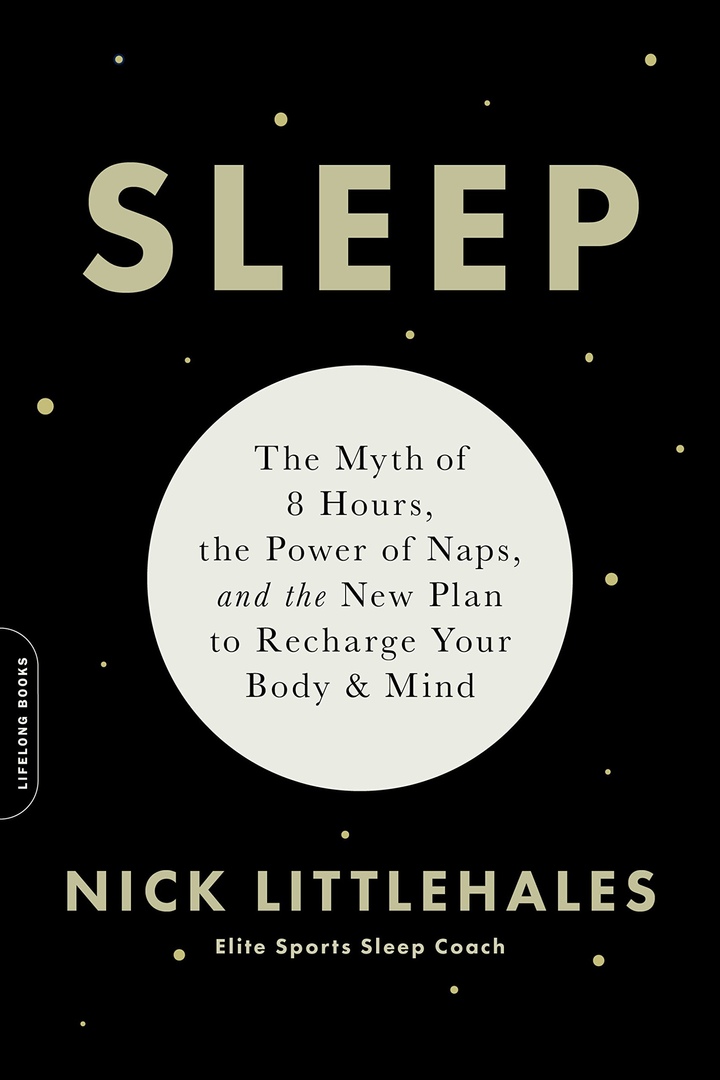
Sleep: The Myth of 8 Hours
If you've ever woken up after eight full hours of sleep feeling absolutely wrecked, you're not alone. And according to Nick Littlehales, the world's leading sports sleep coach, that's because the entire eight-hour rule is fundamentally flawed. Littlehales didn't invent this idea in isolation: he tested it obsessively while working with Manchester United, British Cycling, Team Sky, NBA athletes, and Olympic competitors. Their success speaks louder than any sleep science debate: the 90-minute sleep cycle matters far more than the number of hours you spend in bed.
Sleep: The Myth of 8 Hours, the Power of Naps... and the New Plan to Recharge Your Body and Mind isn't a book that asks you to believe harder. It's a book that gives you a system, and then backs it up with enough practical detail that you'll actually know how to use it.
What the book covers
Littlehales structures everything around the R90 Program: his framework for understanding and optimizing sleep through seven Key Sleep Recovery Indicators (KSRIs). The core insight is elegantly simple: instead of thinking about "eight hours," think about completing sleep cycles. A full cycle takes about 90 minutes: time enough to move through all the stages of sleep (light, deep, and REM). If you complete five or six of these cycles per night, you'll feel better rested than someone who forces themselves to stay in bed for eight hours and interrupts their last cycle midway.
But the book doesn't stop at theory. Littlehales is meticulous about the details that actually matter:
Sleep environment comes first. He covers dawn-wake simulator alarms, room temperature (cool is better), darkness, noise, and (critically) technology use before bed. It's not mystical; it's biomechanics.
Napping gets genuine strategic treatment. Instead of dismissing naps as laziness, Littlehales reframes them as Controlled Recovery Periods (CRPs). The research here is compelling: even a 20-minute nap between 1-3pm or 5-7pm can meaningfully boost cognitive performance, memory, and mood. For shift workers, parents of young children, or anyone whose schedule is chaotic, this chapter alone might be worth the book's price.
Sleep position and bedding sound mundane until Littlehales explains how your body type (ectomorph, mesomorph, endomorph) affects which sleeping position actually supports your spine. He recommends your non-dominant side in a semi-fetal position, and explains why in terms you'll understand, not medical jargon.
Diet, exercise, and pre-sleep routines all get practical guidance. Eat your last meal 2-3 hours before sleep. Move your body regularly, but not right before bed. Build a wind-down routine that signals to your nervous system that rest is coming. None of it is controversial; most of it is stuff you've heard before. But Littlehales frames it all as part of one coherent system, which is far more powerful than isolated tips.
Who should read this
Sleep is most immediately valuable if you're an athlete, a high-performer under pressure, or someone whose sleep is clearly dragging down your work and health. Littlehales speaks directly to you in the language of optimization and recovery, and his examples draw heavily from world-class sports. If you've ever wondered how elite cyclists or footballers manage to perform at their peak on limited sleep, this book explains it.
That said, it's useful for anyone frustrated with the eight-hour myth. Maybe you're sleeping nine hours and still waking up tired. Maybe you work a shift that doesn't align with a neat nighttime schedule. Maybe you have young kids and know you'll never get eight uninterrupted hours again. This book reframes sleep not as an absolute amount but as a recoverable quantity: something you can accumulate over a week, optimize through cycles, and strategically interrupt with naps when life demands it.
The only reader who might not benefit: someone who's sleeping well with their current routine and has no complaints. If it isn't broken, this book will make you question whether you could do better, which is useful, but not urgent.
Strengths and weaknesses
Strengths: The book's greatest asset is its specificity. Littlehales doesn't offer vague wellness advice. He tells you the exact temperature your bedroom should be. He explains which sleeping position is biomechanically sound. He tells you when to nap. He walks you through pre-sleep routines minute by minute. This level of detail makes the book feel immediately actionable: you close it and you know exactly what to change.
The science is solid and current (the book draws on research from sports physiology, circadian biology, and sleep medicine). Littlehales clearly knows what he's talking about. And his authority comes from working with athletes who demand results; if his methods didn't work, Manchester United wouldn't use them.
The writing is clear and conversational. It's not a dense scientific text; it reads like a smart friend explaining something you actually need to know.
Weaknesses: The biggest one is that the 90-minute cycle approach, while compelling, isn't universally agreed upon in sleep science. Some sleep researchers argue that the concept is oversimplified or that it works better for some people than others. Littlehales addresses criticism somewhat, but the book is fundamentally built on this framework, so if you're skeptical of the 90-minute premise, the whole structure feels less persuasive.
The second weakness is that the book is heavily oriented toward elite performance and sports. For a civilian reader just trying to sleep better without crushing athletic goals, some of the framing feels slightly off-target. The examples are often about Olympic athletes or professional footballers, which is inspiring but can feel distant from everyday life.
Finally, many of Littlehales' recommendations require genuine lifestyle changes: a new sleep routine, a new alarm system, possibly new bedding, and certainly a shift in how you think about rest. If you're exhausted and need help now, some of this advice requires upfront effort you might not have bandwidth for.
Final verdict
Sleep is an excellent book: specific, authoritative, and genuinely useful. At 208 pages, it's also mercifully short; you can read it in an evening or two. The 90-minute cycle concept will change how you think about sleep, and Littlehales' practical advice on environment, napping, and routine gives you real tools to experiment with.
If you're regularly tired despite sleeping "enough," if your schedule doesn't fit the neat eight-hour box, or if you care about optimizing your recovery for better work and health: this book will repay the investment immediately. The Goodreads community clearly agrees, with nearly 4 out of 5 stars from over 3,000 readers.
The only caveat: treat it as a framework, not gospel. The 90-minute cycle works brilliantly for some people and less well for others. Your sleep is as individual as your fingerprint. What Littlehales offers is a well-researched starting point and a permission slip to stop fighting the eight-hour rule. Everything else is yours to adjust.
Reading time: 2-3 hours
Best for: Athletes, high-performers, parents, shift workers, anyone skeptical of the 8-hour rule
Would pair well with: Why We Sleep by Matthew Walker (deeper science), The Power of When by Michael Breus (chronotype-specific advice)