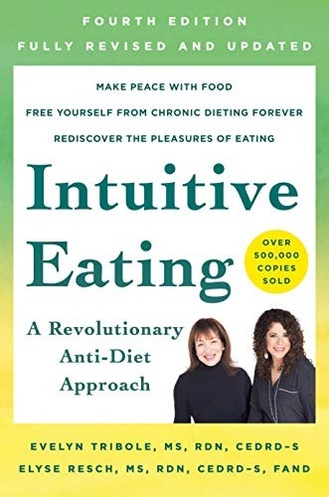
Intuitive Eating is the book that a surprising number of other nutrition books are quietly arguing against, and understanding why tells you a lot about the state of the field. Evelyn Tribole and Elyse Resch, both registered dietitians with decades of clinical experience, first published it in 1995 as a response to what they were seeing in practice: patients who had dieted their way into a worse relationship with food, a worse relationship with their bodies, and often a worse metabolic outcome than where they had started. The 4th edition, published in 2020, integrates twenty-five years of subsequent research and clinical refinement, and it remains one of the most important nutrition books on the shelf - particularly for the Mind Wobble reader, for whom the intersection of food and mental health is the whole point.
What the book covers
The framework rests on ten principles, arranged in a deliberate sequence. Reject the diet mentality. Honour your hunger. Make peace with food. Challenge the food police. Discover the satisfaction factor. Feel your fullness. Cope with your emotions with kindness. Respect your body. Movement - feel the difference. Honour your health with gentle nutrition. The ordering matters. Gentle nutrition comes last, not first, because in Tribole and Resch's clinical experience the readers who need this book most are the ones for whom food rules have become the problem, and adding more rules before the underlying relationship is repaired makes things worse.
The core argument is that chronic dieting - the cycle of restriction, deprivation, overeating, guilt, and re-restriction - disrupts the body's internal hunger and satiety signals to the point where the dieter can no longer tell whether they are hungry, full, satisfied, or eating for emotional reasons. Intuitive eating is the structured process of rebuilding that internal compass. It is not, as critics sometimes caricature it, a permission slip to eat whatever you want whenever you want. It is a progressive framework that starts by removing the external food rules that have overridden internal signals, and ends by reintroducing nutritional awareness in a context where the reader can actually hear it.
The 4th edition adds substantial new material on the research base, which has grown considerably since the first edition. Over a hundred studies have now examined intuitive eating, and the pattern is consistent: intuitive eaters tend to have lower BMI, better metabolic markers, less disordered eating, better body image, and better psychological wellbeing than chronic dieters. The evidence is largely observational, and the authors are transparent about this, but the direction and consistency of the signal is notable.
Who should read this
This is for the reader whose relationship with food has become a source of suffering rather than nourishment. For the person who has dieted repeatedly and ended up heavier, more anxious, and more preoccupied with food than before they started. For the reader with a history of binge-restrict cycles, food guilt, body shame, or the quiet exhaustion of counting, tracking, and monitoring every meal. For anyone who has finished another nutrition book and thought this sounds right but I cannot do it, and suspected the problem might not be willpower.
It is also useful for the reader who is doing well but wants a healthier baseline relationship with food before engaging with the more prescriptive nutrition literature. Reading Intuitive Eating before or alongside books like Eat to Live or The Whole30 gives you a psychological foundation that makes those programmes less likely to tip into unhelpful rigidity.
It is less useful for the reader who has a genuinely uncomplicated relationship with food and simply wants nutritional information. For that reader, Food Rules or The Diet Myth will serve better. Intuitive Eating is built for the reader who has been through the wars.
Strengths and weaknesses
The strength is the clinical grounding. Tribole and Resch have been working with real patients for decades, and the ten principles are clearly derived from watching what actually helps people rather than from theory alone. The book is compassionate without being soft, structured without being rigid, and honest about the limits of the evidence without underselling what it shows. The progressive structure of the principles is particularly well-designed - it meets the reader where they are and builds trust before reintroducing nutritional guidance.
A second strength is the mental health integration. This is one of the few nutrition books that takes the psychological dimension seriously as a first-order concern rather than as an afterthought. The chapters on emotional eating, the food police, and body respect are as much psychological intervention as nutritional guidance, and for the reader who needs them they are worth the price of the book on their own.
The weaknesses are modest. The book is deliberately non-prescriptive about specific foods, which means readers who want a meal plan or a what-to-eat list will not find one. The anti-diet framing, while clinically well-grounded, can for some readers become an identity rather than a tool - the same kind of rigidity it was designed to dissolve, just pointed in the other direction. And the research base, while growing, is still largely observational; the randomised-trial evidence that would clinch the case is thinner than the authors might wish.
A 4.5 is right. This is one of the most important books on the nutrition shelf for readers who need it, and one of the most overlooked by readers who think they do not. The half-point held back is for the deliberate lack of specific food guidance, which will frustrate some readers.
Why this matters for mental health
This is, more than almost any other book on the nutrition shelf, a mental health book. The research on chronic dieting and psychological outcomes is consistent and sobering: dieters report higher rates of depression, anxiety, disordered eating, body dissatisfaction, and food preoccupation than non-dieters, and the cycle of restriction and overeating is itself a significant source of psychological distress. Intuitive eating addresses this directly, and the evidence on its psychological outcomes - better body image, less disordered eating, lower anxiety, greater life satisfaction - is among the most consistent findings in the field. For the Mind Wobble reader, this book is not adjacent to mental health. It is squarely in the centre of it.
Final verdict
Intuitive Eating is the book to read if your relationship with food has become a problem rather than a pleasure. It is compassionate, structured, evidence-informed, and written by two clinicians who have spent decades helping real people rebuild something that diet culture has systematically broken. If you have dieted your way into anxiety, rigidity, or despair around food, this is the place to start. If your relationship with food is already healthy, read it anyway - it will give you a foundation that makes every other nutrition book on the shelf more useful and less dangerous. One of the most important books Mind Wobble has reviewed.