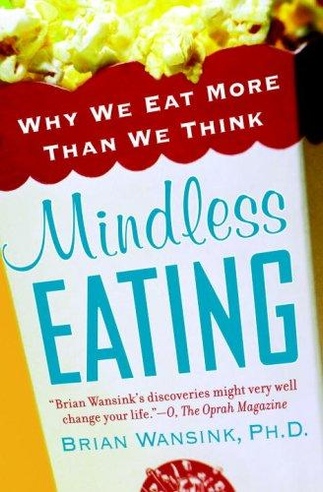
Mindless Eating arrived in 2006 to wide acclaim. Brian Wansink, then the director of Cornell's Food and Brand Lab, had spent years running unusually creative experiments on how environmental cues - plate size, package size, menu wording, the visibility of a food bowl - shape how much people eat without their noticing. The book turned those experiments into an accessible popular read, won the James Beard Award, and became a fixture on corporate-wellness and public-health reading lists. It is also, unusually for a book on this list, one that has to be reviewed with a substantial asterisk. Between 2016 and 2019, Wansink's research came under extensive scrutiny, and the conclusion of that scrutiny was brutal. Any honest review of this book has to start there.
What the book covers
Wansink's central thesis is that eating is overwhelmingly context-driven. We do not eat because we are hungry; we eat because the food is there, the plate is big, the package has not emptied, the television is on, the portion on the plate looks normal, or because some other cue in the environment has told us to keep going. The studies he describes throughout the book are deliberately small and everyday. A cinema handing out stale popcorn in different-sized buckets to measure consumption. A soup bowl secretly refilled from below to measure how much people will eat when the bowl never empties. A buffet laid out with more or less visible ingredients to test whether prominence drives selection. The studies are vivid, the prose is friendly, and the book reads less like science writing and more like a chatty tour of a very active lab.
The practical advice Wansink derives is sensible on the surface. Use smaller plates. Keep tempting foods out of sight. Pre-portion snacks rather than eating from a shared bag. Eat at a table, not in front of a screen. Pay attention to the environmental design of your kitchen as a tool for shaping behaviour. None of this is wrong, and much of it aligns with what later, more carefully replicated work has continued to find. The problem is not the advice. The problem is the evidence base the book relies on.
The research integrity problem
In 2016 Wansink wrote a blog post praising a graduate student for extracting many publishable findings from a single dataset, which triggered scrutiny from the wider research community. What followed was one of the more extensive research misconduct investigations in recent nutrition science. Over the following three years, independent researchers identified systematic problems across dozens of Wansink's papers - inconsistencies in reported sample sizes, impossible statistical values, the same data used to support contradictory claims, and a pattern of what statisticians call p-hacking and Cornell eventually called academic misconduct. Eighteen of his papers were retracted. Cornell found he had committed academic misconduct, and he resigned from the university in 2019. Much of the specific research this book builds on is among the work that has been called into question.
This does not mean every claim in the book is wrong. The broader idea that environmental cues shape eating behaviour is well-established by other researchers whose work has held up. But it does mean that the specific effect sizes, the specific studies, and the specific anecdotes in Mindless Eating should not be trusted as presented. Readers who want to explore the underlying idea should look at Traci Mann's Secrets from the Eating Lab or the broader behavioural-nutrition literature rather than taking Wansink's numbers at face value.
Who should read this
This is, honestly, a difficult recommendation to make in 2026. The book is historically important in that it mainstreamed an idea that has since been supported by other work, and reading it is a useful window into the early years of behavioural nutrition as a popular genre. If you are interested in how influential science books can be built on shaky foundations - a cautionary tale in itself - there is educational value in reading it alongside the Buzzfeed and Stat News reporting that surfaced the misconduct.
For the reader who simply wants practical, evidence-based advice on eating less without willpower, there are better options. Russ Harris on values-based eating, Evelyn Tribole on intuitive eating, or contemporary behavioural-economics writing on food environments will all serve you better without the baggage.
Strengths and weaknesses
What strengths there are in the book are prose strengths. Wansink is a good writer, the book is fun to read, and the central idea - that we eat in response to cues more than to hunger - is genuinely useful when taken as a general principle rather than as the specific numerical claims he makes. The book's practical recommendations are sensible and low-risk. Using a smaller plate will probably not change your life, but it will not hurt.
The weaknesses are substantial. The retracted-paper record is the headline issue. Beyond that, even the surviving claims in the book tend to be stronger than what independent replication has been able to support. The famous bottomless soup bowl study, for example, has held up better than many of Wansink's other studies, but the reported effect sizes are larger than more rigorous contemporary work would expect. Any specific claim in the book should be treated as a hypothesis that may or may not have been replicated rather than as settled science.
A 2.0 reflects the honest assessment. The core idea is useful and has been better supported elsewhere. The specific book is compromised.
Why this matters for mental health
There is a real relationship between the food environment and disordered patterns of eating, and a real argument for using environmental design to reduce the cognitive load of eating well. A person with a busy life cannot make every food decision deliberately, and designing a kitchen, a plate, and a schedule that make the default choice the reasonable one is a genuinely useful mental-health-adjacent move. That argument stands independently of whether the specific studies in this book replicate. For the Mind Wobble reader interested in this idea, look to more recent and more carefully supported sources.
Final verdict
Mindless Eating is a book with a useful core idea built on a research record that has not held up. The broader concept of cue-driven eating remains worth engaging with. The specific book should probably be skipped in favour of more reliable sources. If you read it, read it with the retraction history in mind and treat everything numerical with scepticism. For most Mind Wobble readers, that is enough reason to reach for something else.