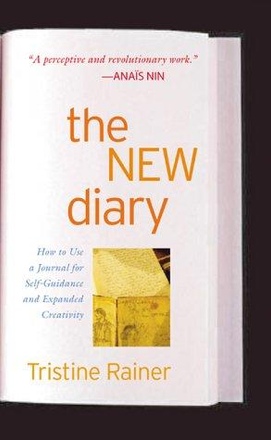
If you have ever opened a fresh notebook, written half a sentence, and then frozen because you weren't sure you were doing it right, this is the book that quietly takes that worry off the table. Tristine Rainer's The New Diary arrived in 1978 with a foreword by Anais Nin, who called it "a perceptive and revolutionary work," and nearly fifty years later it is still the title that other journaling books keep pointing back to. It has sold well over 200,000 copies, been used as a text in university psychology and occupational therapy courses, and earned a steady 4.16 average across hundreds of reader ratings. That kind of staying power is rare for a self-help book, and there's a reason for it: Rainer wasn't trying to sell you a system. She was trying to hand you back your own pen.
What the book covers
The premise is liberating. A diary, Rainer argues, has almost nothing to do with the dutiful "Dear Diary, today I..." entries you may have abandoned as a teenager. Instead, it's a tool for tapping your inner resources - a place to clarify goals, work through problems, process your past, free your imagination, and even loosen creative blocks. Rather than handing you a rigid program of mandatory prompts, she lays out broad ways of writing and invites you to notice which ones you're drawn to.
At the heart of the book are four natural modes of diary writing, drawn loosely from Jung: catharsis (releasing feeling), description (capturing the sensory texture of a moment), free-intuitive writing (letting the unconscious speak), and reflection (thinking something through). Around those she builds a toolkit of specific techniques that readers tend to remember for years - writing unsent letters to people living or dead, holding written dialogues with parts of yourself or with a problem, stepping outside yourself by writing in the third person, working with dreams, making lists, and reviewing old entries to spot the patterns running through your life. There's even a frank chapter on eroticism, a subject most journaling guides tiptoe around entirely. The throughline is always the same: the process matters more than the product, and the diary should become whatever you need it to be.
Who should read this
This book is for two kinds of people, and it serves both unusually well. If you've never kept a journal and don't quite know where to start, Rainer removes the pressure to perform and shows you a dozen doors in. If you've journaled for decades and feel your practice has gone flat - logging events without depth, or turning to the page only in crisis - the techniques here are a way to refresh and deepen what you already do. Readers in that second camp are often the most grateful, describing the book as the thing that helped their journaling "fizz" again after years of going through the motions.
It's worth saying plainly that this isn't a book of fill-in-the-blank prompts. If you specifically want a structured prompt-a-day journal, you'll find this too open-ended. Its gift is the opposite: it teaches you to generate your own ways in, so you're never staring at a blank page again.
Strengths and weaknesses
What makes The New Diary endure is its humanity. Rainer doesn't preach, and she doesn't bury you in inspirational quotations. She shows her methods at work through real diary excerpts - her own and other writers' - so you can see how a dialogue or an unsent letter actually unfolds on the page. That grounding is the book's quiet superpower; the techniques feel discovered rather than prescribed.
It isn't flawless, and honesty requires naming where it shows its age. Many of the diary excerpts date from the 1960s and 70s, and they carry the assumptions of that era - women agonising over whether to marry or pursue a career, the occasional cultural framing that reads awkwardly today. One reader noted that even the revised editions didn't fully address this. There's also a strand of new-age spirituality - inner guides, wiser selves, synchronicities - that some readers find genuinely useful and others find a touch too woo. A few feel the book runs slightly long and repetitive. None of this is fatal; the sheer richness of ideas earns it room to carry a few duds. But it's the difference between a near-perfect book and a very good one, which is why this lands at a confident 4.0 rather than a flawless five.
Why this matters for mental health
Journaling is one of the most accessible, evidence-friendly forms of self-care we have, and Rainer's approach is mental health writing before that phrase was common. Her four modes map neatly onto things therapy does: catharsis lets you discharge what you're carrying, reflection helps you make sense of it, and the dialogue technique - writing a conversation with your fear, your grief, or a younger version of yourself - is a remarkably gentle way to approach pain you might not say aloud. Readers describe using the book to process abuse, untangle decisions, sit with grief, and find emotional distance when life feels overwhelming. That it does all this with a private notebook, on your own terms and your own schedule, is precisely what makes it such a sustainable companion to your wellbeing.
Final verdict
The New Diary has outlived nearly every journaling trend that followed it, and that's because it gives you something a prompt book never can: a relationship with your own diary that grows as you do. Yes, you'll occasionally feel the 1970s in the margins. But you'll also close the book wanting to write - which, for a book about writing, is the whole point. If you've been meaning to start a journal, restart one, or simply rediscover why the practice mattered to you, this is the one to keep on the shelf and return to whenever you're stuck. Pick up a copy, open a fresh notebook beside it, and see where your own pen takes you.