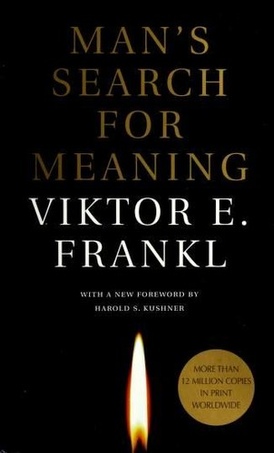
There are books you read and books you survive, and Man's Search for Meaning is both. Viktor Frankl, a Viennese psychiatrist who lost his wife, parents, and brother in the Nazi camps, wrote the first half of this book in nine days after his liberation. The second half is his theory of what allows a human being to keep going when everything has been taken from them. Together they make up one of the shortest, densest, and most quietly important books of the twentieth century - a book that has sold more than sixteen million copies and continues to turn up on bedside tables whenever readers find themselves in the kind of circumstances that make meaning feel like a question rather than an assumption.
What the book covers
The book is a diptych. Part one, Experiences in a Concentration Camp, is Frankl's memoir of his three years in Nazi camps, including Auschwitz and Dachau. He does not dwell on the horrors in the way you might expect. Instead he writes as a clinician with one eye on his own psychological state and one eye on the prisoners around him, trying to understand what distinguished those who endured from those who gave up. The specifics are unsparing - the roll calls, the bread rations, the frozen feet, the deaths - but the register stays observational. He is watching the human mind under conditions no one should ever face, and taking notes.
What emerges from those notes is the book's central claim: that under even the most extreme circumstances, a person retains one thing - the freedom to choose their response. A prisoner could lose everything except, as Frankl puts it, the last of the human freedoms, the choice of attitude in any given set of circumstances. He saw men with nothing give away their last crust of bread. He saw others, better fed, abandon every scrap of themselves. The difference, Frankl argues, was meaning - whether the person had something or someone they were still reaching toward.
Part two, a shorter section called Logotherapy in a Nutshell, sets out the therapeutic school Frankl built around these observations. Logotherapy treats the search for meaning as the primary motivational force in humans, rather than Freud's pleasure or Adler's power. Frankl lays out the three paths he believes lead to meaning - creative work, loving relationships, and the attitude we take toward unavoidable suffering - and illustrates each with clinical cases from his Vienna practice. The prose turns drier here, but the argument is coherent and, for many readers, clinically useful.
Who should read this
This is for anyone in a season of loss, illness, or protracted difficulty where the usual self-help advice feels insulting. It is for the person who has lost faith that their life can be meaningful again, for the therapist looking to ground their practice in something older and deeper than evidence-based protocols, and for any reader who has quietly asked themselves, at three in the morning, what the point of continuing is. Frankl does not answer that question for you. He gives you a framework for asking it differently.
It is also, oddly, a good book for people who are doing well. Meaning is easier to locate in crisis than in comfort, and Frankl's account of his patients in post-war Vienna - successful, well-fed, and quietly despairing - is strikingly relevant to a generation raised on achievement metrics.
Strengths and weaknesses
The strength of the book is Frankl's restraint. A lesser writer would have drowned the camp memoir in horror or the therapy section in jargon. Frankl does neither. He writes as someone who has earned the right to his conclusions and does not need to shout them. The sentences are plain, the pacing is unhurried, and the emotional weight is load-bearing rather than decorative. Few books can hold both a concentration camp and a theory of human motivation without collapsing under one or the other. This one does.
The weaknesses are modest. The logotherapy section has not aged as gracefully as the memoir - the clinical case studies feel dated, and the theoretical framework has been absorbed and refined by subsequent schools of existential psychology. The book is also, inevitably, a product of its time and place, and some readers will want more engagement with the specific moral and political horror Frankl survived than he offers. His focus is on the individual psyche, not the structures that crushed it.
A 5.0 is unusual and deserved. This is not a flawless book, but it is a necessary one, and its flaws are trivial next to what it achieves. Some books earn their ubiquity through marketing; this one earned it by being true.
Why this matters for mental health
Mental health care has spent the last several decades getting progressively better at treating symptoms - the anxious loop, the depressive fog, the intrusive thought. What it has been slower to engage with is the deeper question of what a recovered life is actually for. Frankl's answer is that a meaningful life is not one free of suffering but one in which suffering is held inside a larger sense of purpose. For anyone working through depression, grief, chronic illness, or trauma, this reframe is quietly revolutionary. It does not minimise the pain - Frankl would be the last to do that - but it refuses to treat pain as the end of the story. For Mind Wobble readers, this is a foundational text. Read it once for the memoir. Read it again when you need the framework.
Final verdict
Man's Search for Meaning is short, uncomfortable, and as close to essential as a book of this kind gets. It will not fix anything. It will, if you let it, change how you think about the things that need fixing. Read it in one sitting on a quiet afternoon, underline what you need, and return to it the next time life gets hard. Few books keep paying off like this one. Very few deserve to.