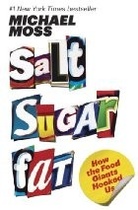
Salt Sugar Fat is the book that belongs on the shelf next to every nutrition book you own, because it tells the other half of the story. Michael Moss, a Pulitzer Prize-winning investigative journalist at the New York Times, spent years inside the food industry - interviewing food scientists, marketing executives, flavour engineers, and the occasional repentant CEO - and the result is a meticulously reported account of how the processed-food giants have spent decades engineering products designed to override your body's satiety signals and keep you eating. The book won the James Beard Award in 2014 and became a number-one New York Times bestseller, and it has aged remarkably well. If you want to understand why the modern food environment is the way it is, this is the place to start.
What the book covers
Moss structures the book around the three pillars the food industry has optimised: sugar, fat, and salt. Each gets its own section, and each section walks through the industrial science, the internal company documents, and the marketing strategies that have turned these three ingredients into the backbone of the ultra-processed food supply.
The sugar section is the most striking. Moss introduces the concept of the bliss point - the precise concentration of sugar at which a product is most pleasurable - and shows how food scientists have spent decades calibrating it for every product from pasta sauce to yoghurt. He traces the internal debates at companies like Coca-Cola, General Mills, and Kraft, where scientists raised concerns about the health effects of their products and were overridden by marketing and sales teams who understood that sugar was the single most reliable driver of repeat purchase. The anecdotes are vivid and specific. A Coca-Cola executive worrying about childhood obesity while his company's internal projections depend on increasing per-capita consumption. A General Mills scientist mapping the precise sugar concentration that makes a cereal maximally appealing to children.
The fat section explores how the industry has leveraged fat's unique textural and flavour properties - its ability to carry other flavours, to create mouthfeel, to deliver a sense of richness - to build products that are difficult to stop eating once started. The salt section is denser but makes a parallel case: salt is cheap, shelf-stable, and effective at masking the off-flavours that arise from industrial food processing, and the industry uses it in quantities that have gradually recalibrated the population's taste baseline.
Running through all three sections is a structural argument. The food companies are not, for the most part, staffed by villains. They are staffed by people operating inside incentive structures that reward maximising consumption, and within those structures the science of cravings, bliss points, and sensory-specific satiety has been deployed with genuine sophistication. The problem is not individual bad actors; it is a system that produces ultra-processed food by design.
Who should read this
Nearly everyone who eats. This is not a nutrition book in the prescriptive sense - it does not give you a meal plan or a set of rules - but it is the essential context that makes every other nutrition book more useful. Once you understand how the bliss point works, how sensory-specific satiety is engineered, and how the food supply has been shaped by commercial incentives, the advice in books like Food Rules, The Diet Myth, or The Blue Zones becomes easier to follow because you understand what you are up against.
It is especially useful for the reader who has struggled with willpower-based approaches to eating and has concluded that the problem is personal weakness. Moss makes the case, convincingly, that the problem is structural. The food you are trying to resist has been engineered, with decades of research and billions of dollars, to be as difficult to resist as possible. Knowing this does not solve the problem, but it reframes it in a way that is both more accurate and more forgiving.
Strengths and weaknesses
The strength is the reporting. Moss had extraordinary access to internal industry documents, former executives, and food scientists, and he uses it with care. The anecdotes are specific, the structural arguments are well-sourced, and the book never devolves into conspiracy thinking or moral outrage - it stays in the register of careful journalism throughout. The prose is also better than most books in this space; Moss writes with the clarity and pacing of a long-form magazine piece, and the individual chapters stand on their own as self-contained investigations.
A second strength is the systemic lens. Most nutrition books frame the problem as individual (what should I eat?) or scientific (what does the evidence show?). Moss frames it as industrial (what has the food system been designed to do?). This is a genuinely important perspective that most of the shelf misses, and it transforms how the reader understands their own food environment.
The weaknesses are minor. The book is more diagnosis than prescription - if you finish it wanting to know what to do next, you will need another book. The middle section on salt, while important, is slower-paced than the sugar and fat sections. And the book, published in 2013, does not cover some of the more recent developments in ultra-processed food research (the NOVA classification system, the randomised trials by Kevin Hall at the NIH). These are small caveats against a book that is otherwise as good as investigative food journalism gets.
A 4.5 is right. Essential reading, beautifully reported, and one of the most useful context-setting books in the nutrition space. The half-point held back is for the thin prescription and the pace of the salt section.
Why this matters for mental health
Ultra-processed food and mental health are linked in ways the research has been clarifying over the last decade. Diets high in ultra-processed products have been associated in observational studies with higher rates of depression and anxiety, and the randomised work (Kevin Hall's NIH trial in particular) has shown that ultra-processed food drives higher calorie intake in ways that appear to be independent of macronutrient composition. Moss's book does not address mental health directly, but it provides the essential context: the ultra-processed food environment is not a neutral backdrop to your mental health efforts. It is a system designed to override your satiety signals, and understanding how it works is part of defending against it. For the Mind Wobble reader, this is the book that explains why eating well in the modern food environment requires active resistance, and why that resistance is not a sign of weakness but a rational response to a deliberately engineered problem.
Final verdict
Salt Sugar Fat is the book to read before, after, or alongside any nutrition book on your shelf. It does not tell you what to eat, but it tells you what you are up against, and that knowledge is as useful as any meal plan. Pair it with Food Rules for the short practical version or The Diet Myth for the scientific depth, and you will have a more complete picture of the nutrition landscape than any single book can provide. Essential reading. Buy it, read it, and then look at your supermarket differently.