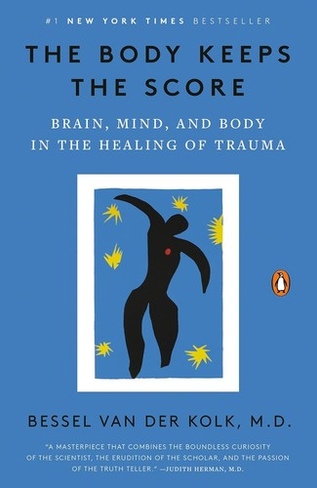
Ten years after publication, The Body Keeps the Score is still the book that lands on the nightstand of almost everyone who has encountered trauma - their own or someone else's - and wants to understand what is happening underneath. Bessel van der Kolk, a psychiatrist who has spent most of his working life studying PTSD at the Trauma Center in Boston, wrote it as a synthesis of four decades of clinical work and research. The book has sold more than three million copies, spent several years on bestseller lists, and become the unofficial reading assignment for anyone beginning trauma-informed therapy. It deserves the attention.
What the book covers
The book is structured as a long argument, interspersed with case studies, and it builds steadily across twenty chapters. Van der Kolk opens by tracing his own journey through the field, starting with the Vietnam veterans who first made him realise that the psychiatric tools of the 1970s were laughably inadequate for what trauma actually does. He then walks the reader through the neuroscience - how traumatic experience hijacks the threat-detection circuitry, fragments memory, alters the relationship between the thinking brain and the feeling brain, and takes up residence in the body in ways that persist long after the immediate danger has passed.
The middle section is where he earns the book's title. Drawing on studies of combat veterans, abused children, refugees, and survivors of sexual violence, van der Kolk argues that trauma is stored not only in the narrative memory of the mind but in the posture, breathing, heart rate, and somatic responses of the body. This is why survivors so often describe feeling haunted by something they cannot put into words, and why purely verbal therapies - talk it out, reframe the thought, cognitively restructure the trauma - reach only part of the problem. The body remembers what the mind has tried to forget.
The final third of the book is about treatment, and it is in many ways the most useful section for a reader looking for a path forward. Van der Kolk walks through modalities that have shown clinical promise - EMDR, yoga, internal family systems, neurofeedback, theatre, somatic experiencing - and gives a practitioner's account of where each fits. He is careful to note that no single approach works for everyone, and that healing is almost always multi-modal. The section reads as a map, not a manual, but it is a map more readers wish they had been handed sooner.
Who should read this
This book is for survivors of trauma who are tired of feeling broken and want to understand what is actually going on in their nervous systems. It is for therapists, especially those trained in purely cognitive approaches, who want a broader framework. It is for partners, parents, and friends of trauma survivors who are trying to make sense of behaviour that does not respond to reason. And it is for the curious reader who senses that a lot of contemporary mental health struggles - anxiety, depression, chronic pain, dissociation, eating issues - may have roots deeper than current categories capture.
It is not a book to read in crisis. Some chapters, especially those describing childhood abuse and its aftermath, are genuinely difficult. If you are in an acute trauma response, read it with support or save it for a steadier season.
Strengths and weaknesses
The strength of The Body Keeps the Score is the marriage of rigour and humanity. Van der Kolk has the neuroscientist's respect for data and the clinician's respect for individual stories, and he refuses to sacrifice either. The case studies are unflinching but never voyeuristic. The science is presented with enough detail to feel real but never enough to overwhelm the general reader. By the time you finish the book, you have something close to a mental model of what trauma actually is, which is rare.
The weaknesses are worth naming. Some of the therapeutic modalities van der Kolk champions - particularly neurofeedback and certain forms of body-based therapy - sit on thinner evidence bases than the confident tone of those chapters suggests. The book occasionally blurs the line between well-established clinical practice and still-emerging approaches, and readers should pair it with a trauma-informed therapist who can help them discriminate. Van der Kolk himself has also been the subject of professional controversy in recent years, which is worth knowing but does not change the quality of the synthesis in this particular book.
A 4.5 is right. This is the single best book on trauma for a general reader, and the minor caveats do not diminish what it achieves.
Why this matters for mental health
If Mind Wobble has a core argument, it is that mental health is not separable from physical health. Van der Kolk's book is the most rigorous and compassionate articulation of that argument you will find. For anyone whose anxiety, depression, or chronic symptoms have resisted standard treatment, the book offers a genuine reframe - your system may not be broken, it may be doing exactly what it was shaped to do, and the path forward may involve more than the prefrontal cortex. That reframe is worth the cover price by itself.
Final verdict
The Body Keeps the Score is one of those rare books that has quietly changed the conversation. A decade after publication, it still turns up in therapists' offices, book clubs, and the hands of people trying to understand themselves. Read it carefully, read it in manageable chunks, and read it with a willingness to let what it says about your own body land. Few books earn the kind of cultural place this one has. Very few deserve it more.