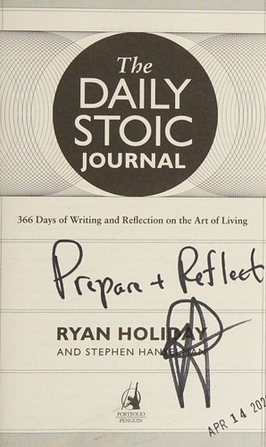
If you have ever sat down with a blank journal and felt that small wave of dread, the one where you have no idea what you are supposed to write and so you write nothing, then The Daily Stoic Journal was practically made for you. Ryan Holiday and Stephen Hanselman, the pair behind the wildly popular The Daily Stoic, took everything that makes a daily reflection habit hard and quietly removed it. What is left is a year of gentle structure that asks you to show up, think for a few minutes, and put a pen to paper. That is it. And there is something genuinely freeing in that simplicity.
What the book covers
This is not a book you read so much as a book you live alongside for a year. It is a beautifully made hardcover, Smyth-sewn so it will survive 366 days of being opened, scribbled in, and tossed in a bag. The format is the whole point. Each week opens with a single Stoic theme, drawn from Marcus Aurelius, Seneca, and Epictetus, explained in a short passage and paired with a quotation to set the tone. Then each day you answer the same prompting question twice, once in the morning and once in the evening, watching how your thinking shifts as the day unfolds.
The themes circle the core Stoic preoccupations: what you can control and what you cannot, how perception shapes experience, the value of doing the work without obsessing over the outcome. A helpful introduction lays out the basic Stoic toolkit before you begin, and there are resources for further reading at the back if a particular idea grabs you. Holiday and Hanselman are clear that you do not need to have read their earlier book to use this one, though as I will get to, that promise comes with a small asterisk.
Who should read this
This journal is for the person who wants the benefits of reflective writing without the paralysis of the blank page. If you have tried free-form journaling and bounced off it, the scaffolding here is a gift. The morning-and-evening rhythm is short enough that it survives busy weeks, which is exactly when a practice like this earns its keep. It is also a natural fit for anyone already curious about Stoicism, that practical, unfussy philosophy that has quietly become the operating system for so many people trying to stay level in a noisy world.
It is especially well suited to beginners and to people who like their self-improvement to come with a bit of ritual. There is a real pleasure in the physical object, in the act of uncapping a pen at the same time each day. If you are someone who has read a stack of mindfulness books but never quite built the daily habit, this lowers the barrier about as far as it can go.
Who might it frustrate? If you are a maximalist journaler who likes pages of stream-of-consciousness writing, the tight format may feel like a cage. And if you want a pure introduction to Stoicism with no writing component, you would be better served by a straight read first.
Strengths and weaknesses
The great strength here is friction reduction. Most journaling habits die not from lack of desire but from lack of a starting point, and this book solves that completely. The weekly themes give your reflection a spine, the daily questions give you a concrete thing to answer, and the morning and evening pairing turns each day into a small before-and-after experiment in self-awareness. Readers who have stuck with it, some for years, describe feeling calmer, more accepting of what they cannot change, and steadier in the face of setbacks. That is not nothing. That is the philosophy actually doing its job.
The craftsmanship deserves a mention too. This is a lovely object, and that matters more than it should. A journal you enjoy picking up is a journal you will keep picking up.
The weaknesses are real but modest. The most common, and fairest, criticism is that the stand-alone promise stretches thin in places. A handful of weekly prompts lean on context or ideas that The Daily Stoic itself develops more fully, and if you have not read it, you can occasionally feel like you have walked into the middle of a conversation. The fix is simple, which is to keep that book or a Stoicism primer nearby, but it does dent the idea that this works perfectly on its own. The other limitation is the flip side of its greatest strength: the structure that makes it so approachable also constrains it. There is little room to sprawl, to follow a thought somewhere unexpected, or to write at length when you need to.
Weighing all of that, I land at a confident four out of five. It does precisely what it sets out to do, the build quality is excellent, and the reception has been consistently warm. It loses half a point for the stand-alone caveat and half for the rigidity that some writers will find limiting. For its intended reader, though, it is close to ideal.
Why this matters for mental health
Here is the part that makes this more than a pretty notebook. The Stoic move at the heart of this journal, captured in the line that there is no good or bad without us, there is only perception, is essentially the same insight that underpins cognitive behavioural therapy. The event is one thing; the story you tell yourself about it is another, and that story is where anxiety and rumination take root. By prompting you to name what is in your control, to separate the situation from your reaction to it, and to revisit the same question with fresh eyes by evening, the journal quietly trains the exact skills that help with emotional regulation. It builds the small daily pause between a feeling and a response, and over a year that pause becomes a habit you carry into the hard moments.
Final verdict
The Daily Stoic Journal will not transform your life overnight, and it does not pretend to. What it offers is quieter and more durable: a low-effort, genuinely sustainable way to think a little more clearly every single day. For anyone who has wanted to start journaling but never found the door, this is one of the easiest doors to walk through, and the philosophy waiting on the other side is some of the most practical wisdom ever written down. Pair it with The Daily Stoic if you want the fullest experience, keep your favourite pen close, and give it the year it asks for. If a calmer, steadier version of yourself sounds worth a few minutes a day, this is an easy and rewarding place to begin.