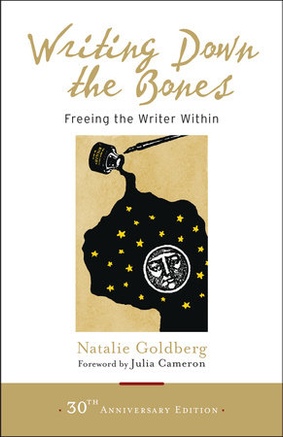
Some books teach you how to write. This one teaches you how to get out of your own way long enough to do it. Natalie Goldberg published Writing Down the Bones in 1986, and four decades later it is still the book that working writers, anxious beginners, and burned-out journalers press into each other's hands. NPR called it the most popular writing manual of the 20th century, and with well over a million copies in print, that is not hyperbole. What surprises people is how little of it is actually about craft in the technical sense. It is really a book about attention, and that is exactly why it belongs on a shelf next to your meditation cushion as much as your notebook.
What the book covers
Goldberg's central idea is something she calls writing practice, and the word practice is doing a lot of work there. Drawing on years of Zen study with her teacher Katagiri Roshi, she treats writing the way a meditator treats sitting: as a repeated, low-pressure discipline you return to whether or not you feel inspired. The rules are simple enough to fit on an index card. Keep your hand moving. Don't cross out. Don't worry about spelling or grammar. Lose control. Go for the jugular. The point is to outrun your internal censor and reach what she calls first thoughts, the raw, unguarded material that lives underneath your polished social self.
The book delivers this in roughly sixty short chapters, most only two or three pages long, with titles that tell you everything about her sensibility: "Writing Is Not a McDonald's Hamburger," "Man Eats Car," "Be an Animal." She writes about listening (she claims writing is ninety percent listening), about the energy verbs carry, about doubt as a form of torture you simply refuse to obey, and yes, even about how to pick a good restaurant to write in. It is less a curriculum than a collection of nudges, and you can open it almost anywhere and find something to put to use that afternoon.
Who should read this
If you have ever sat down to write and felt a cold hand close around your throat, this book was written for you. It is ideal for beginners who are convinced they have nothing worth saying, and equally for experienced writers who have talked themselves into a block. Journalers will recognize the territory immediately, because Goldberg's timed writing exercises are essentially structured free-writing prompts, and they slot neatly into a morning pages habit or a reflective journaling routine.
It is also, quietly, a book for people who are not sure they want to be writers at all. Goldberg is clear that the practice has value even if you never publish a word, because the real product is a sharper, kinder relationship with your own mind. If you are drawn to mindfulness but find seated meditation difficult, writing practice can be a back door into the same state. The one reader who may come away frustrated is the person who wants a linear, step-by-step program with milestones and outcomes. That is not what this is, and pretending otherwise would do you a disservice.
Strengths and weaknesses
The great strength here is tone. Goldberg writes the way a generous teacher talks, and the effect is genuinely disarming. She gives you permission to be bad, repeatedly and without condescension, and that permission is the thing most blocked writers are actually missing. Robert Pirsig, who knew something about the intersection of Zen and craft, praised her sentences for flowing with speed, grace, and simplicity, and noted that this kind of ease is the hardest writing of all. The short-chapter format is a quiet masterstroke too: it makes the book impossible to feel intimidated by and easy to keep returning to for years, which is precisely why so many readers do.
The weaknesses are the flip side of those same qualities. Because the book is built from short, impressionistic pieces, it can feel loose and repetitive if you read it straight through, and readers who crave a system may find themselves wishing for more scaffolding. The Zen framing, beautiful as it is, occasionally tips into the mystical in a way that will not land for everyone, and some of the anecdotes carry an unmistakable whiff of the 1980s. None of this dents the core method, which is why the book holds a 4.21 average across more than thirty-two thousand Goodreads ratings and continues to sell. I land at 4.5 rather than a perfect score precisely because of that structural looseness: the wisdom is five-star, but the delivery asks you to do a little assembling yourself.
Why this matters for mental health
This is where Writing Down the Bones earns its place on a wellness shelf. The practice Goldberg describes is, functionally, a mindfulness exercise: it asks you to stay present with whatever arises, to stop editing your own experience, and to loosen the grip of the inner critic that polices so much of our mental life. For people carrying anxiety, grief, or the low hum of self-judgment, that act of writing without censorship can be a real form of emotional release, a way of getting what is stuck inside out onto the page where it becomes smaller and more workable. Goldberg never positions the book as therapy, and it is not a substitute for it, but the overlap with expressive-writing research and contemplative practice is unmistakable, and many readers find the daily ritual steadying in a way that has very little to do with becoming a published author.
Final verdict
Writing Down the Bones has survived forty years and a million-plus copies for a simple reason: it works, and it asks almost nothing of you to start. You do not need talent, a plan, or even a reason. You need a notebook, a pen, ten minutes, and the willingness to keep your hand moving while your inner critic protests. The thirtieth-anniversary edition from Shambhala, with new forewords by Julia Cameron and Bill Addison, is the one to reach for, and at around twenty dollars it is one of the most generous returns on investment in the entire self-development aisle. If any part of you has been waiting for permission to write, to journal, or simply to sit with your own thoughts without flinching, consider this your permission slip. Pick up a copy, open it to any page, and start before the censor wakes up.