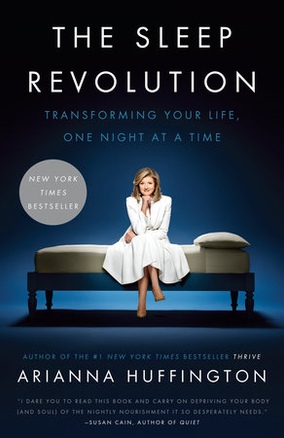
Arianna Huffington is not subtle. The Sleep Revolution opens with the story of her own collapse, face-first into a desk, broken cheekbone and all, after years of sleeping four or five hours a night while building the Huffington Post. That moment reframed how she lives, and this book is her attempt to reframe how the rest of us do too. She is not writing a clinical manual. She is writing a manifesto, and like all good manifestos it is sometimes brilliant, sometimes overcooked, and impossible to ignore.
What the book covers
The scope is deliberately sweeping. Huffington moves from a cultural history of sleep (the Greeks dreamed in temples, the Victorians napped in two shifts, the industrial revolution flattened all of that into a single over-caffeinated block) into the science of what actually happens inside a sleeping brain, and then out again into the modern workplace, the sleeping pill industry, our phones, our kids, and the athletes and CEOs who have quietly decided that rest is a competitive advantage.
The chapter on dreaming is the book at its best: she weaves Jung, neuroscience, and her own family into something that genuinely feels like a recovery of meaning from a subject most adults stopped taking seriously sometime around university. The chapters on sleep and performance are almost as strong, and the material on how tech companies (including her own at the time) are redesigning offices around rest will make you look at your open-plan desk differently.
Where the book is less sure-footed is the practical stuff. There is a long appendix of sleep tips, most of them reasonable, most of them things you have heard before: dark room, cool temperature, no screens, no late coffee. If you have read a decent sleep article in the last five years, you will not find a hidden protocol here.
Who should read this
This is not a book for someone with a diagnosed sleep disorder. Huffington is clear about that, and you should be too; if you suspect apnoea or chronic insomnia, a clinician is a better first stop than a bestseller.
Where The Sleep Revolution earns its place is with a specific kind of reader: the high-functioning, slightly worn-out professional who treats sleep as a line item to be cut when work gets busy. The person who wears a four-hour night like a badge. The parent who scrolls at midnight because it is the only quiet time in the day. For those readers, this book does something useful that a clinical guide cannot. It gives them permission, it gives them evidence, and it gives them the vocabulary to push back against a culture that treats exhaustion as a virtue.
If that sounds like you, or someone you love, the book is worth the weekend it takes to read.
The mental health angle
Sleep is not a side issue for mental health, it is one of the load-bearing walls. Huffington does not write as a psychiatrist, but she gets this right: chronic sleep deprivation ramps up the amygdala, flattens emotional regulation, worsens anxiety, and strips away the buffer that lets you absorb a bad day without it becoming a bad week. Every meta-analysis on sleep and mood lands roughly in the same place, and the behavioural science community has come around to treating sleep as first-line rather than adjunct. Huffington's contribution is making that case for a general audience in language that sticks. If reading this book nudges one anxious, over-committed reader into actually getting seven hours, that is a real mental health intervention, even if the book would not describe itself that way.
Strengths and weaknesses
The great strength of the book is tonal. Huffington is a persuader, and she is persuading you to do something that is almost entirely good for you. She is good company on the page, the research is clearly done, and the sheer range of reference (from Homer to Thich Nhat Hanh to a young athlete experimenting with nap pods) keeps it moving. You will finish it a little more convinced that your sleep matters, and that is the point.
The weaknesses are the ones most critics have landed on, and they are fair. The book is padded. At over 400 pages, with a substantial appendix of tips, it is longer than its argument really needs. Kirkus called it a "disappointing addition to the celebrity self-help shelf" and while that is harsher than I would go, there is something to the charge that Huffington sometimes reaches for an inspirational quote where a harder empirical point would have landed better. The other criticism, a sharp one, is that for a book published by the founder of a notoriously always-on media company, the tension between her own career and her thesis is never really examined. A more honest chapter on that would have been the best in the book.
The science is solid where it appears, but the book is not a science book, and readers who want Walker-level rigour will be happier elsewhere. This is a cultural argument with scientific footnotes, not the other way around.
Final verdict
The Sleep Revolution is not the definitive book on sleep. That crown probably still belongs to Matthew Walker. What it is, though, is the most persuasive book on why sleep should matter to you, written by someone who learned the lesson the hard way and clearly means it. For the exhausted professional, the new parent, the founder running on fumes, this book can be the intervention that finally lands. For the reader who already treats sleep seriously, it will feel repetitive.
A 3.5 feels right. Not a life-changing read for everyone, but a genuinely useful one for the people who most need to hear it. If you have been meaning to take your sleep seriously and just have not got around to it, this is the book that will probably get you there. Close the laptop, click through, and read it before bed.