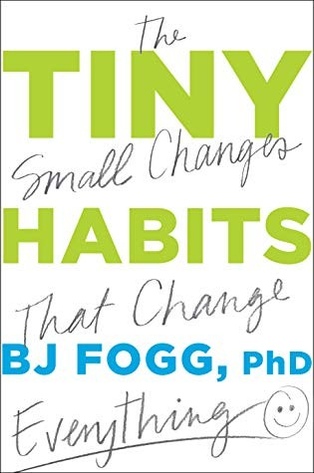
Before there was Atomic Habits, there was BJ Fogg. A behaviour scientist at Stanford who ran the university's Behavior Design Lab for two decades, Fogg quietly trained a generation of habit designers - including, as he is careful to note, James Clear - before finally publishing his own book in 2019. Tiny Habits is the result: denser, less poetic, and in some ways more practical than the more famous book it preceded. If Atomic Habits is the elegant popularisation, Tiny Habits is the source code.
What the book covers
Fogg opens with the Fogg Behavior Model, which is the framework he has been teaching at Stanford for years. Behaviour, he argues, happens when three things converge - motivation, ability, and a prompt. If any one of them is missing, the behaviour does not happen. Motivation fluctuates wildly and you cannot rely on it. So if you want a habit to survive, the move is not to crank up motivation but to shrink the behaviour until your ability is more than enough to do it even on a low-motivation day, and to attach it to a reliable prompt you already encounter.
From there he introduces the tiny habits method itself. Pick a behaviour. Make it ridiculously small - so small that you cannot talk yourself out of it on the worst day. Anchor it to an existing habit with a specific recipe: after I brush my teeth, I will floss one tooth. After I pour my coffee, I will write one sentence in my journal. The third step, which sounds embarrassing until you try it, is to celebrate immediately. A fist pump, a smile, a quiet yes - something that fires the emotional reward that encodes the behaviour as a habit. Fogg's claim, which is grounded in his Stanford research and thousands of coached participants, is that emotions create habits, not repetition. The celebration is not optional.
The middle of the book walks through variations - how to build a morning routine, how to help a partner or child with habit formation, how to untangle and disassemble bad habits using the same model in reverse. Fogg is generous with examples from the forty thousand people he has coached through the programme, and the case studies are specific enough to be useful. The final section on habit design in families and organisations is thinner and can be skipped without losing much.
Who should read this
This is for the reader who has bounced off other habit books. The person who tried 75 Hard and gave up in week two, who signed up for a meditation app and has not opened it in six weeks, who knows exactly what they should be doing and cannot seem to get themselves to do it. Fogg's argument is that the problem is almost never motivation - it is design. Readers who take that reframe seriously tend to start shipping habits they have been failing to ship for years.
It is also useful for therapists, coaches, and managers trying to help other people change behaviour. The celebration step and the anchoring recipe are tools you can hand someone in session and expect them to use.
Strengths and weaknesses
The strength of the book is the model. Fogg has been teaching this framework for two decades, and the clarity of the B=MAP equation is a genuine contribution to popular behaviour change writing. The tiny-and-celebrate approach sounds twee until you realise how elegantly it sidesteps the two things that kill most habits - the overambitious first week and the lack of felt reward. Fogg's system is engineering, not motivation, and that is why it works.
The weaknesses are real but modest. The writing is functional rather than elegant - Fogg is a scientist who has written a science-backed workbook, and the prose reflects that. Readers coming from Clear's more polished style will notice. There is also substantial overlap with Atomic Habits, which came out a year earlier, to the point where most readers do not need both. If you have read one, the other will feel like familiar territory with a slightly different vocabulary. That said, the celebration mechanic and the systematic focus on shrinking behaviour to near-zero are distinctive to Fogg and worth knowing.
A 4.0 is right. The book is not as enjoyable to read as some of its competitors, and it is more useful than most.
Why this matters for mental health
A lot of mental health work, especially in behavioural activation, anxiety treatment, and recovery contexts, is essentially habit design. The person needs to get out of bed and walk around the block before the depressive fog lifts enough to consider going further. The person needs to do three diaphragmatic breaths at the cue of a certain stressor before the anxiety spiral catches them. Fogg's method is almost perfectly suited to this kind of work because it treats emotional reward as the load-bearing piece, not willpower. For the Mind Wobble reader using habits as part of a broader mental health practice, Tiny Habits gives you a cleaner mechanical model than almost any other book in the category.
Final verdict
Tiny Habits is the book for the reader who needs a system, not inspiration. Fogg is the scientist who figured out why small works and wrote the book to prove it. The prose is plain, the framework is precise, and the results, if you actually apply the method, tend to compound quickly. Pair it with a good cognitive workbook and a few weeks of patience, and it will change more than you expect.