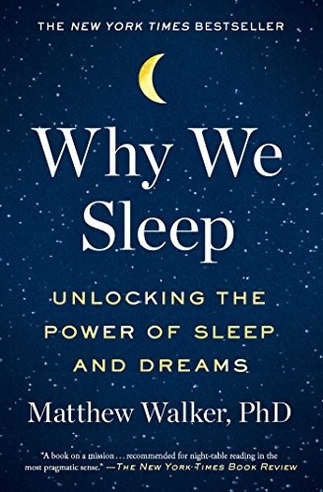
If you have ever told yourself that you will catch up on sleep at the weekend, Matthew Walker would like a word. Why We Sleep, published in 2017 by a neuroscientist who directs the Center for Human Sleep Science at UC Berkeley, is the book that did more than any other to drag sleep out of the self-care aisle and place it back where it belongs - squarely at the centre of mental and physical health. Nearly a decade after publication, it remains the default recommendation when someone asks what one book they should read about why they feel so terrible at 2pm.
What the book covers
Walker organises the book in four parts, and the pacing is deliberate. Part one explains what sleep actually is - the two-process model, the difference between NREM and REM, how circadian rhythm and sleep pressure negotiate to decide when your eyelids drop. Part two is where the book hits hardest: the health consequences of not getting enough of it. Memory, learning, emotional regulation, cardiovascular health, immune function, cancer risk, metabolic disease, reproductive health - Walker marches through the evidence with the steady confidence of someone who has read all the papers and is quietly furious that you have not.
Part three is about dreams. It is the section most readers remember, partly because Walker makes a persuasive case that REM sleep is not a byproduct of the brain idling but an active, essential process of emotional digestion and creative problem-solving. He walks you through why depriving someone of REM sleep reliably makes them more emotionally reactive, less able to read faces, and worse at every creative task you can throw at them. By the end of the section, dreaming starts to feel less like a weird nightly side effect and more like the mind's overnight therapist.
Part four is practical. How to sleep better, why sleeping pills are worse than most people realise, what employers and schools get wrong, and what a sanely designed society might do differently. It is the shortest section, but it is the one readers dog-ear.
Who should read this
This book is for the person who wears their five-hour nights as a badge of honour, the insomniac who has tried everything and is starting to think their brain is broken, the parent whose teenager will not get up in the morning, and anyone on an SSRI who has not yet considered whether their sleep architecture is quietly sabotaging the rest of their mental health. It is also, quietly, for the shift worker and the frequent traveller - Walker treats circadian misalignment as a genuine occupational hazard, not a personal failing.
It is not for the person looking for a fast-action sleep programme. Walker gives you principles, not protocols. Pair it with a CBT-I workbook if what you need is step-by-step insomnia treatment.
Strengths and weaknesses
The strength of Why We Sleep is Walker's ability to make you care. He does not just tell you sleep matters - he walks you through what happens to your prefrontal cortex after a single night of poor rest, and suddenly that 2am scroll feels less like a habit and more like sabotage. His writing has momentum. The science is dense but the sentences are short, the metaphors do real work, and the book moves. For a subject most people associate with boredom, this is a genuine achievement.
The weakness is a now well-documented one. In late 2019, researcher Alexey Guzey published a detailed critique arguing that several of the book's most dramatic claims - on sleep and cancer, on the decline of average sleep duration, on specific studies Walker cites - are either overstated or misrepresented. Walker himself has acknowledged errors and the book has been revised. None of this unravels the core argument, which is supported by a wide and growing literature, but it does mean the most alarming numbers in the book should be treated as directional rather than precise. For anxious readers this matters - the book is capable of triggering real sleep anxiety, and a little scepticism about the specifics is healthy.
A 4.0 feels right. The central thesis is correct and has genuinely shifted how clinicians, educators, and ordinary readers think about sleep. The small overreach on a handful of numbers is real but does not undo the achievement.
Why this matters for mental health
Sleep is the most under-discussed pillar of mental wellness. Anxiety, depression, and ADHD all have bidirectional relationships with sleep - each makes the other worse, and each improves when sleep improves. Walker is not a clinician treating depression, but his book gives anyone managing a mood disorder a reason to take their sleep hygiene as seriously as their therapy appointments. For the Mind Wobble reader, this is foundational reading. You cannot out-meditate, out-journal, or out-exercise a chronically sleep-deprived brain.
Final verdict
Why We Sleep is a flawed masterpiece. It will convince you that sleep is non-negotiable, it will explain exactly why, and it will probably change what time you put your phone down tonight. Read it with a pencil, treat the scariest statistics with a pinch of salt, and give yourself permission to actually act on what Walker is telling you. Few health books have moved the cultural needle this far. This one earns its place on the shelf - and then, ideally, a place on your bedside table for the nights you need reminding.