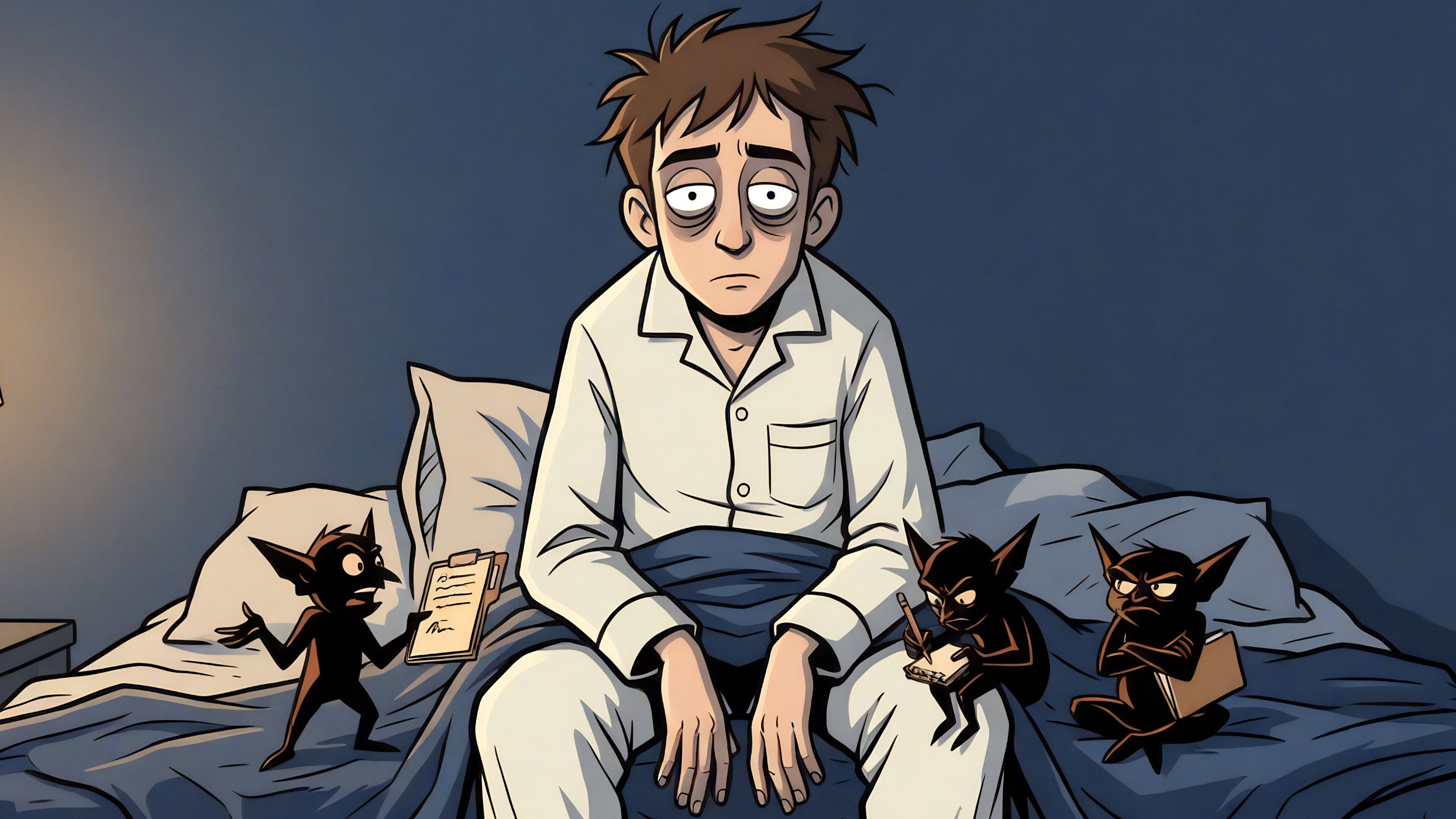
The clock reads 3:14am. You know this because you've checked it twice already. The flat is silent except for the hum of the fridge and the inside of your skull, which is currently hosting an emergency board meeting about Tuesday's deadline, the email you should have sent yesterday, and a slightly off remark from your manager that has now become a referendum on your entire career.
You are not, it turns out, alone. The National Safety Council estimates that more than 43% of American workers are sleep-deprived, and surveys consistently put work stress near the top of the list of reasons people lose sleep. The 3am wake-up where your brain decides to play "every mistake you've ever made" on a loop is so common it's practically a club. There's no membership card, but there is a deeply unhelpful inner monologue.
What's actually happening when this hits is not laziness, weakness, or a sign that you "can't switch off properly". It's a real, measurable physiological event with clear knock-on effects for mental health. Chronic 3am rumination feeds anxiety, sours mood, and chips away at the daytime resilience you need to handle the very work that's keeping you up. Once you understand the mechanics behind it, you can start interrupting the cycle with techniques that have actually been tested in clinical trials, not just borrowed from the comments section of a wellness blog.
Why Your Brain Picks 3am, of All Times
Cortisol, the body's main stress hormone, isn't quite the villain it's often made out to be. Your body runs on a roughly 24-hour cortisol rhythm: levels are lowest in the small hours, then start a slow climb in the second half of the night to nudge you awake by morning. According to a review on sleep and circadian regulation of cortisol published in Frontiers in Endocrinology, this rise typically begins around 2 to 3am, peaks shortly after waking, then falls across the day.
Now picture the rhythm of someone running on chronic work stress. Their cortisol baseline is already higher. The pre-waking rise still happens on schedule, but instead of nudging them gently towards morning, it spikes hard enough to push them across the wakefulness threshold. That's why 3am, specifically, gets so much airtime. It isn't a mystical hour. It's a hormonal one.
Layer on top of that something called nocturnal cognitive arousal, the technical name for "brain refuses to power down". A 2021 study published in Sleep found that high levels of nocturnal cognitive arousal were linked to objectively worse sleep, including longer sleep latency, lower sleep efficiency, and shorter total sleep time, even in people who didn't meet the criteria for clinical insomnia. In plain English: a busy mind at night doesn't just feel like worse sleep; it produces worse sleep.
So when you wake at 3am with a head full of work, two things are usually true at once. Your cortisol is rising, which makes you physiologically alert. And your sleeping brain, which has been quietly chewing on stress all evening, takes that alertness as an invitation to host a full meeting. Welcome to the boardroom.
The Difference Between Problem-Solving and Spinning
Here's the cruel joke. At 3am, your brain isn't trying to ruin your life. It's trying to help. That nagging loop about the deadline is the same instinct that once kept your ancestors alive by reminding them about the sabre-toothed tiger they'd seen by the river. The instinct works fine. The application has aged poorly.
The catch is that lying in the dark replaying problems isn't problem-solving. It's rumination, and the two are not the same. Researchers studying rumination as a transdiagnostic factor in depression and anxiety define it as repetitive, passive, and abstract focus on distress and its causes, rather than active steps towards a solution. Problem-solving moves towards an answer. Rumination moves in circles.
You can usually tell which one you're doing with a quick test. Are you generating new options, or replaying the same five thoughts? Could you write down a next step, or are you simply re-feeling the worry? If the answer is "looping", you're ruminating, and the brain is not going to thank you for sticking with it. A longitudinal study following adults over time found that rumination significantly predicted increases in both depression and anxiety symptoms, even after controlling for the original stressful events that triggered it. Translation: if the 3am loop is allowed to run unchallenged for months on end, it doesn't just steal a night's sleep. It quietly recalibrates how you feel during the day, raising the baseline noise of anxiety and lowering the floor of mood. The cost compounds.
Your Stress Response Treats Work Email Like a Tiger
Your nervous system, when it's working well, has a foot on two pedals. The gas pedal (sympathetic, fight-or-flight) gets you through danger. The brake pedal (parasympathetic, rest-and-digest) lets you eat dinner and sleep. For a decent night, the brake needs to be firmly down by the time your head hits the pillow.
Work stress, especially the kind delivered in unpredictable doses through messaging apps and email, keeps the gas pedal lightly engaged for hours after the official end of the day. Think of cortisol like a smoke alarm that was designed to scream during a genuine fire. Modern work has rewired it to also scream when someone forwards a meeting invite at 9pm.
A 1-month observational study of IT employees published in the Journal of Occupational Health tracked actigraphic sleep, cortisol, and after-hours email frequency in real workers. The finding was unambiguous. Workers who emailed more often after hours had measurably worse sleep quality, even when their total time off the clock was longer. Simply having time at home wasn't enough; the brain didn't actually disengage. The researchers called this lack of psychological detachment, and it has emerged as one of the most reliable predictors of how well a working adult sleeps.
Because here's the thing: the brain doesn't really distinguish between "real" threats and "abstract work threats" once cortisol is elevated. A passive-aggressive Slack message at 6pm activates the same biological alarm system as something that genuinely needs urgent attention. By the time you put the phone down, the smoke alarm is already going. By 3am, it's still going. You're not panicking about an actual lion. You're panicking about Q3 revenue, which is somehow harder to outrun.
The "Always-On" Trap: How Modern Work Erodes Mental Boundaries
Psychological detachment is the opposite of carrying work home in your head. It's the deliberate mental separation between your role as an employee and your role as a person who eats dinner, watches something silly, and sleeps. A 2024 longitudinal cohort study from the Wellbeing of the Workforce project found that working-age adults with higher psychological detachment from work had significantly better mental wellbeing over time, independent of how stressful their jobs actually were. The job didn't have to be easier. People simply had to be able to put it down.
The problem is that modern work is engineered to make detachment hard. Notifications follow you. Calendar invites land at all hours. The expectation, often unspoken, is that you're reachable. Even people who don't actively check email after dinner are often mentally rehearsing tomorrow's meeting in the shower.
This matters for sleep because detachment isn't just about turning off the laptop. It's about giving your mind permission to be off too. When your evening is technically work-free but your brain is still composing replies to emails, your nervous system never gets the signal to switch gears. By bedtime, the gas pedal is still gently down.
The good news is that detachment is a skill, not a personality trait. People can build it. The techniques worth knowing are essentially detachment training, dressed in different clothes.
Cognitive Defusion: How to Watch Thoughts Instead of Wrestling Them
If you've tried to "stop thinking about work" by force, you've probably noticed it doesn't work. Telling yourself not to think about something tends to summon it more loudly. The technique that does work, with a surprising amount of evidence behind it, comes from Acceptance and Commitment Therapy (ACT). It's called cognitive defusion.
The idea is simple, even though the name sounds clinical. Most of the time, thoughts feel like facts. "I'm going to mess up this presentation" feels real, urgent, and worth panicking over. Cognitive defusion is the practice of noticing that a thought is just a thought; a mental event passing through, not a verdict from the universe.
A 2009 experimental study published in Behaviour Research and Therapy tested this directly. Participants who were taught a brief defusion exercise (repeating a distressing self-referential thought until it sounded like noise) reported significantly less emotional discomfort and rated the thought as less believable than participants who tried a thought-distraction strategy. The finding has been replicated and expanded since. A 2018 review of cognitive defusion in ACT summarised growing evidence that defusion reliably reduces the impact and believability of unwanted thoughts.
There are two simple defusion moves you can use at 3am.
The first is the labelling trick. Instead of thinking "I'm going to fail tomorrow", think "I'm having the thought that I'm going to fail tomorrow". You can go further: "I notice I'm having the thought that I'm going to fail tomorrow". It sounds clunky on the page. In your head at 3am, it's oddly powerful. The thought stops being the room you're standing in. It becomes a poster on the wall of the room.
The second is the leaves-on-a-stream image. Picture each work thought arriving on a leaf, floating downstream, and disappearing. You don't argue with the leaves. You don't try to pull them out. You just watch them go. If you notice you've grabbed one and started chewing on it, that's fine. Place it back on the next leaf. Repeat.
Neither of these techniques makes the thoughts go away on demand. They make the thoughts matter less, which, oddly, is what allows them to leave.
The Worry Window: Why Postponing Worry Actually Works
The second evidence-based technique flips the usual logic. Instead of trying not to worry, you schedule it.
Worry postponement (also called scheduled worry time) is a CBT technique with a strangely good track record. The instructions are surprisingly simple. During the day, when a worry pops up, write it down on a list. Tell yourself you'll think about it properly later. Then schedule a fixed 15 to 30 minute "worry window" in the early evening, well before bed. During that window, you sit with the list and worry deliberately. When the window ends, you stop.
It sounds too simple to work. The research says it does. A 2023 meta-analysis published in the International Journal of Cognitive Behavioral Therapy, pooling data from seven randomised trials and 999 participants, found that worry postponement reliably reduced both the duration and frequency of daily worry compared with simply registering worries. A more recent randomised waitlist-controlled trial showed similar effects, with a recovery rate of around 40% among participants with generalised anxiety disorder.
For 3am wake-ups specifically, a 2025 randomised controlled trial published in Psychology & Health tested worry postponement against control conditions for daily worry and sleep across 14 days. Participants in the postponement group showed reduced worry and improvements in sleep, especially when the technique was paired with brief planning during the worry window.
The reason it works isn't magical. By giving the brain a designated time and place for worry, you stop trying to shove worries away (which makes them louder) and you stop letting them happen at random (which is exhausting). They get a meeting room. Outside that room, they have less authority.
A practical way to set this up is to pick a regular time, around 6 or 7pm, and a specific spot that is not your bed. A kitchen table is ideal. Bring a notebook. Spend 15 minutes writing the worry down, then writing one possible next step beside it (even if that step is "wait and see"). When the timer ends, close the notebook. If a worry pops up later, tell yourself, with surprising firmness, "not now, I'll see you tomorrow at 6".
Building a Brain-Off-Work Wind-Down
A wind-down isn't about scented candles. It's about giving your nervous system enough runway to switch from work mode to sleep mode. Around 60 to 90 minutes is the rough target. Less than 30 and the brain hasn't had time to disengage; you're handing it the bedroom while it's still in a meeting.
A practical wind-down looks something like this. Around 90 minutes before bed, the work day formally ends. That means closing the laptop, silencing work apps, and ideally moving the phone to a different room or at least a different mode. (If "different room" sounds extreme, consider how much money you'd pay to never have a 3am wake-up again. A drawer in the kitchen costs nothing.)
What happens in those 90 minutes matters less than what doesn't. No work email. No "just one more quick thing". No mental rehearsal of tomorrow's meeting. If a work thought appears, it goes onto the worry-window list and is dealt with then.
The activities that help most are unglamorous. A walk. Light stretching. A book that isn't related to your job. A shower or bath. A conversation with another person or a pet. Anything that signals to the body that the day's emergency response is over and recovery can begin. The research on psychological detachment is consistent on this point: passive non-work time (scrolling, doom-checking the news) provides much less recovery than active disengagement.
Caffeine deserves an honourable mention here. The half-life of caffeine is around 5 to 6 hours, which means a 3pm coffee still has roughly half its hit working at 9pm. If 3am wake-ups are a regular feature, the afternoon flat white is one of the easiest things to negotiate with first.
What to Do When You're Already Awake at 3am
Sometimes prevention fails. The cortisol spikes, the brain ramps up, and you're staring at the ceiling. Here's what the evidence says actually helps in the moment.
The first rule, counterintuitive as it sounds, is to stop trying to fall asleep. Effortful attempts to force sleep raise arousal, which is the opposite of what you need. A long-running clinical technique called stimulus control therapy, which is a core component of cognitive behavioural therapy for insomnia (CBT-I), works on exactly this principle. According to guidance from Stanford Health Care, if you've been awake for around 20 minutes and feel wired, you should get out of bed and do something quiet and non-stimulating in dim light until you feel sleepy again. Then, and only then, return to bed.
The reason this works is that staying in bed while wide awake teaches your brain to associate the bed with wakefulness. Get up, do something low-key (read a book, fold laundry, sit on the sofa with a glass of water in dim light), and you protect the bed-equals-sleep association. A 2024 systematic review in the Journal of Sleep Research confirmed stimulus control as one of the most reliably effective components of CBT-I.
The second rule is to use defusion or a worry dump while you're up. Keep a notebook by the bed. If a thought is genuinely useful (a deadline you'd genuinely forgotten), jot it down so the brain stops re-reminding you. If it's the standard 3am loop, name it: "this is the loop, I see you, leaves on a stream". Don't argue with it. Don't try to solve it. You will not solve a work problem at 3am. Your prefrontal cortex isn't fully online at this hour, and any "solution" you reach is unlikely to look as clever in the morning.
The third rule is to keep the room cool, dim, and screen-free. Screens at 3am pour light into eyes that are already telling the brain it's morning. Even briefly checking the time can make the wake-up worse. If you must know the time, turn the phone face-down or move the clock out of view.
When 3am Thinking Becomes Something More
Most 3am wake-ups are stress and bad timing, and they will ease as soon as the workload does. Sometimes, though, the pattern is pointing at something bigger, and noticing it early matters. It's worth paying attention if any of the following sound familiar.
If you wake at the same time every night for several weeks running, with intense anxiety or a sense of dread, and the daytime version of this is also creeping into your life, the 3am loop may be acting as a pressure-release valve for something larger. Generalised anxiety, depression, and burnout all have well-documented links with sleep disruption.
If the racing thoughts include hopelessness, intense self-criticism, or thoughts about not wanting to be here, please don't wait. Speak to your GP, doctor, or a service like the Samaritans (in the UK, 116 123, free, 24/7) or your local crisis support equivalent. 3am thoughts can feel definitive at the time; they almost never are.
If you've tried sensible sleep-protection strategies for several weeks and the wake-ups continue, a course of CBT-I from a qualified therapist is the treatment with the strongest evidence base for chronic insomnia. The 2023 primer on CBT-I from StatPearls summarises the standard protocol, which usually runs over 6 to 8 weeks and outperforms sleeping medication for long-term outcomes.
The 3am club is bigger than you think, but it isn't a life sentence. The brain that won't switch off can be taught to switch off, with patience, the right techniques, and the understanding that you're not weak; your nervous system is just doing its best with very modern problems and very ancient wiring. The first night you sleep through to morning will feel like a small miracle. It isn't. It's just your nervous system, finally given the conditions it needed all along.