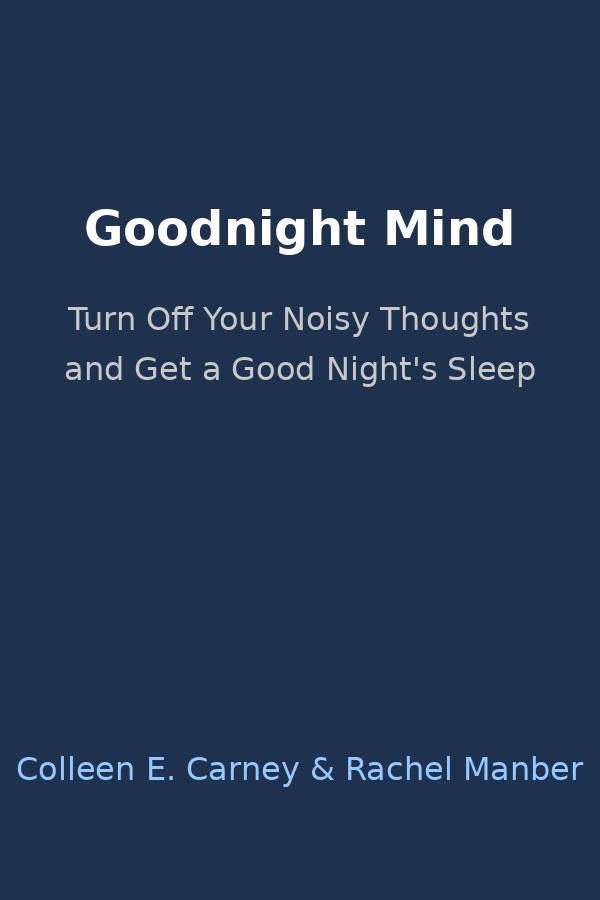
What the book covers
If your brain is a hamster on a wheel at 2 AM, Goodnight Mind is the book that finally explains why it won't stop spinning and, more importantly, what to do about it.
Colleen Carney and Rachel Manber, two sleep psychologists who've spent their careers treating insomnia, take a laser focus on rumination: that exhausting loop of worries, regrets, and tomorrow's to-do list that hijacks your sleep. The book doesn't pretend the problem is mysterious. Your racing mind isn't a character flaw. It's a symptom of an overtaxed brain that never got permission to stop processing the day.
The authors walk through ten practical steps. The first half sets the foundation: understanding your sleep system, matching your sleep to your actual chronotype, and creating what they call the "Buffer Zone" (that crucial time between your day ending and your pillow beginning). The second half teaches you how to actually quiet your mind: how to reschedule worry, how to problem-solve before bed instead of during it, relaxation techniques that don't require an app subscription, and how to break the anxiety-about-sleep cycle.
Each chapter is bite-sized, with takeaway summaries so you can skim at 3 AM without guilt. The book is only 192 pages: short enough that you might actually finish it before your sleep debt swallows you whole.
Who should read this
Read this if your insomnia is primarily mental, not medical. If a doctor has ruled out sleep apnea, restless legs, or other physiological culprits, but you still can't sleep because your mind won't stop talking, this is your book.
It's especially useful if:
- You fall asleep easily but wake at 3 AM with racing thoughts
- Your best sleep happens when you're exhausted enough not to think
- You've tried meditation apps but felt worse because you were judging yourself for not meditating correctly
- You've noticed your insomnia got worse after you read an article about the health impacts of insomnia (yes, anxiety about sleep is a real trap the book addresses)
- You're therapy-curious but not currently in therapy, or you want to supplement existing therapy with practical tools
The book is also designed for people who are medication-averse or waiting for a therapist appointment. It's not a replacement for professional help if you have severe insomnia or depression, but it's a solid interim tool that actually works.
Skip it if you've already done significant CBT-I work with a therapist. You'll recognize most of the framework. It's not wrong, just not new to you.
Strengths and weaknesses
Strengths:
The biggest strength is that Carney and Manber actually understand the specific flavor of insomnia caused by an overactive mind. They don't treat rumination as something to fight: they teach you to negotiate with it. The Buffer Zone concept is genuinely useful: a structured wind-down period where you're allowed to worry, plan, and process, which paradoxically gives your brain permission to stop at bedtime. That alone is worth the book's price.
The writing is warm and non-judgmental. These authors have heard every insomnia story and they're not here to shame you for your sleep hygiene crimes. The practical exercises are immediately doable: you're not being asked to retrain your entire nervous system by Tuesday.
The research credentials matter too. Carney directs the Sleep and Depression Lab at Ryerson University; Manber directs the Insomnia program at Stanford. These aren't wellness influencers. This is evidence translated into action.
Weaknesses:
The main weakness is that it's introductory. If you've already read Why We Sleep, taken a CBT-I course, or spent time with a sleep therapist, you'll recognize the concepts. It's solid foundational material, but not groundbreaking.
Some readers report that the "Turn Off Your Noisy Thoughts" part of the title promises more than the book delivers. If you're expecting a deep dive into meditation or brain training, you'll be disappointed. The mind-quieting section is pragmatic but not expansive: more "here are three techniques you can use" than "here's how to completely rewire your thinking."
Finally, the book is brief by necessity, which means it doesn't go deep into complicated cases. If your insomnia involves trauma, severe anxiety disorders, or complex medication interactions, you need a therapist more than a self-help book. Goodnight Mind works best as a first step, not a final answer.
Final verdict
Goodnight Mind does exactly what the subtitle promises: it gives you tools to turn off your noisy thoughts and sleep better. It's not a miracle cure, but it's practical, grounded in real research, and written by people who genuinely understand the specific hell of lying awake at 2 AM while your brain catalogs every embarrassing thing you've ever done.
The book works particularly well for people whose insomnia is driven by rumination and racing thoughts: people who don't have a physiological sleep disorder but a thinking problem masquerading as a sleep problem. If that's you, this book could genuinely change your nights within weeks.
Score: 3.5/5
It's a solid, helpful, evidence-based tool that does its job without overselling. It's not revolutionary, but revolution isn't what you need at 2 AM. You need a practical framework that actually works. This delivers that. Read it if your insomnia is mental. Recommend it to friends who describe their nights as "my brain won't shut up." That's the reader this book was made for.
Read Next
- Why We Sleep by Matthew Walker (for the deeper science)
- Quiet Your Mind and Get to Sleep by Carney and Manber (a more detailed workbook version)
- The Anxiety and Phobia Workbook by Edmund Bourne (if anxiety is the root)