What the book covers
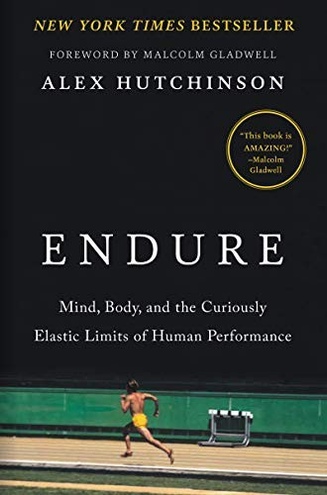
Endure is Alex Hutchinson's meticulous investigation into the question that haunts every athlete, runner, and person who's ever pushed themselves to the edge: where exactly do our limits live?
The traditional answer is obvious: your muscles give out, your lungs burn, your legs won't move another step. But Hutchinson, a science journalist and former competitive distance runner, unravels something far more interesting: what we call our physical limits are largely illusions created by the brain.
Through chapters that explore distinct dimensions of endurance: pain, muscle, oxygen, heat, thirst, fuel, and brain itself. Hutchinson weaves together cutting-edge neuroscience, physiological research, and gripping stories from elite athletes. He draws on work from sports psychologists, neuroscientists, and endurance athletes themselves to show that the governor of human performance isn't muscle fatigue or oxygen debt. It's your brain deciding it's had enough.
The science is accessible without being dumbed down. Hutchinson explains why we feel pain the way we do, how elite athletes train their brains as much as their bodies, and why a runner who believes they're running downhill performs better, even on flat ground. He explores the neurochemistry of suffering, the malleability of perception, and why mental toughness is actually a trainable skill, not something you're born with.
Who should read this
If you run, cycle, swim, or compete in endurance sports, this book is essential reading. Period. The mental frameworks Hutchinson introduces will change how you approach training and competition.
But it extends far beyond the athletic world. Anyone wrestling with anxiety, trying to break through self-imposed limits, or interested in the mechanics of resilience will find profound insights here. The book speaks to the human condition: our ability to suffer, endure, and discover that we're capable of far more than we believed possible.
It's also perfect for coaches, trainers, therapists, and anyone in a helping profession who wants to understand how the mind-body connection shapes human potential. The research on how perception shapes performance, how self-talk rewires neural pathways, and how mental training produces measurable physical changes has applications well beyond sport.
Strengths and weaknesses
The brilliance here is real. Hutchinson refuses to let you stay comfortable with simple answers. He shows that pain is partly a constructed experience, that your body's warning signals can be misinterpreted or trained, and that what you believe about your limits becomes a self-fulfilling prophecy. The narrative hook (following real athletes, researchers, and discoveries) keeps the science from feeling abstract.
The foreword by Malcolm Gladwell and the book's accessibility to mainstream readers elevates what could have been a dense science text into something genuinely compelling. You don't need a physiology degree to understand the arguments, yet the science is rigorous and deeply researched.
The weaknesses are real too. The book's structure is nonlinear. Rather than follow a single athlete's journey or build toward climactic revelations, Hutchinson jumps between different limits: pain one chapter, oxygen the next, heat the next. This mirrors how science actually progresses (messy, multidisciplinary), but some readers find it scattered. You're constantly shifting mental gears.
The heavy focus on running and endurance sports, while appropriate for the subject matter, means examples feel less directly applicable if you're interested in mental resilience in contexts like public speaking, surgical precision, or creative work. Hutchinson hints at these connections but doesn't explore them deeply.
A few sections wade into dense physiological detail that can feel heavy for readers seeking motivation or practical strategies. You might skim the weeds about lactate metabolism to get to the payoff on the other side.
Final verdict
Endure is the rare book that rewires how you think about your own limitations. It's not a motivational pep talk or a training manual. It's a systematic deconstruction of what "limit" actually means, and a demonstration that your limits are far more elastic, far more mental, and far more trainable than you've been told.
For anyone serious about pushing past perceived ceilings, understanding the psychology of resilience, or simply curious about what makes humans capable of extraordinary things under stress, this is essential. Hutchinson combines rigorous science with genuine storytelling. He respects his reader's intelligence while keeping the page-turning momentum alive.
The insights about the brain-body connection feel especially relevant for mental health: anxiety, panic, and burnout all involve the brain sending false "stop" signals to your body. Understanding how elite athletes train to override or reframe these signals offers a genuine roadmap for managing your own mental barriers.
This is the kind of book you'll reference in conversations for years. It's the kind that makes you want to test its principles yourself: whether in training, work, or life. It earns its place on the shelf next to The Sports Gene and The Rise of Superman as one of the definitive explorations of human potential.
Score: 4.2 / 5
A vital, intellectually rigorous, and genuinely page-turning exploration of the mind-body frontier. Essential for athletes; profound for anyone interested in mental resilience and human capability.